It is a Thursday night in Fort Worth and you have finally decided to go all in. The LLC is formed, you have a logo you half like, and three people already want to sign up the week you open. Then you fall down a Reddit thread and someone says you need a bond and a state registration before you can take a single payment, or you are breaking the law. You assume it is noise. You search “credit services organization Texas.” It is not noise.
Here is the short answer before you spend another dollar: credit repair is legal in Texas, but the state regulates you as a credit services organization under Finance Code Chapter 393. Before you do business, you register with the Texas Secretary of State and post a $10,000 surety bond or trust account, and your contracts have to carry a specific disclosure statement and a three-day cancellation notice. Skip any of it and a violation of Chapter 393 is a Class B misdemeanor. This is not Georgia, where the whole model is banned. Texas lets you run the business. It just makes you do the paperwork first.
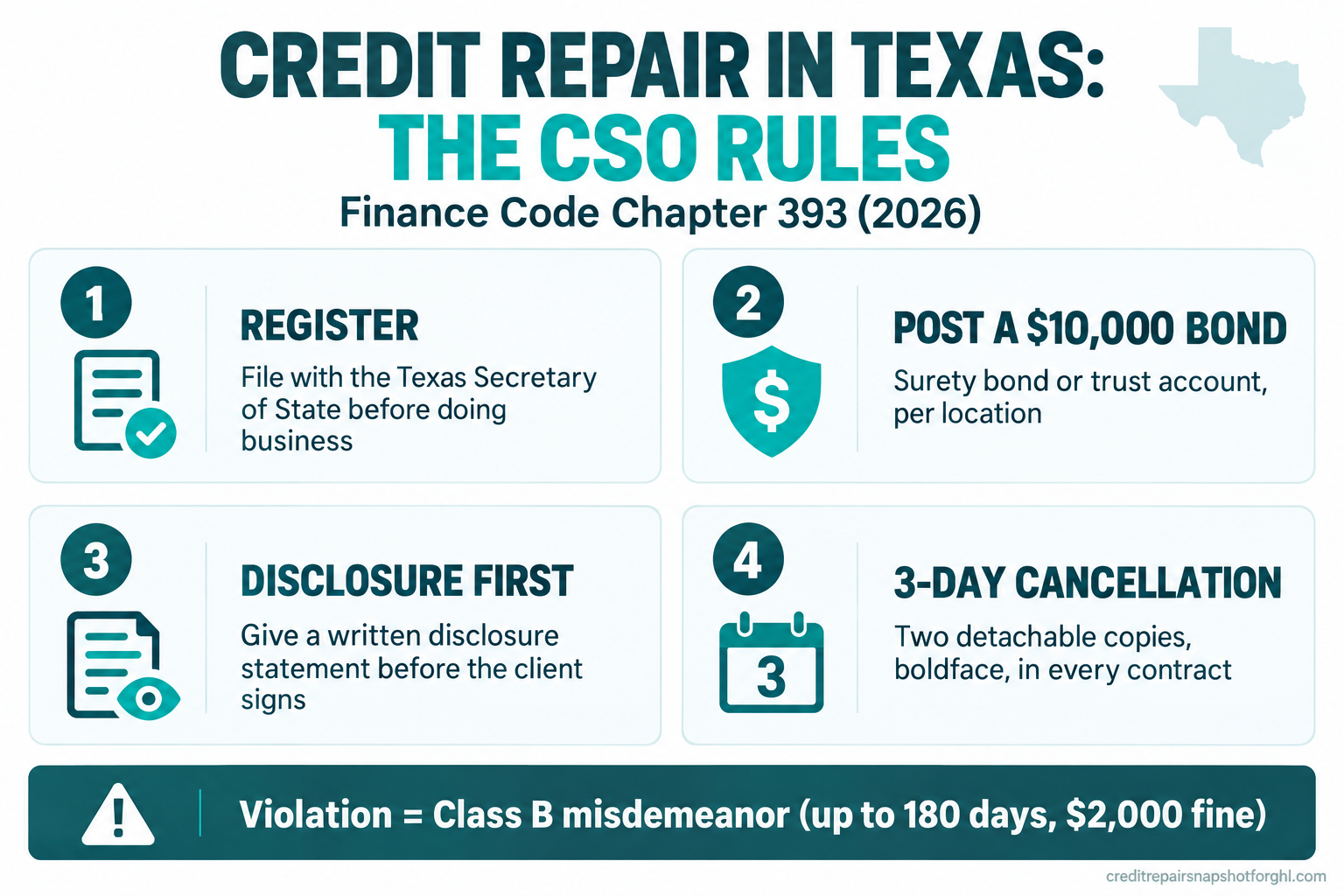
Table of contents
- Is credit repair legal in Texas? The short answer
- What counts as a credit services organization
- How to register with the Texas Secretary of State
- The $10,000 bond, explained in plain money terms
- The paperwork every Texas client has to sign
- CROA sits on top, and it is stricter than Texas
- Solo operator, out-of-state firm, or multi-location
- What happens when you get it wrong
- Steal this: the compliant language and documents
- Objections and hard questions
- Frequently asked questions
Is credit repair legal in Texas? The short answer
Yes. Unlike Georgia, which treats for-profit credit repair as a crime for most operators, Texas built a licensing-style framework and lets you work inside it. The catch is that the framework has teeth, and the steps are not optional. You register, you bond, and you use the exact contract machinery the statute spells out.
The law that governs you is the Texas Credit Services Organizations Act, in Finance Code Chapter 393. It is a consumer-protection statute, written after Texas watched a wave of operators take money up front and vanish. Everything in it points one direction: the consumer knows who you are, the consumer has something to claim against if you fail, and the consumer can walk away in the first three days.
That makes Texas one of the friendlier big states for this business, as long as you treat the setup as a real legal step and not a weekend of forms. The rest of this post walks each requirement, where it breaks, and the words you can borrow.
What counts as a credit services organization
Read the definition first, because it is broader than people expect. Under § 393.001, a credit services organization is a person who provides, or represents that they can or will provide, for the payment of valuable consideration, any of these services with respect to the extension of consumer credit by others:
- improving a consumer’s credit history or rating,
- obtaining an extension of consumer credit for a consumer, or
- providing advice or assistance to a consumer regarding either of those.
Two things jump out. First, the word “represents.” You do not have to actually fix anyone’s credit to be a CSO. If you advertise that you can improve a credit rating for a fee, you are inside the definition the moment the ad goes live. Second, “advice or assistance” sweeps in the coaching-adjacent work a lot of operators think is safe. If you charge money and your pitch is about raising a score or getting someone approved, assume Chapter 393 applies to you.
One group goes a different way. Businesses that arrange payday or auto-title loans operate as credit access businesses and are licensed separately under Subchapter G. That is a different world from consumer credit repair, so if someone online warns you about “CAB licensing,” that is almost certainly not you. Your lane is the plain CSO registration below.
How to register with the Texas Secretary of State
The registration itself is the least painful part. Under § 393.101, unless you are exempt, you must register with the Texas Secretary of State before you conduct business in the state. You file a registration statement, attach proof of your bond or trust account, and pay the fee, which the statute caps at $100. The Secretary of State also issues a certificate for each additional location for $15 (Texas SOS FAQ).
Here is the order of operations that keeps you out of trouble.
- 🏢Step 1
Form the entity
Set up your LLC or corporation and get your EIN before you touch the CSO registration.
- 🛡️Step 2
Buy the bond
Get the $10,000 surety bond (or fund a trust account). You need the bond number before you register.
- 📝Step 3
File the statement
Submit the CSO registration statement to the Secretary of State with proof of the bond and the fee.
- 📄Step 4
Build the documents
Draft the § 393.105 disclosure and the § 393.201 contract with cancellation notice before your first sign-up.
- ✅Step 5
Then open
Only after the registration and bond are on file and documents are ready do you take a paying client.
Failure mode: opening before the paperwork is on file. The most common mistake is signing your first clients while the registration is “in progress.” Doing business before you register is the violation, and those early friends-and-family clients are exactly the ones who later feel burned and file a complaint. A complaint is how most small operators get looked at. Do not take money until the registration and bond are confirmed.
Failure mode: letting it lapse. Registration and the bond are not one-and-done. A lapsed bond can suspend your registration, which means you are suddenly operating unregistered without realizing it. Put the renewal dates on a calendar with a reminder 45 days out, the same as a domain renewal.
The $10,000 bond, explained in plain money terms
The single most misunderstood line in this process is the bond. People read “$10,000” and panic that they need ten grand in cash. You do not.
Under § 393.403, the bond or account “must be in the amount of $10,000.” That number is the coverage, not the price. A surety bond is a three-way promise: you buy it from a surety company, and if a client is damaged by your conduct, they can make a claim against the bond under § 393.405. The surety pays the client, then comes after you to recover it. It protects your clients, not you.
What you actually pay is a premium, usually a small percentage of that $10,000 face value, priced on your personal credit. Clean credit pays a modest annual premium; rough credit pays more. Either way it is an annual cost of doing business, not a deposit.
Required credit services organization surety bond face value by state, in US dollars (2026). The face value is the coverage, not your premium; a surety charges a fraction of it as your annual cost. Texas sits at the low end. Sources: Tex. Fin. Code § 393.403, Texas Secretary of State.
At $10,000, Texas is one of the cheaper states to bond into. California, Illinois, and Nevada run the face value to $100,000, which costs real premium money every year. For the full picture across states before you decide where to form, our state-by-state licensing and bond checklist lays out who requires what.
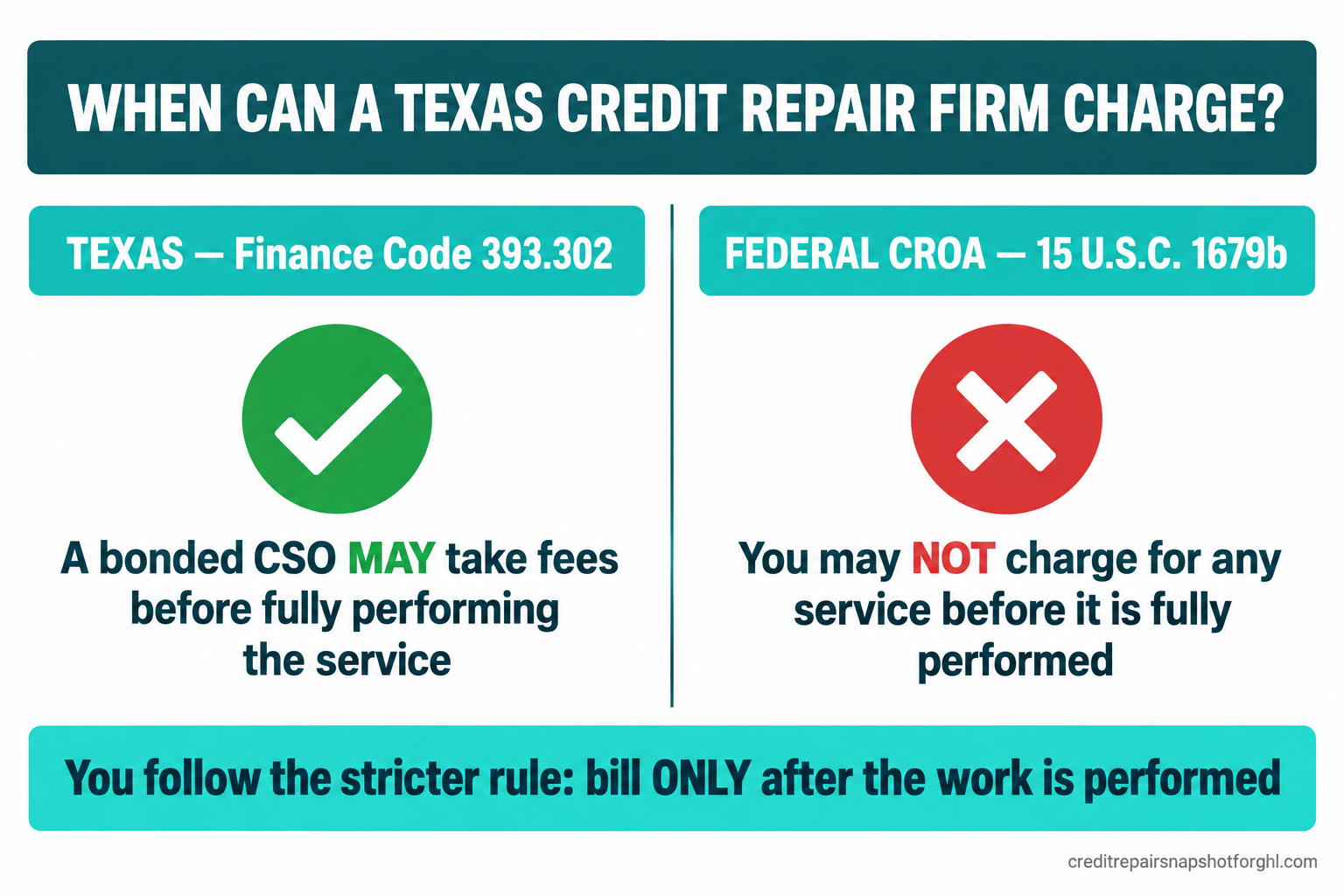
There is a second reason the bond matters, and most operators miss it. Under § 393.302, a CSO “may charge or receive from a consumer valuable consideration before completely performing all the services” only if it has the bond or trust account in place for that location. In plain terms: in Texas, the bond is the thing that legally lets you bill before the job is finished. No bond, no early money, by state law. Hold that thought, because federal law has something much stricter to say in a minute.
The paperwork every Texas client has to sign
This is the part that separates operators who survive a complaint from operators who do not. Texas tells you, almost word for word, what has to be in front of the client and when.
The disclosure statement, before anything is signed. Under § 393.105, before you execute a contract or receive any money, you give the consumer a written disclosure. It must include a complete, detailed description of the services and the total cost, plus a statement about the availability of nonprofit credit counseling. You then keep a copy, signed by the consumer to acknowledge receipt, until the second anniversary of the day you handed it over. That two-year retention rule is the statute talking, not optional advice.
The contract itself. Under § 393.201, the agreement must be in writing, dated, signed by the consumer, and state the payment terms, including the total of all payments the consumer will make.
The three-day cancellation notice. This is the one people botch most. Under § 393.202, the contract must carry two easily detachable copies of a cancellation notice, in boldface type, telling the consumer they may cancel “without any penalty or obligation, within three days after the date the contract is signed.” If they cancel, any payment comes back within 10 days. A separate, conspicuous cancellation statement also goes near the signature line.
Failure mode: a generic nationwide template. Plenty of operators grab a one-size-fits-all contract off the internet. Those templates almost never carry the Texas disclosure statement, the nonprofit-counseling line, or the exact cancellation form. A contract that is fine in another state can be non-compliant in Texas. Build the documents for Texas, or have a Texas lawyer adapt them. Our CROA-compliant contract template walkthrough shows the federal shape; the Texas form requirements sit on top of it.
CROA sits on top, and it is stricter than Texas
Clearing Chapter 393 does not clear the federal law. The federal Credit Repair Organizations Act, 15 U.S.C. §§ 1679 to 1679j, applies nationwide and the FTC enforces it. Where Texas and CROA disagree, you follow the stricter one, and on fees they disagree in a big way.
Texas, under § 393.302, lets a bonded CSO take money before the work is fully performed. CROA does not. Under 15 U.S.C. § 1679b(b), a credit repair organization “may not charge or receive any money or other valuable consideration for the performance of any service” before that service is fully performed. No bond buys you out of the federal advance-fee ban. So the practical rule for a Texas operator is simple: post the bond because the state requires it, then bill only for work already completed because the federal rule requires that. The bond is not a license to collect up front.
Three more CROA rules break the most businesses:
- A written contract with the Consumer Credit File Rights disclosure, handed over before signing, separate from the Texas disclosure.
- A three-day federal cancellation right that runs alongside the Texas one, so your window has to satisfy both.
- No untrue or misleading claims. You cannot promise to remove accurate negative items or guarantee a score. That is the fastest way a well-meaning operator ends up in an enforcement file.
For the full federal playbook, work through our CROA compliance playbook before you launch.
Solo operator, out-of-state firm, or multi-location
The setup looks different depending on who you are. Three honest scenarios.
The Texas solo operator working from a spare bedroom. Limited cash, no legal team, and the $10,000 bond premium feels steep before your first client. It is still the cheapest part of doing this right. Form the entity, buy the bond, register with the Secretary of State, and build your Texas disclosure and contract once, carefully. Price your work as work performed, never as a promised score. Your single highest-risk move is taking that first eager client’s money before the registration is on file. Do the setup first even if it costs you two weeks. For the full cost of standing up compliantly, see our credit repair startup cost breakdown.
The out-of-state firm with Texas leads. You are registered and bonded elsewhere and Texas residents keep filling out your form. Do not assume your home-state registration travels. Chapter 393 keys on doing business in Texas, not on where your LLC was formed, so the safer read is that you register and bond in Texas too. Get a Texas lawyer’s read before you treat Texas clients like any other lead.
The operator adding staff and a second location. Growth changes your filing. The bond and certificate requirements are written per location, so a second office means a second bond or account and a $15 certificate. Build a compliance calendar now, while you have two dates to track, instead of later with six and a lapse you did not notice. The firms that scale are the ones that treat compliance as a system, the same way they treat their client case-tracking pipeline.
What happens when you get it wrong
The penalty is not theoretical. Under § 393.501, “a person commits an offense if the person violates this chapter,” and that offense is a Class B misdemeanor. Under Texas Penal Code § 12.22, a Class B misdemeanor carries up to 180 days in county jail, a fine up to $2,000, or both.
The criminal charge is rarely what ends a small firm, though. Chapter 393 also opens the door to injunctive relief, damages, and treatment of a violation as a deceptive trade practice, which pulls in the Texas DTPA and its own remedies. And federal CROA lets the FTC and state attorneys general come after you in federal court. The real risk is a consumer-protection action that names you personally, not a single misdemeanor fine.
If you think enforcement is a fantasy, it is not. In 2026 the FTC sent more than $10.9 million to consumers harmed by a credit repair operation it accused of running a pyramid scheme and violating CROA, and in June 2025 it announced more than $3.5 million in refunds to people harmed by another scheme, The Credit Game (FTC, 2025). Those operators did not get there for a typo. They got there for promising results and taking money up front, the two lines both Texas and CROA draw brightest.
Steal this: the compliant language and documents
You do not have to invent the wording. Here is language you can adapt for a Texas CSO. Have your own Texas-licensed attorney review it before it goes live, because a blog post is not legal advice.
The Texas disclosure statement skeleton, given before the consumer signs anything:
“Before you sign a contract with us, you have the right to review this disclosure. It describes the specific services we will perform for you and the total cost of those services. Nonprofit credit counseling services may be available to you at little or no cost, and you may wish to contact a nonprofit credit counseling organization before deciding to use our services.”
The three-day cancellation notice, in boldface, with two detachable copies attached to the contract:
“YOU MAY CANCEL THIS CONTRACT, WITHOUT ANY PENALTY OR OBLIGATION, WITHIN THREE DAYS AFTER THE DATE THE CONTRACT IS SIGNED. Any payment made by you under this contract will be returned within 10 days after we receive your cancellation notice. To cancel, mail or deliver a signed, dated copy of this notice, or any other written notice, to [business name and address] before midnight of the third day after you signed.”
A CROA-safe services description that sells effort, never an outcome:
“We provide credit-related services including reviewing your credit reports, helping you identify and dispute inaccurate information, and educating you on building positive credit history. Results vary and are not guaranteed. No one can legally remove accurate, current, and verifiable information from a credit report. You have the right to dispute inaccurate information yourself for free.”
A billing statement that respects the advance-fee ban:
“You are not charged for any service before it is fully performed. Each billing cycle, you are billed only for the services actually completed in the prior period. There is no advance fee to begin.”
Telling a Texas prospect exactly what they are signing, and that free nonprofit counseling exists, builds more trust than any pitch, and it is the statute talking anyway. For the sales conversation that stays inside these lines, borrow our CROA-compliant sales script. And if Texas is not where you are, our breakdown of whether credit repair is legal in Georgia shows how differently a neighboring state treats the same business.
Objections and hard questions
“Everyone I know runs credit repair in Texas without any of this. Why bother?” Enforcement is uneven, and plenty of operators run until a complaint lands. That is a risk description, not a compliance plan. The ones who get named usually grew loud, promised results, and took money up front, which is exactly what the bond, the disclosure, and the advance-fee ban are built to stop. Being unregistered is not an edge. It is a liability you carry silently.
“Is the $10,000 bond really worth it for a two-client start?” The bond is a premium, not a $10,000 deposit, and on clean credit it is one of the cheaper line items in your launch. More to the point, in Texas the bond is literally what the statute ties to charging a client, and operating as an unbonded, unregistered CSO is the Class B misdemeanor. The question is not whether the bond is worth it. It is whether being legal is.
“Does a CRM like GoHighLevel become a problem in Texas?” No. Software is neutral. The tools that run onboarding, billing, and communication are not the regulated activity; the business model is. A properly registered Texas CSO runs on the same systems an out-of-state firm would. What matters is that the system enforces your compliance, so your contract always carries the cancellation notice and your billing never runs before work is performed.
Frequently asked questions
Do you need a license to do credit repair in Texas?
Texas does not issue a traditional occupational license, but it requires you to register as a credit services organization with the Secretary of State under Finance Code Chapter 393 and post a $10,000 bond before doing business. That registration is your permission to operate.
How much is the credit services organization bond in Texas?
The bond or trust account must be $10,000 under Section 393.403. That is the coverage, not your cost. You buy the bond from a surety and pay a premium that is a small percentage of the $10,000 face value, priced on your credit.
Where do I register a credit repair business in Texas?
With the Texas Secretary of State, by filing a credit services organization registration statement under Section 393.101 before you conduct business. The fee is capped at $100, with a $15 certificate per additional location. You attach proof of your bond to the filing.
Can I charge a credit repair client up front in Texas?
Section 393.302 lets a bonded CSO take money before fully performing, but federal CROA is stricter and bans charging for any service before it is fully performed. Because you follow the stricter rule, the practical answer is no: bill only for completed work.
What is the penalty for an unregistered credit repair business in Texas?
A Chapter 393 violation is a Class B misdemeanor under Section 393.501: up to 180 days in jail and a $2,000 fine under Penal Code 12.22. Civil exposure under the Texas Deceptive Trade Practices Act and federal CROA can be far larger than the fine.
Does a Texas credit repair contract need a cancellation notice?
Yes. Under Section 393.202 the contract must include two easily detachable copies of a three-day cancellation notice in boldface type, giving the consumer three days to cancel without penalty and a refund within 10 days. A separate cancellation statement must appear near the signature line.
Is credit repair legal in Texas if my company is based in another state?
Chapter 393 keys on doing business in Texas, not where your entity is formed. If you take on Texas consumers, the safer approach is to register and bond as a CSO in Texas rather than assume your home-state filing covers them. Get a Texas attorney's read first.
This is operational and educational information for business owners, not legal advice. Credit services organization law is state-specific and changes. Confirm the current text of Texas Finance Code Chapter 393 and consult a Texas-licensed attorney before registering, bonding, or taking clients in the state.