
It is 6:10pm and your last consult of the day is going well. She has a charge-off, two late payments, and a collection she swears is not hers. She is ready. Then she asks the question every prospect asks, and you hear yourself start to answer: “So can you get these off my report?” You want the sale. The honest, human thing to say is “yes, absolutely.” And in that one sentence you have just broken federal law, handed a future complaint its first exhibit, and put your business on the wrong side of the same statute that produced a $2.7 billion judgment against the biggest credit-repair company in the country.
The sales call is where credit-repair firms get in the most legal trouble, not the dispute work. Nobody is recording your letters. Someone is almost always able to recall, screenshot, or testify to what you promised on the phone.
The answer up front: you can sell hard and still stay legal, but you have to sell the work, never the result. You describe the process, the effort, the timeline, and what you will do each round. You never promise a deletion, a score number, or a guarantee, and you never charge a dollar before the work is done. This post gives you the word-for-word script for every stage of the call, the exact phrases that get firms sued, and the two disclosures you are legally required to put in front of a prospect before they sign.
One line before the script: nothing here is legal advice. This is an operations playbook. Have your own CROA attorney review your final script and contract before you use them.
Table of contents
- What one sentence on a sales call can cost you
- The three rulebooks behind every word you say
- The compliant sales script, call stage by call stage
- The banned phrases, and what to say instead
- The same script at three sizes
- The compliance layer under the whole call
- Objections operators have about the script itself
- FAQ
What one sentence on a sales call can cost you
Most owners think of CROA as something that touches the contract and the billing. It touches the sales call harder, because the sales call is where the overpromise lives. You are motivated to close, the prospect is motivated to hear “yes,” and the easiest way to get a yes is to promise the thing they want, which is the one thing the law says you cannot promise.
The record on this is not theoretical. In August 2023 the CFPB announced a stipulated judgment of $2.7 billion against Lexington Law and CreditRepair.com, the largest firms in the business. Earlier that year a court had found the operation violated the advance-fee provision of the Telemarketing Sales Rule, meaning they collected fees before delivering the results they had sold. The proposed order also banned the companies from telemarketing credit repair for ten years and added civil penalties of $45.8 million and $18.4 million against two of the entities (CFPB, Aug 28 2023).
Then in August 2026 the FTC moved against a network trading as Credit Glory, alleging the operation “scammed consumers out of nearly $200 million” through unlawful up-front and recurring charges, sometimes with an opening fee of just $1. The FTC alleged violations of CROA, the Telemarketing Sales Rule, and the FTC Act (FTC, Aug 10 2026). That case is pending and decided by the court, so the $200 million is the amount regulators say was collected, not a final judgment. The pattern in both is identical: sell a result, take money early, get caught.
You are a two-person shop, not a national telemarketer, and no regulator is building a $2.7 billion case against you. That is not the point. The point is that the rule they enforced against the giants is the exact same rule that governs your 6:10pm call, and the cheapest version of getting it wrong is still a chargeback, a refund demand, and a one-star review that says “they promised to delete my collections and nothing happened.”
Advance-fee and deceptive-claim enforcement in credit repair, in millions of USD. The 2023 figure is a proposed stipulated judgment; the 2026 figure is alleged consumer harm in a pending case. Sources: CFPB, FTC.
The three rulebooks behind every word you say
Before the script, you need to know which three bodies of rules are listening to your call. You do not need to be a lawyer. You need to know where the walls are.
1. The Credit Repair Organizations Act (CROA). This is the spine. Two parts of it touch the sales call directly. 15 U.S.C. §1679b(a)(1) bars you from making, or advising a client to make, “any statement which is untrue or misleading” about their credit worthiness, standing, or capacity. Section (a)(2) bars untrue or misleading representations of your services. Section (b) is the advance-fee ban: no money “for the performance of any service… before such service is fully performed.” Promising a deletion is an untrue statement because you cannot know it will happen. Taking the first payment before you have worked a round is an advance fee.
2. The FTC Telemarketing Sales Rule (TSR). If your sales calls are phone calls, and most consults are, the TSR applies on top of CROA, and it is stricter. 16 CFR §310.4(a)(2) says you cannot take payment for credit-repair services until the promised timeframe has passed and you can show the consumer a credit report, issued more than six months after the result, proving the result was achieved. Read that twice. On the phone, the bar for taking money is higher than CROA’s “fully performed.” The TSR also bans misrepresenting any material part of what you sell.
3. State CSO law. Many states layer their own Credit Services Organization statutes on top, with registration, bonding, and in some states their own required contract language. Georgia goes furthest and makes operating a credit-repair services organization a misdemeanor outside narrow exemptions. Your script has to survive your state’s rules too; see the state bonding and registration checklist for where to look.
The compliant sales script, call stage by call stage
Here is the call, in six stages, with the actual words. Steal the language verbatim, then fit it to your state and your attorney’s review. For each stage you also get the failure mode, which is the specific way operators blow it right there.
Stage 1: Open by saying exactly who you are, and who you are not
The first thirty seconds set the legal frame for the whole call. You are not the credit bureau, not a lawyer, and not the entity that decides what comes off a report. Say so plainly. It protects you and it builds the honest tone that actually closes skeptical buyers.
Failure mode: skipping the “who I am not” line because it feels like it weakens the pitch. It does the opposite. When you later say “I can’t guarantee a deletion,” the prospect does not feel like you are backpedaling, because you set that expectation in the first minute. Firms that open with hype have to walk it back later, and walking it back mid-close kills deals.
Stage 2: Discovery, ask and don’t promise back
Discovery is where you are most tempted to react to pain with a promise. The client describes a medical collection and you want to say “oh, we get those removed all the time.” Don’t. Ask questions, reflect the pain, and describe the process you would run, in the conditional.
Failure mode: the reflexive “we get those off all the time.” Even as a statement about past clients, it functions as a prediction about this client’s result, and that is exactly the “untrue or misleading” territory §1679b(a)(1) is about. Replace every “we get those off” with “here’s how we’d challenge that.”
Stage 3: Explain the process, never the outcome
This is the heart of the pitch and the part firms most want to turn into an outcome promise. Sell the machine, not the magic. Walk them through rounds, timelines, and touchpoints. The value is real: a documented, FCRA-based dispute process run on a schedule with communication the whole way, which is worth paying for whether or not any single item moves.
Notice what that last line does. “No honest company legally can” turns your compliance into a competitive weapon. The prospect has probably talked to someone who promised the moon. You are the one who sounds like they know the rules, which is exactly who a nervous buyer wants handling their file.
Failure mode: attaching a number or a timeframe to the result. “You’ll see 40 to 100 points in 90 days” is the single most common illegal sentence in this niche. Points, deletions, and deadlines-to-result are all predictions. Timeframes for your process (“first round goes out in week one”) are fine because they describe your effort, not their outcome.
Stage 4: Present the price without touching an advance fee
Pricing is where CROA’s money rule bites. You cannot charge for work before it is fully performed, and on the phone the TSR is stricter still. That shapes how you structure and describe the offer. The common compliant structure is a first-work fee charged only after the first round of service is performed, plus a monthly fee for each subsequent month of work performed, never a lump sum collected up front for future results.
Failure mode: “Let’s just get the first payment in to get you started.” That is the advance fee. It is the precise thing the court found Lexington Law did, and it is the fastest way to turn a client into a CFPB complaint. If your merchant setup or your recurring-billing workflow collects before the first round of work is performed, fix the system, not just the script.
Stage 5: Read the disclosure and the 3-day cancellation right
Before anyone signs, two documents are legally required, and the sales call is where you introduce them. This is not optional fine print. It is §1679c and §1679e, and doing it well actually raises close rates because it signals you are the real, regulated operator.
The required statement must be a separate document from the contract, handed over before signing, and you must keep the client’s signed acknowledgment of receipt on file for two years (§1679c). The contract itself has its own content requirements under §1679d, and the cancellation notice has to come in duplicate with a bold-type statement of the right under §1679e.
Failure mode: rushing the signature inside the three-day window and treating the disclosure as a formality you paraphrase. If you cannot show a signed acknowledgment that the client received the separate rights statement, you have a hole in your file that a complaint or an audit walks right through. Automate it so the statement and the acknowledgment are delivered and stored every time; see the CROA-compliant onboarding checklist for the full sequence.
Stage 6: Handle the “can you guarantee it?” objection
Every prospect, at some point, asks for the guarantee. Your whole business depends on answering it in a way that is honest, legal, and still closes. The move is to replace the guarantee they are asking for with the guarantees you can actually make: effort, process, communication, and an easy exit.
Failure mode: caving under pressure with “well, between us, we almost always get these off.” The side-mouth promise is still a promise, and now it is undocumented, which is worse because you cannot even point to a script to defend yourself. Train yourself and your closers to treat “can you guarantee it” as a trust question, not a results question, every single time.
The banned phrases, and what to say instead
If you remember nothing else, remember the left column kills you and the right column sells. Print this and tape it next to the phone.
| Don’t say (prohibited or dangerous) | Say instead (compliant) |
|---|---|
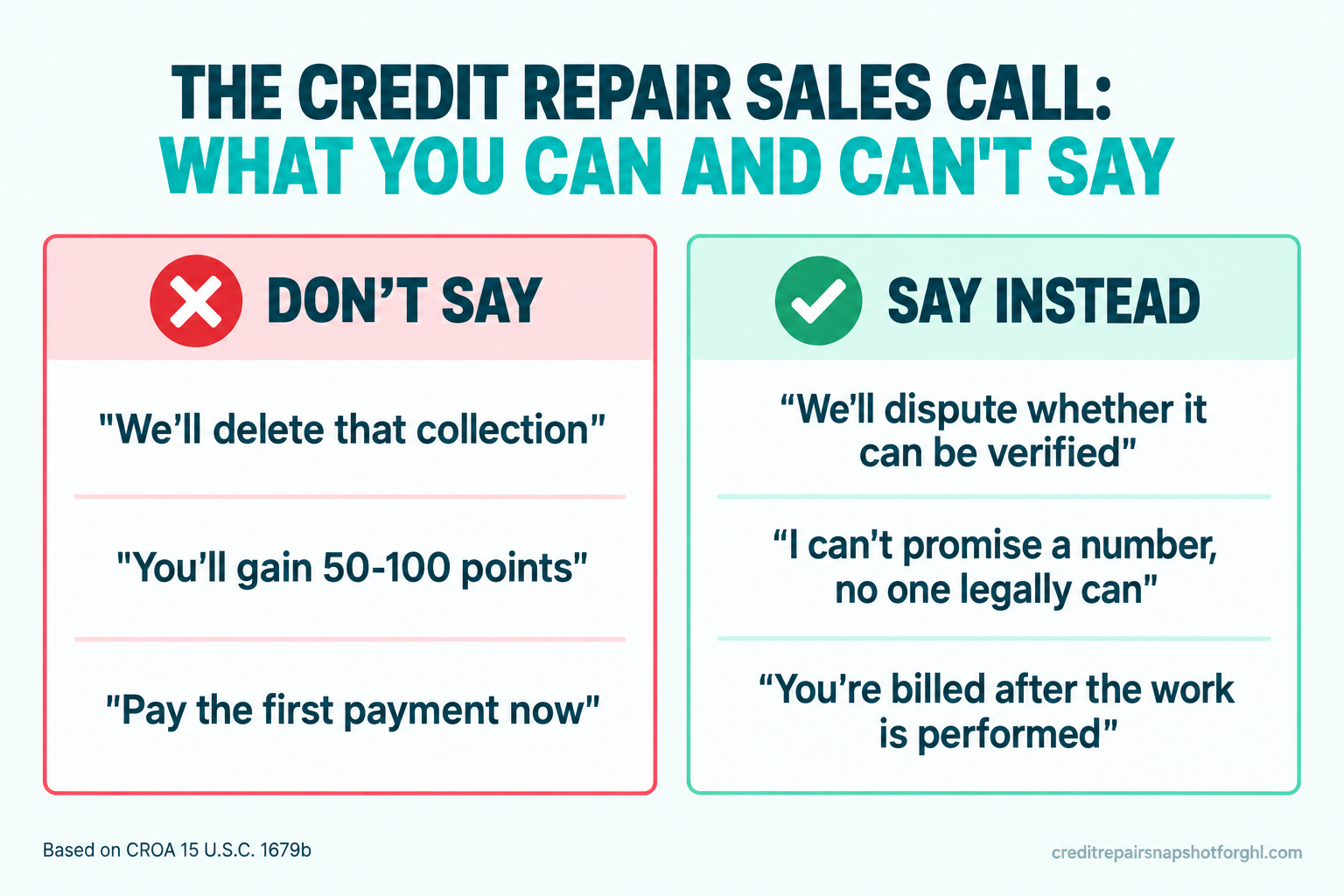
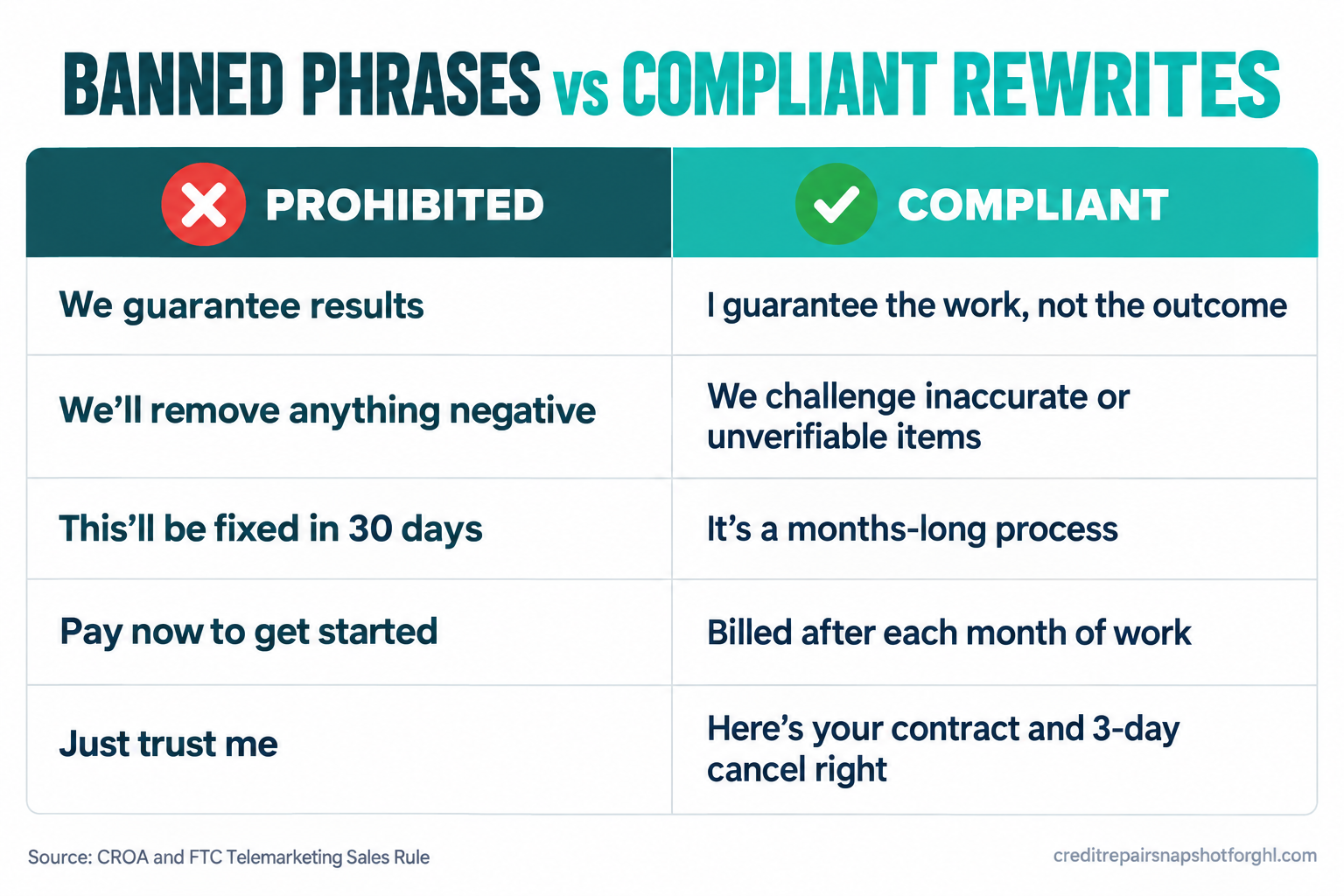
| “We’ll delete that collection.” | “We’ll dispute whether that account can be properly verified under the FCRA.” |
| “You’ll gain 50 to 100 points.” | “Clients often see movement over time, but I can’t promise a number, and no one legally can.” |
| “We guarantee results.” | “I guarantee the work and the communication, not a specific outcome.” |
| “We can remove anything negative.” | “We challenge items that are inaccurate, incomplete, or unverifiable. Accurate, current info is different.” |
| “Pay the first payment now to get started.” | “You’re billed for each month of work after it’s performed. Nothing up front for future results.” |
| “This’ll be fixed in 30 days.” | “This is a months-long process; the first dispute round goes out in week one.” |
| “We’ve never had a client we couldn’t help.” | “Here’s exactly the process we’d run on your file.” |
| “Just trust me, we’ll take care of it.” | “Here’s the contract and your rights statement. Read them, and you’ve got three days to cancel.” |
The phrases on the left are not banned because a regulator hates the word “delete.” They are banned because each one is a statement about a future result you cannot control, which is what §1679b(a)(1) calls untrue or misleading, or a payment demand that trips the advance-fee ban in §1679b(b). The phrases on the right all pass the one filter from earlier: they describe what you will do, not what will happen.
The same script at three sizes
The language does not change as you grow. What changes is who says it and how you make sure they say it right. Here is the same compliant call run at three sizes.
Solo operator, you take every call. Your risk is not inconsistency, it is fatigue. At 6:10pm on the fifth call of the day you cut corners, skip the “who I am not” line, and reach for the easy promise. Your fix is mechanical: keep the eight-row banned-phrase table in your eyeline, and keep the two required documents ready to send with one click so the disclosure step never gets skipped because you were tired. Record your own calls for a week and listen back; you will catch yourself making one soft promise you did not know you made.
Small team, a setter books and a closer sells. Now the risk is drift. Your closer is good, which means your closer improvises, and improvisation is where the illegal sentence sneaks in. Your fix is a one-page approved script and a hard rule that the guarantee objection has exactly one approved answer. Pull one recorded call per closer per week and score it against the banned-phrase list. Treat a promised result the way an airline treats a missed checklist item: not a vibe, a defect.
Call center or a floor of reps. The risk is scale multiplying a single bad habit across thousands of calls, which is the exact fact pattern in the Lexington Law and Credit Glory cases. The fix is real QA infrastructure: call recording with consent, a scored rubric where any results promise or any advance-fee ask is an automatic fail, a script no rep is allowed to deviate from, and a compliance officer who listens to a sample every week. At this size, “a rep went off script” is not an excuse a regulator accepts. The system has to make the compliant call the only call that is easy to make.
The through-line: the smaller you are, the more the compliance lives in your own discipline; the bigger you are, the more it has to live in your systems and QA. Either way, the words are the words. For why the handoffs and QA break down exactly when you grow, see why you can’t scale past 50 clients.
The compliance layer under the whole call
Pull it together. Five rules govern every credit-repair sales conversation, and all five come straight from the statutes above.
- No untrue or misleading statement about the client’s credit. Predictions of deletions, scores, or timeframes-to-result all fail this. CROA §1679b(a)(1).
- No untrue or misleading representation of your services. You sell the dispute process you actually run, not a magic outcome. §1679b(a)(2).
- No money before the work is fully performed. CROA bans it, and on the phone the TSR is stricter, requiring the promised timeframe to pass and a six-month-later credit report before payment for results. §1679b(b).
- The separate rights statement, before signing, with a kept acknowledgment. “Consumer Credit File Rights Under State and Federal Law,” a separate document, receipt stored two years. §1679c.
- A compliant contract and a bold 3-business-day cancellation right. Total cost, services, timeline, and the cancellation notice in duplicate. §1679d and §1679e.
One more that is easy to forget: if your follow-up to a booked consult goes out by text, credit repair is debt-relief-adjacent and your messaging has to clear A2P 10DLC carrier registration, which this niche gets rejected for constantly. The script is clean; make sure the channel carrying it is too. See the A2P 10DLC approval guide.
Objections operators have about the script itself
“Won’t I sound weak if I can’t promise results?” You will sound like the one honest person they talked to. Nervous buyers in a niche full of scammers are not looking for the biggest promise; they are looking for someone they can trust with their money for six months. “I guarantee the work, not the outcome, and here’s your three-day exit” closes more skeptical prospects than “we’ll wipe it clean,” because the skeptic has heard “we’ll wipe it clean” from the last three firms that took their money and vanished.
“I already trained my team on a hype script. Do I really have to redo it?” Yes, and it is cheaper than one refund wave or one complaint. The two biggest enforcement actions in the industry both turned on the same advance-fee and overpromise problems your hype script is built on. Swapping to the compliant language is a one-afternoon rewrite and a QA rule. Keeping the hype script is a liability you carry on every call.
“Do I have to record my calls?” You do not have to, but at any size past solo you should, with consent, because recordings are how you catch drift before a client does and how you defend yourself if a complaint claims you promised something you did not. Where you do record, honor your state’s consent rules; many require all-party consent. A short “this call may be recorded for quality and training” line at the open handles it.
“What if the prospect keeps pushing for a guarantee and I’m losing the sale?” Then you are being protected from a client who will file a complaint the moment their result does not match the promise they demanded. The guarantee-seeker who walks when you stay honest is the same client who becomes a chargeback when you cave. Let them go, and spend that energy on filling the top of the funnel with better-qualified consults instead.
“Isn’t this just the dispute work? Why does the sales call matter so much?” Because the sales call is the most-remembered, most-recordable, most-litigated moment in the whole relationship. Your dispute letters are seen by a furnisher and a bureau. Your sales promise is heard by the one person most motivated to hold you to it. That is why one sentence at 6:10pm matters more than a whole month of letters.
So, back to that 6:10pm call. She asks “can you get these off my report?” You take a breath and you say: “Here’s my honest answer. I can’t promise that, and the law won’t let me. What I can promise is that we’ll pull all three reports, challenge that collection under your federal rights, and keep you updated every round. You’ll get your rights in writing before you sign, and you’ve got three days to change your mind for any reason.” She signs. Not despite the honesty. Because of it.
What can you legally say on a credit repair sales call?
You can describe what you will do: review all three credit reports, identify items that look inaccurate, incomplete, or unverifiable, and dispute them with the bureaus and furnishers under the Fair Credit Reporting Act, with updates each round. You can state your process timeline, like when the first dispute round goes out. What you cannot do is promise a result: no guaranteed deletions, no promised score increases, and no timeframe for when an item will come off. CROA 15 U.S.C. §1679b(a)(1) bars untrue or misleading statements about a consumer's credit, and a prediction of a result you cannot control is exactly that.
Is it illegal to guarantee credit repair results?
There is no statute that bans the word 'guarantee' by itself, but guaranteeing a specific result, a deletion, or a score number is enforced as an untrue or misleading statement under CROA §1679b(a)(1) and (a)(2). Every CROA violation is also treated as an unfair or deceptive act under the FTC Act. In practice, guaranteeing results is one of the fastest ways to draw a complaint or an enforcement action, so the safe answer is to guarantee your effort and process, never the outcome.
Can I charge an upfront fee for credit repair?
No. CROA §1679b(b) bars charging or receiving any money for a service before that service is fully performed. On phone sales the FTC Telemarketing Sales Rule (16 CFR §310.4(a)(2)) is stricter still, requiring the promised timeframe to pass and a credit report issued more than six months after the result before you take payment for results. The common compliant structure is a first-work fee billed only after the first round is performed, plus a monthly fee for each month of work actually done.
What disclosures must I give before a credit repair client signs?
Two. First, the separate written statement titled 'Consumer Credit File Rights Under State and Federal Law' required by CROA §1679c, which must be its own document, handed over before signing, with the client's signed acknowledgment of receipt kept on file for two years. Second, a written contract that meets §1679d (total cost, services, timeline) and includes a bold-type notice of the client's right to cancel within three business days, with a Notice of Cancellation form in duplicate under §1679e.
Does the FTC Telemarketing Sales Rule apply to my credit repair calls?
If your consultations or closes happen by phone, yes, the TSR applies on top of CROA. It covers misrepresentations of any material part of your service and sets an advance-fee bar for credit repair that is stricter than CROA's. The 2023 court finding against Lexington Law and CreditRepair.com was a TSR advance-fee violation, and the 2026 FTC action against the Credit Glory network alleged TSR violations too. Treat the phone as the most regulated channel you sell on.
What's the single most common illegal thing credit repair owners say?
Attaching a number or a deadline to the result, like 'you'll gain 50 to 100 points in 90 days' or 'we'll have that collection off in a month.' Both are predictions of a result you cannot control, which makes them untrue or misleading statements under CROA §1679b(a)(1). The close second is 'let's get the first payment in to get started,' which is an advance fee banned by §1679b(b). Replace result-and-timeframe promises with process-and-effort descriptions, and never take money before the first round of work is done.
Should I record my credit repair sales calls?
At any size past a true solo operation, recording with consent is strongly worth it. Recordings let you score closers against an approved script, catch an overpromise before a client does, and defend yourself if a complaint claims you guaranteed something. Follow your state's consent law, since many require all-party consent, and add a 'this call may be recorded for quality and training' line at the open. The two largest enforcement actions in the industry both turned on patterns that call QA would have caught early.