
It is 9:15 on a Tuesday. A lead who filled out your form on Sunday just booked with a competitor instead, because nobody followed up. At the same time, three dispute responses came back and need to go into round two. You are one person doing both jobs with one login, and the tool you bought does one well and the other barely at all. That is the real GoHighLevel versus Credit Repair Cloud question: not “which is better,” but “which half of my business does each one run.”
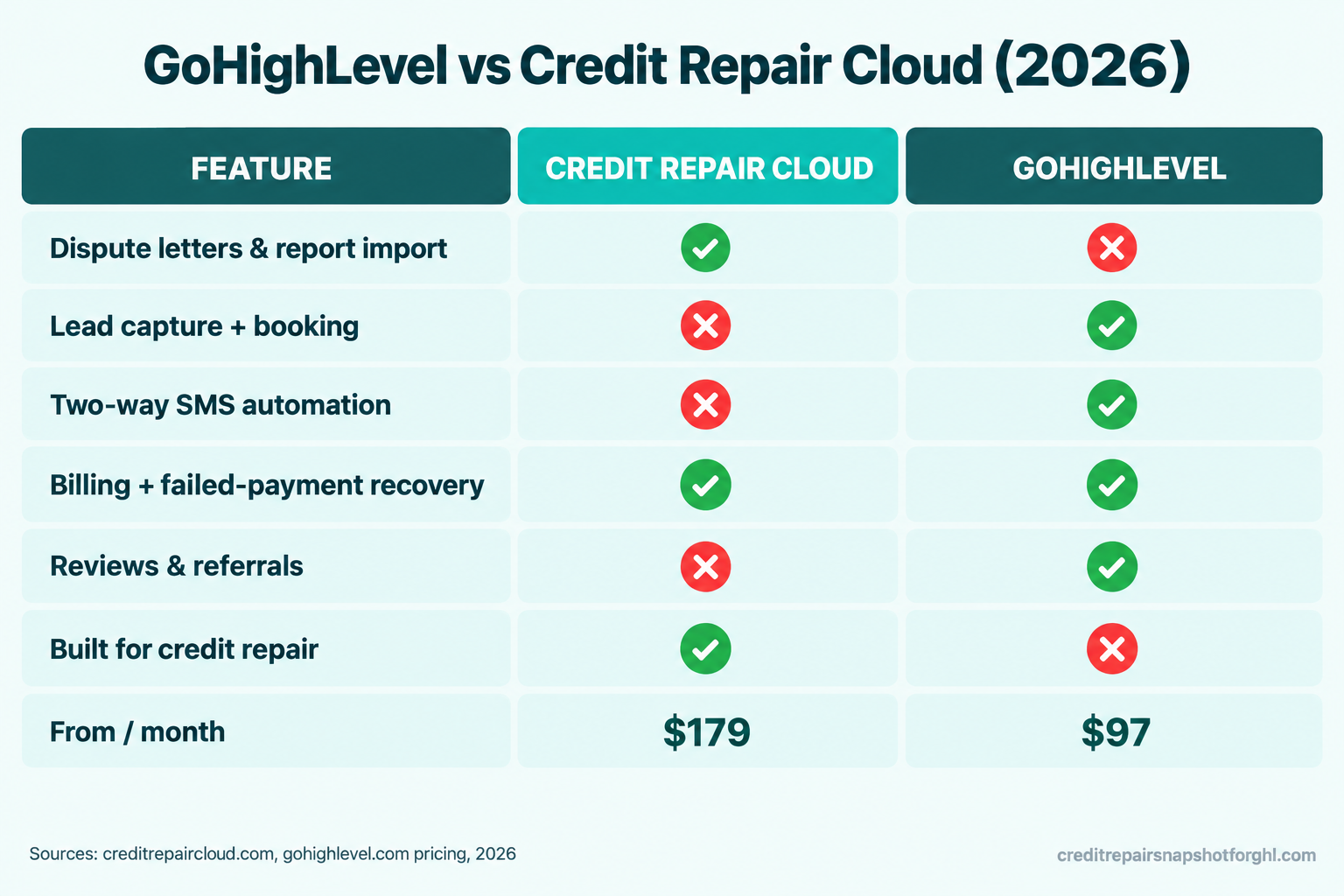
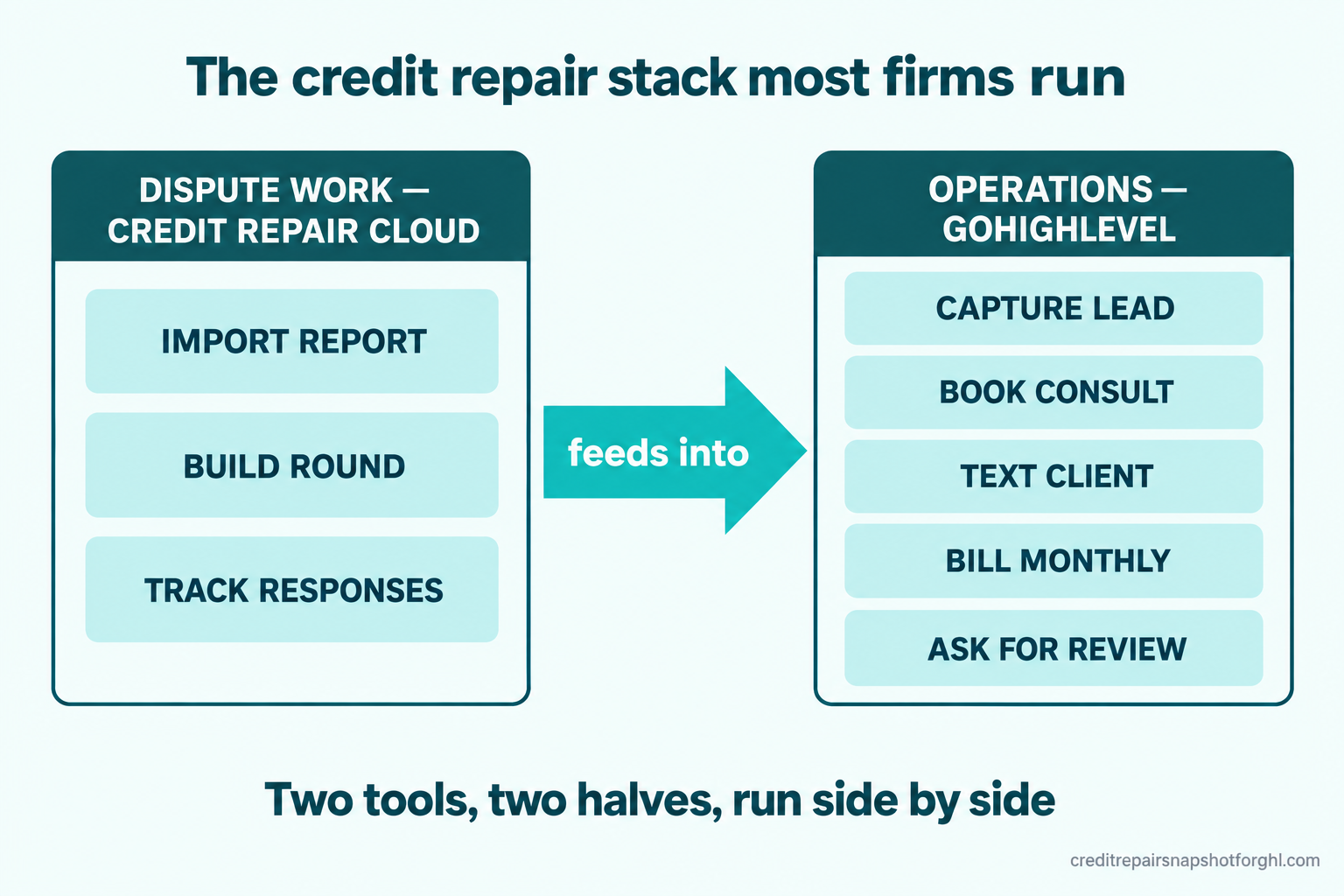
Here is the short answer. Credit Repair Cloud is dispute software: it imports a credit report, builds a round of disputes, tracks the bureau responses, and stores the file. GoHighLevel is a business operations platform: it captures the lead, books the consult, texts the client back, runs onboarding, bills every month, and asks for the review. They barely overlap: Credit Repair Cloud does not run your front desk, and GoHighLevel does not generate a dispute letter. Most firms past their first ten clients end up running both. This guide is about which half each owns, what it costs in 2026, and where each breaks.
We sell the operating system, never the outcome. Nothing here promises a score change or a deletion, and no software should. These are tools. Your firm stays the credit repair organization responsible for the contract, the disclosures, and CROA compliance.
Table of contents
- The honest answer first
- Why comparing them one to one is the wrong frame
- What each platform actually costs in 2026
- Function by function: who owns what
- The stack most firms actually run
- Solo operator vs small team vs agency
- The hidden cost on both platforms: texting
- Steal this: the messages that do the work
- Common objections, answered
- Frequently asked questions
- About the author
- Sources
The honest answer first
If you have never sent a dispute letter and need something that walks you through the process, buy Credit Repair Cloud. Its training, letter library, and round-tracking are the fastest way to get your first dispute out the door.
If leads are slipping away, clients go quiet and cancel, and your “system” is a phone, a spreadsheet, and your memory, you do not have a dispute problem. You have an operations problem, and that is what GoHighLevel is built for: lead capture, booking, follow-up, monthly billing, and chasing the failed payment before it becomes a cancellation. Most operators past their first handful of clients need both jobs done, and the rest of this piece shows which tool owns which.
Why comparing them one to one is the wrong frame
People search “GoHighLevel vs Credit Repair Cloud” expecting a winner. There isn’t one. Credit Repair Cloud is vertical software, built for one workflow: import a report, dispute items, track the result. GoHighLevel is a general CRM platform used by gyms, dentists, and agencies that does not know or care that you are in credit repair.
Why does that matter for a small firm? Because the money does not leak where you think. Demand is not your problem: the average U.S. FICO score sat at 713 in 2025, still leaving roughly a third of consumers below the 670 subprime line (Experian). Firms do not fail because they cannot write a dispute. They fail because a lead waited two days for a callback, a client went silent in month two, or a card declined and nobody noticed. No dispute tool fixes those.
Ask which job is bleeding you, and buy the tool that owns it.
What each platform actually costs in 2026
Prices move, so confirm on each vendor’s page before you buy. Here is where both stand in 2026.
Credit Repair Cloud publishes a full ladder by client capacity: Personal $49/mo (3 clients), Start $179/mo (300 clients, most popular), Grow $299/mo (600), Scale $399/mo (1,200), and Enterprise $599/mo (2,400). There is a 30-day free trial with no card, and annual billing cuts roughly 20% (Credit Repair Cloud).
GoHighLevel runs three tiers: Starter $97/mo (3 sub-accounts, unlimited contacts and users), Unlimited $297/mo (unlimited sub-accounts, rebilling with no markup), and Agency Pro $497/mo (SaaS mode and rebilling with markup, for agencies reselling the platform). A branded client portal app is a separate add-on at $49/mo per sub-account (GoHighLevel). A single-firm operator lives on the $97 or $297 tier.
The two are not substitutes, so most firms pay for one tier of each. GoHighLevel at $97 is not “cheaper than” Credit Repair Cloud at $179, because it does not do what Credit Repair Cloud does.
Monthly platform cost by tier (2026). GoHighLevel’s single-firm tiers ($97, $297) sit alongside Credit Repair Cloud’s dispute-software ladder ($179, $299, $399). Sources: GoHighLevel pricing, Credit Repair Cloud pricing.
If you need both jobs, your real cost is one tier of each, often around $276 before usage fees.
Function by function: who owns what
Here is the comparison that helps: eight jobs a credit repair business has to do, and who owns each.
| The job | Credit Repair Cloud | GoHighLevel | Who owns it |
|---|---|---|---|
| Generate and track dispute letters | Built for it | Not available | Credit Repair Cloud |
| Import and read a credit report | Native | Not available | Credit Repair Cloud |
| Capture leads and book consults fast | Basic | Native, instant | GoHighLevel |
| Two-way SMS and email automation | Limited | Deep | GoHighLevel |
| Recurring billing + failed-payment recovery | Has billing | Native payments + dunning | GoHighLevel |
| Reviews and referrals | Not a focus | Native | GoHighLevel |
| CROA guardrails (contract, disclosures, trail) | Industry-aware | You configure it | Split |
The ones that decide the money:
Dispute letters and report import: Credit Repair Cloud, no contest
You import a three-bureau report, Credit Repair Cloud parses the tradelines, you pick the items, and it generates the round. GoHighLevel does none of this: no report parser, no Metro 2 awareness, no dispute-round object. If dispute generation is the job, a dedicated letter tool wins by default. Where it breaks: the import still needs a report pulled from a monitoring service (a separate per-client bill), and a human still decides what is disputable under the FCRA, which we cover in why bureaus reject dispute letters.
Speed-to-lead and booking: GoHighLevel, decisively
A credit repair lead is warm for minutes, not days. GoHighLevel captures the form, fires an instant text and email, and books the consult on a calendar with reminders. Credit Repair Cloud holds a contact record but was never built to be your front desk. Where it breaks: that instant text only sends once your A2P 10DLC registration clears, a real wall covered below.
Client communication and retention: GoHighLevel
Clients cancel when they feel forgotten. GoHighLevel runs the between-rounds progress cadence, the milestone check-in, and the go-quiet nudge as automated two-way sequences and routes replies to you. This is where most monthly revenue is saved or lost. Credit Repair Cloud informs clients inside its portal, but proactive cross-channel follow-up is GoHighLevel’s turf, as we cover in why clients go quiet after month two. Where it breaks: automation with no judgment annoys people; a client who just got a denial should never get a chirpy milestone text.
Recurring billing and failed payments: GoHighLevel
Both platforms take a monthly payment. The difference is what happens when a card declines, which is where subscription businesses quietly bleed. GoHighLevel can detect the failed charge, text a secure update link, retry, and pause service if it never clears, all automatically, as we lay out in recurring billing without chargebacks. Where it breaks: CROA timing. You can only bill for work already performed, so the logic has to fire after the round, never before.
Reviews and CROA guardrails: GoHighLevel plus a genuine split
A happy client is your cheapest lead source, but only if someone asks at the right moment. GoHighLevel triggers a review request after a milestone and routes unhappy replies to you privately first; Credit Repair Cloud does not play here, and requests must never imply a guaranteed result. On compliance it is a split: Credit Repair Cloud ships niche-specific agreement and disclosure templates (a real head start), while GoHighLevel can run a fully CROA-compliant onboarding with e-signed agreements, the Consumer Credit File Rights disclosure, and the three-day cancellation window, but you build it or deploy a setup that has it (our checklist is the blueprint). Neither tool makes you compliant on its own.
The stack most firms actually run
Once you see that the two tools own different halves, the setup is obvious. Firms usually run one of three stacks:
- Credit Repair Cloud alone, early on. One tool, one bill, maximum hand-holding. Fine until operations leak.
- Credit Repair Cloud plus GoHighLevel. The dispute engine stays put; lead capture, booking, follow-up, billing, and reviews move to GoHighLevel. The most common mature setup.
- A lean letter tool plus GoHighLevel as the hub. Swap Credit Repair Cloud for a cheaper letter generator and run everything else on GoHighLevel. We compare the dispute tools in the best credit repair software for a solo operator, and the move in migrating a credit repair business to GoHighLevel.
The pattern is the same: keep whatever generates compliant letters, and put the business system on the platform built to run a business.
Disclosure: the GoHighLevel link above is an affiliate link. If you start an account through it we may earn a commission, at no extra cost to you.
Solo operator vs small team vs agency
The right answer changes with the size of your shop.
Solo operator (under 30 clients)
Your bottleneck is not letters, it is time. If you are brand new, start on Credit Repair Cloud Start at $179 for the training wheels. The moment you drop a lead or forget a follow-up, add GoHighLevel Starter at $97 for the front desk. Total around $276/mo, and at a typical $100-a-month service, one retained client more than pays for the second tool.
The small team (two to six people, 30 to 150 clients)
Now the problem is consistency: three people onboarding three different ways is a compliance risk and a client-experience mess. Run Credit Repair Cloud Grow at $299 for dispute capacity and GoHighLevel Unlimited at $297 so every lead, onboarding, and billing event runs the same automated path. That is what lets you add clients without adding chaos, as we map in why you cannot scale past 50 clients.
The agency or multi-brand operator
If you serve several firms or resell software, the math flips. GoHighLevel Agency Pro at $497 with SaaS mode lets you spin up a sub-account per firm and rebill the platform under your own brand. Most agencies run GoHighLevel as the hub and let each client firm bring its own letter tool.
The hidden cost on both platforms: texting
Here is the bill nobody quotes you, on either platform. To send automated SMS in the United States, your business must register for A2P 10DLC through the carriers, and credit repair is a restricted, debt-adjacent category that gets rejected.
This is not a maybe. Twilio, the carrier most platforms route through, publishes a specific code: error 30950, “Campaign rejected: Credit repair content detected,” which fires when a campaign “promotes services that claim to improve, fix, or repair consumer credit scores or credit reports.” Twilio states the rejected campaign “is not eligible for resubmission” (Twilio). A sibling code, 30949, hits debt-relief content the same way (Twilio).
Neither platform solves this for you. Register the business entity correctly, frame the use case as client communication rather than credit-repair marketing, and keep guaranteed-result language out of every sample message. We walk the full approval path in getting A2P 10DLC approved for credit repair. Budget for a first submission that bounces, because a tool that cannot text is half a tool.
Steal this: the messages that do the work
The platform is plumbing. What retains a client is what you say and when. Here is real copy you can paste into whichever tool runs your communication. Keep every line inside CROA: describe effort and process, never a promised result.
The instant speed-to-lead text (fires the second a form comes in):
Hi [First Name], this is [Your Name] with [Firm]. Thanks for reaching out about your credit. I have time today at 2:00 or 4:30 to walk through your situation and how our process works. Which is better? (Reply STOP to opt out.)
The between-rounds progress update (so silence never sets in):
Quick update, [First Name]. Round [N] is submitted and the bureaus have up to 30 days to respond. Nothing for you to do right now. I will message you the day anything changes. You are exactly where you should be at week [X].
The failed-payment recovery text (the cash-flow saver):
Hi [First Name], your payment for this month’s work did not go through. No stress, these things happen. Here is a secure link to update your card so we can keep your file moving: [link]. Reply here if you need a hand.
The review request (only after a real milestone, never promising a result):
[First Name], you have hit a real milestone in your process and I am glad to be working with you. If you have a minute, a short note about your experience so far would mean a lot: [link]. Thank you for trusting us with this.
On GoHighLevel these become automated workflows triggered by a form, a round status, a declined charge, and a milestone. On Credit Repair Cloud you send most of them by hand. That automation gap is the clearest reason operations end up on GoHighLevel.
Common objections, answered
“Can’t I just run everything in Credit Repair Cloud and skip the second tool?”
You can, until you cannot. One tool is simpler and cheaper, and that is the right call under ten clients. The problem shows up when leads slip and clients go quiet, because Credit Repair Cloud was not built to be your front desk or your retention engine. You feel it as missed callbacks and month-two cancellations, and that is when the second tool earns its keep.
“Isn’t GoHighLevel overkill for one person?”
Only if you turn on everything at once. The fix is one or two workflows, not forty. A solo operator who wires up speed-to-lead and a progress cadence gets most of the value for $97 a month. It is a blank platform, though, so someone builds those workflows, or you deploy a setup that already has them.
“I already pay for Credit Repair Cloud. Do I rip it out?”
Usually no. If the dispute side works, keep it and add GoHighLevel next to it. Ripping it out means migrating files and risking a service gap, for zero revenue. Switch the letter tool only if its price ladder has outgrown you or you keep bolting on apps because it does not do CRM. We run that math in build it yourself vs done-for-you.
Frequently asked questions
GoHighLevel vs Credit Repair Cloud: FAQ
Is GoHighLevel a replacement for Credit Repair Cloud?
No. GoHighLevel does not generate dispute letters, import credit reports, or track rounds, so it cannot replace a dedicated dispute tool. It replaces the business layer around the disputes: lead capture, booking, two-way texting, recurring billing, and reviews. Most firms run both.
How much do both cost together per month in 2026?
A single-firm operator typically pays Credit Repair Cloud Start ($179) plus GoHighLevel Starter ($97), about $276 before usage fees. A small team is more likely on Credit Repair Cloud Grow ($299) plus GoHighLevel Unlimited ($297). Credit monitoring for each client is a separate bill, usually paid by the client directly.
Does Credit Repair Cloud do recurring billing?
Yes, it takes recurring payments. The difference is failed-payment recovery: GoHighLevel can detect a declined card, text a secure update link, retry, and pause service automatically, which saves involuntary churn. On Credit Repair Cloud that is more manual. Either way, CROA requires you to bill only after the month's work is fully performed.
Will GoHighLevel handle my client texting out of the box?
Only after you clear A2P 10DLC registration, and credit repair is a restricted category. Twilio publishes error 30950 for rejected credit-repair SMS campaigns and marks them not eligible for resubmission. Neither platform solves this for you. Register the business correctly, frame the use case as client communication, and keep guaranteed-result language out of every message.
Can GoHighLevel keep me CROA compliant?
No software makes you compliant. GoHighLevel can run a fully CROA-compliant onboarding with e-signed agreements, the Consumer Credit File Rights disclosure, and the three-day cancellation window, but you build it or deploy a setup that has it. Credit Repair Cloud ships niche templates as a head start. Either way, your firm remains the credit repair organization responsible for compliance.
About the author
Simone Braxton spent eight years running back-office operations for credit-repair firms before moving full-time into GoHighLevel implementation. She writes about onboarding sequences, compliance documentation, and the operational details that decide whether a firm scales or stalls. Personas on this blog are editorial bylines, not licensed professionals, and nothing here is legal or financial advice.