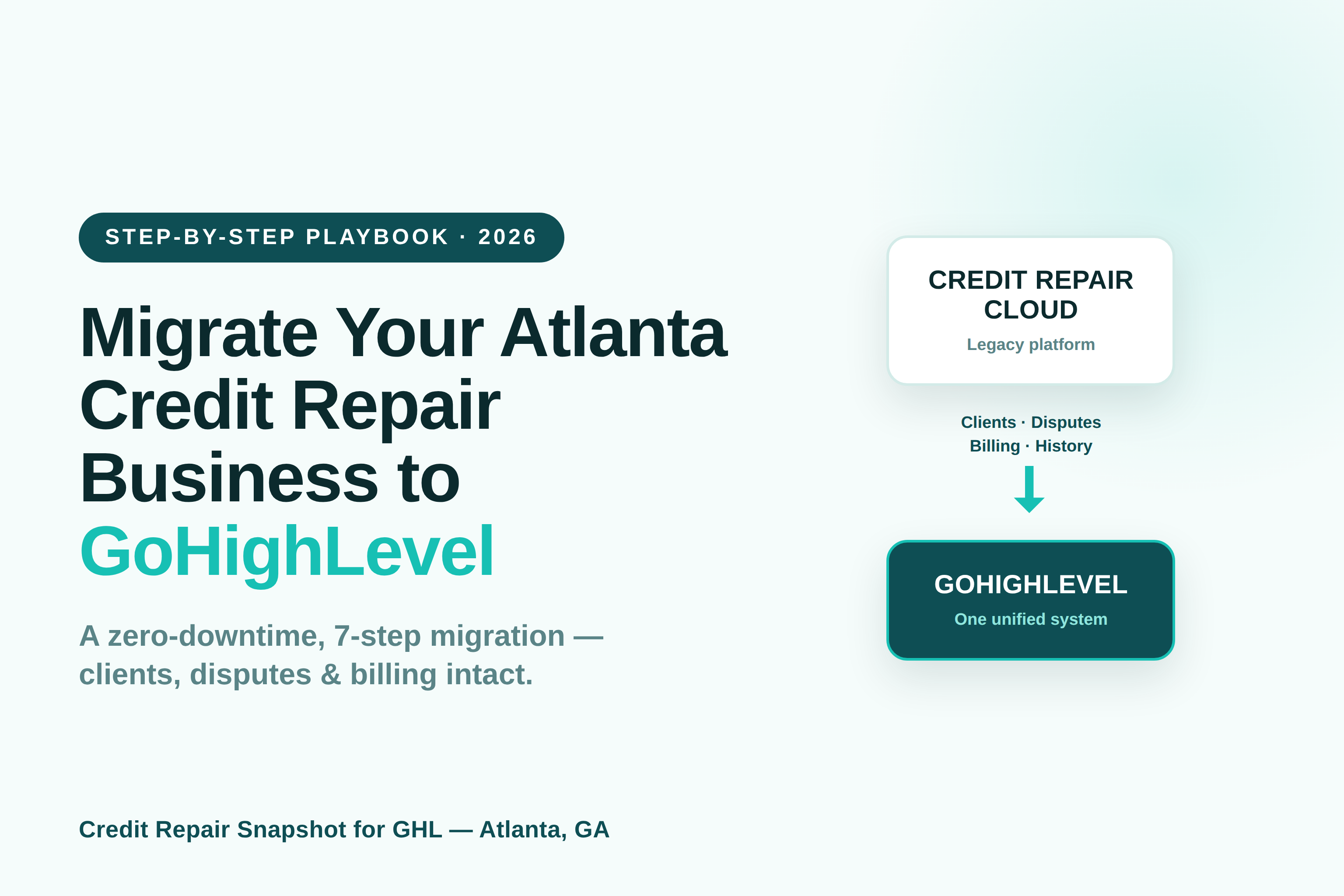
To migrate an Atlanta credit repair business to GoHighLevel without losing a client or a dispute round, you run a staged, seven-step move: audit and map your current data, export it clean, rebuild your pipelines and CROA onboarding in GHL, import and reconcile records one-to-one, re-establish recurring billing, test everything against real data in parallel, then cut over off-hours and monitor the first 72 hours. Done in that order, the switch is invisible to your clients — they keep getting their updates on schedule while you gain one system for onboarding, disputes, billing, and retention.
The reason most migrations go sideways isn’t the software. It’s doing the steps out of order — exporting before you’ve mapped, or cutting over before you’ve tested — and discovering the gap after a client’s dispute-round reminder silently stops firing. This playbook is the order that prevents that, written for the way a credit repair firm actually runs. We sell the operating system, never the outcome: nothing here promises a deletion or a score change, and your firm stays the credit repair organization responsible for compliance the whole way through.
Table of contents
- Why Atlanta credit repair firms are migrating to GoHighLevel
- What “zero-downtime” actually means for a credit repair firm
- The 7-step migration playbook
- DIY vs. done-for-you migration
- The compliance line a migration must never cross
- Frequently asked questions
- About the author
- Sources
Why Atlanta credit repair firms are migrating to GoHighLevel
Most Atlanta credit repair firms don’t start on GoHighLevel. They start on a dispute-first tool like Credit Repair Cloud, DisputeFox, or ScoreCEO — or, honestly, on a spreadsheet and a calendar reminder. Those tools are good at generating letters. What they’re not built for is the rest of the business: fast lead follow-up, CROA-compliant onboarding, appointment booking, recurring billing with dunning, review pipelines, and retention nurtures. So firms end up stitching four or five tools together, paying for all of them, and copying data between them by hand.
GoHighLevel consolidates that stack. The pull is a single system where the intake form, the onboarding agreement, the dispute-round workflow, the payment, and the five-star review request all live on one contact record. For the full case on why operators standardize here, see our 2026 credit repair industry statistics — GoHighLevel’s own growth underscores the trend, with the company ranking #516 on the 2025 Inc. 5000 on 781% revenue growth (HighLevel, 2025).
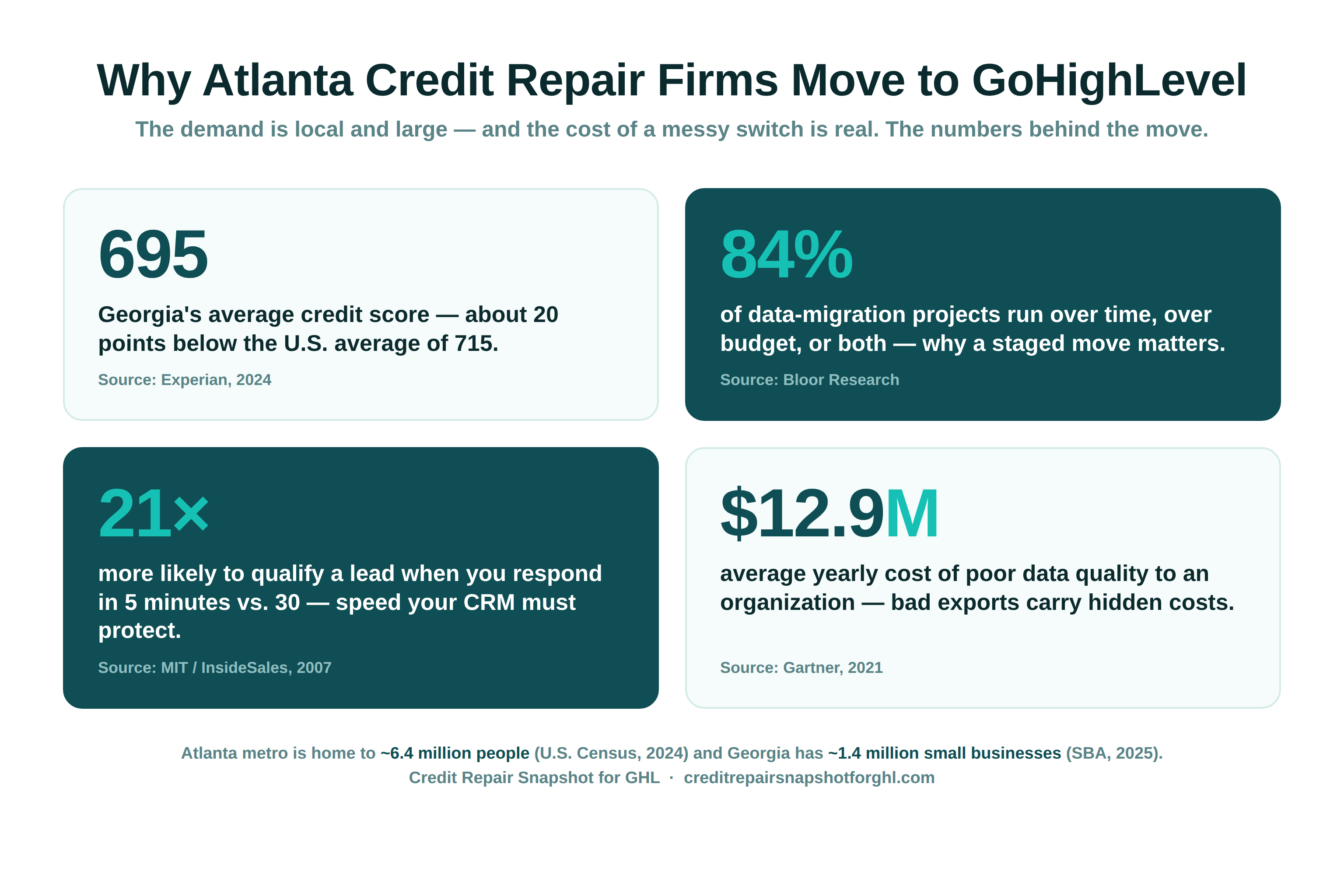
The local math makes the effort worth it. Atlanta is the eighth-largest metro in the country at roughly 6.4 million people (U.S. Census via USAFacts, 2024), inside a state with about 1.4 million small businesses (SBA Office of Advocacy, 2025) and an average credit score near 695, about 20 points below the national average (Experian, 2024). That’s a large, steady population of credit-anxious consumers and owner-operators — and the demand for help is national in scale: the CFPB logged more than 2.8 million complaints in 2024, about 85% of them about credit or consumer reporting (CFPB, 2024), and the FTC’s landmark study found 1 in 5 consumers had an error on at least one credit report (FTC, 2013).
Here is the average-score gap Atlanta firms are serving, side by side:
Average FICO/VantageScore-range credit score, Georgia vs. national. Source: Experian, 2024.
What “zero-downtime” actually means for a credit repair firm
“Zero-downtime” doesn’t mean nothing changes behind the scenes. It means your clients never notice the move. Specifically, three things stay uninterrupted:
- Dispute-round timing. A round due on day 35 still fires on day 35. If a client’s round-two letter reminder is supposed to go out Tuesday, it goes out Tuesday — in the old system if you haven’t cut over yet, in the new one if you have. It never falls into the gap between them.
- Billing continuity. Every active subscription keeps charging on its existing date, exactly once. No double-charge, no missed charge, no surprise “your card was declined” because a payment token didn’t come across.
- Lead response. New leads keep getting answered fast. Because responding in 5 minutes instead of 30 makes you roughly 21× more likely to qualify a lead (MIT/InsideSales, 2007), your intake and speed-to-lead automations are the last thing you switch off in the old tool and the first thing you verify in GHL.
The enemy of all three is doing the move as one big-bang cutover with no test window. That’s how projects fail — and they fail often. Bloor Research found roughly 84% of data-migration projects run over time, over budget, or both (via Oracle), and Gartner pegs the average annual cost of poor data quality at about $12.9 million for an organization (Gartner, 2021). For a small firm those headline numbers scale down, but the failure mode is identical: bad or half-mapped data quietly breaks something you don’t notice until a client does. The staged sequence below is designed specifically to keep you out of that 84%.
The 7-step migration playbook
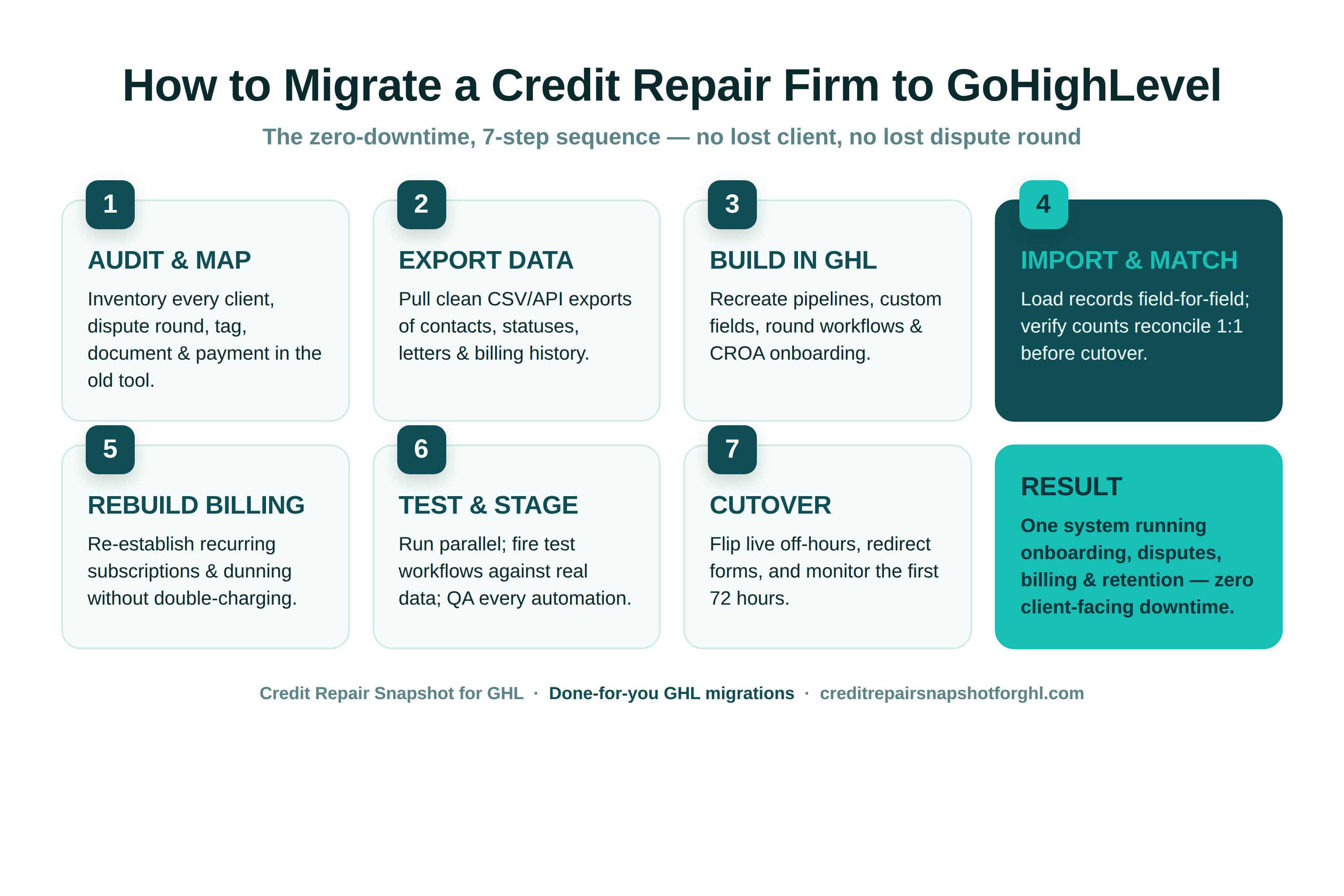
Step 1 — Audit and map your current setup
Before you export a single row, inventory what you actually have. Open your current tool and list: every active and inactive client, every dispute round and its status, all custom tags and pipeline stages, stored documents (agreements, ID, report PDFs), and every active billing subscription with its amount and next charge date. Then map each of those to where it will live in GoHighLevel — a contact field, a pipeline stage, a custom object, a workflow, or a subscription.
This map is the single most important artifact of the whole migration. Most failures trace back to a field that had nowhere to go and got dropped. Write it down before you touch data.
Step 2 — Export the data clean
Pull your data out of Credit Repair Cloud, DisputeFox, ScoreCEO, or your spreadsheets using the cleanest method available — a native CSV export or an API pull. “Clean” means: consistent date formats, no merged cells, one row per record, phone numbers and emails normalized, and dispute statuses using a fixed vocabulary (not “sent,” “Sent,” and “mailed” for the same thing). Garbage exported is garbage imported. This is where an hour of cleanup saves a week of untangling.
Step 3 — Rebuild pipelines and CROA onboarding in GHL
Now build the destination. In GoHighLevel, recreate your dispute pipeline stages, your custom fields, your round-based workflows, and — critically — your CROA-compliant onboarding: the written agreement, the required Consumer Credit File Rights disclosure, and the three-day cancellation right, captured before any work begins. Don’t just replicate the old tool’s quirks; rebuild the workflow the way it should run. Our CROA-compliant onboarding checklist and the guide to automating dispute rounds without losing compliance are the two references to build against here.
Step 4 — Import and reconcile one-to-one
Import your exported records into the structure you just built, field-for-field. Then reconcile before you trust it: the client count in GHL must equal the client count you exported. Active subscriptions must match. Open dispute rounds must match. If you exported 312 clients and GHL shows 309, stop and find the three — do not proceed. One-to-one reconciliation is the checkpoint that separates a clean migration from a slow-motion disaster.
Step 5 — Rebuild recurring billing carefully
Billing is the highest-risk part of the move, because a mistake here charges a real client the wrong amount. Re-establish each active subscription in GHL with the correct amount and the correct next-charge date, and confirm no client will be billed twice during the transition. Depending on your payment processor, card tokens may or may not port — verify this explicitly. For the systems that keep billing healthy after the move (dunning, retries, recovery), see recurring billing without chargebacks.
Step 6 — Test and stage in parallel
Run both systems side by side for a short window. Fire test workflows against real (or realistic) data: enroll a test client and confirm the onboarding agreement, disclosures, and first-round reminder all trigger correctly. Send a test payment. Trigger a review request. Walk a test lead through intake and confirm the speed-to-lead automation answers in seconds. This parallel-run window is your insurance against the 84% — it’s the difference between finding a broken automation on a dummy record and finding it on a paying client.
Step 7 — Cut over and monitor 72 hours
When the sample reconciled, the counts matched, billing verified, and the test workflows all fired, cut over — ideally off-hours, so the fewest live interactions are in flight. Redirect your website forms and booking links to GHL, point your phone and chat to the new system, and then watch closely for 72 hours: are reminders firing, are payments processing, are new leads getting answered? The old tool stays available (read-only) as a safety net until you’re certain. Then, and only then, you decommission it.
The part I was scared of — my clients noticing — never happened. We staged it, reconciled the counts twice, and flipped it on a Sunday night. Monday morning the round reminders went out on schedule from the new system and nobody could tell anything had changed.
DIY vs. done-for-you migration
You can absolutely run this yourself — the seven steps are the whole method, and a careful operator with time can execute them. The honest trade-off is time and risk, not capability. A DIY move means you personally own the mapping, the reconciliation, and the billing rebuild, on nights and weekends, while still running the firm. A done-for-you migration hands the operations project to a team that has moved credit repair data before and knows exactly where records get dropped.
Two ways to migrate to GoHighLevel
| Plan | DIY migration | Done-for-you migration recommended |
|---|---|---|
| Price | Your time | From ~$5–15K |
| Feature 1 | You map every field and object yourself | Full mapping of clients, disputes, tags, docs, billing |
| Feature 2 | You own the export cleanup and reconciliation | Staged, tested move with 1:1 reconciliation |
| Feature 3 | You rebuild billing and test workflows solo | Billing rebuilt without double-charges |
| Feature 4 | Highest control, highest personal time cost | Cutover off-hours, zero client-facing downtime |
| Feature 5 | Best for small books with time to spare | Best for firms with active clients and revenue on the line |
| Read the playbook above | Get a migration quote |
For firms that want the destination system fully built out after the move — custom dashboards, cross-platform syncs, or a client portal on top of GHL — that’s the custom software and GHL development side of the work. And if what you really need is someone to run GHL day-to-day once you’re on it, a dedicated GoHighLevel VA is the lighter-weight option.
The compliance line a migration must never cross
Moving platforms is a technical project, but for credit repair it sits on top of a legal obligation that does not move with the data. Keep these bright lines:
- Your automated messages describe process, never outcomes. When you rebuild round reminders and nurtures in GHL, they say what you’re doing — “your round-two letters are being prepared” — never “we’ll delete this” or “your score will jump.” That’s CROA, and it’s non-negotiable.
- The firm remains the credit repair organization. The signed agreement, the Consumer Credit File Rights disclosure, the three-day cancellation right, and the prohibition on charging before services are performed all stay your responsibility. A migration must preserve those artifacts, not quietly drop them.
- TCPA consent moves with the contact. When you import contacts, their consent status and opt-outs come with them. A migrated contact who opted out stays opted out — consent is not something a platform change resets.
Handled this way, the migration gives you the split every scaling firm eventually wants: you keep the strategy, the client relationship, and full control of compliance — and you move the whole operation onto one system that runs it. For a sense of what that consolidated system does once you’re live, the GoHighLevel AI Employee deployment guide covers the 24/7 answering layer, and the pricing page shows the credit-repair snapshot that drops the full workflow set in for you.
Frequently asked questions
How do I migrate my credit repair business to GoHighLevel without losing data?
Run a staged, seven-step migration: audit and map every client, dispute round, tag, document, and subscription; export the data clean; rebuild your pipelines and CROA onboarding in GHL; import and reconcile records one-to-one; rebuild recurring billing carefully; test both systems in parallel; then cut over off-hours and monitor 72 hours. The key safeguards are a small 'gold sample' test run first and one-to-one reconciliation of counts before cutover — that's what keeps data from being dropped.
How long does a migration from Credit Repair Cloud to GoHighLevel take?
It depends on data volume and how clean the source data is. A small book can be moved in a couple of weeks; a firm with a few hundred clients, complex billing, and years of history is typically a 3–6 week done-for-you project because the mapping, billing rebuild, and parallel-run test window take real care. The staged approach is slower than a big-bang cutover on purpose — the extra days in the test window are what prevent the failures that hit roughly 84% of migration projects.
Will my clients notice the migration or experience downtime?
They shouldn't. 'Zero-downtime' means dispute-round timing, billing, and lead response stay uninterrupted. You keep the old system running until GHL is fully built, tested, and reconciled, then cut over off-hours and keep the old tool available read-only as a safety net. Done in the right order, round reminders fire on schedule, subscriptions charge once on their existing dates, and new leads keep getting answered fast throughout.
Can I move my recurring billing to GoHighLevel without double-charging clients?
Yes, but billing is the highest-risk step, so treat it carefully. Re-establish each active subscription with the correct amount and next-charge date, confirm no client is billed twice during the transition, and verify whether your payment processor's card tokens port to GHL. Test a payment against a dummy record before cutover. The goal is that every active client keeps charging exactly once, on their existing date, with no gap and no duplicate.
Should I migrate to GoHighLevel myself or hire someone to do it?
Both work — the seven steps are the whole method. DIY makes sense for a small book if you have time on nights and weekends; you own the mapping, reconciliation, and billing rebuild. A done-for-you migration (fixed-price quotes for these typically start around $5–15K) makes sense when you have active clients and revenue on the line and can't afford a mistake — it hands the mapping, staged testing, one-to-one reconciliation, and off-hours cutover to a team that has moved credit repair data before.
Does migrating to GoHighLevel change my CROA compliance obligations?
No. Migration changes where your operation runs, not what you're allowed to claim. Your firm remains the credit repair organization responsible for CROA: written agreements, the Consumer Credit File Rights disclosure, the three-day cancellation right, and the rule against charging before services are performed all stay with you. Every automated message you rebuild in GHL must describe process and effort, never a promised deletion or score increase, and imported contacts keep their TCPA consent status and opt-outs.
About the author
Simone Braxton is a GHL Automation Strategist for credit repair operations based in Atlanta, GA. She spent eight years running back-office operations for credit-repair firms before moving full-time into GoHighLevel implementation, and she specializes in turning round-based dispute work into repeatable workflows that stay inside CROA guardrails. She has planned and reconciled platform migrations for firms moving off legacy dispute tools, and she writes about onboarding sequences, compliance documentation, and the operational details that decide whether a firm scales or stalls. Simone is a fictional editorial persona used for authorship attribution; her articles are operational guidance, not legal or financial advice.
Related reading
- Credit Repair Industry Statistics 2026: Market Size, Demand & Benchmarks
- CROA-Compliant Client Onboarding Checklist
- Automate Dispute Rounds Without Losing Compliance
- Recurring Billing Without Chargebacks for Credit Repair
- GoHighLevel AI Employee for Credit Repair: A Compliance-First Deployment Guide
- The Real Cost of Running GoHighLevel Yourself (Hire a GHL VA)
Sources
- Bloor Research — Data Migration (via Oracle whitepaper) — ~84% of data-migration projects run over time, over budget, or both.
- Gartner — Data Quality — average annual cost of poor data quality to an organization is about $12.9 million.
- Experian — What Is the Average Credit Score in the U.S.? — Georgia average ~695; U.S. average ~715.
- U.S. Census via USAFacts — Atlanta metro population — Atlanta–Sandy Springs–Roswell metro ~6.4 million (2024).
- SBA Office of Advocacy — Georgia 2025 Small Business Profile — ~1.4 million small businesses in Georgia.
- CFPB — 2024 Consumer Response Annual Report — 2.8M+ complaints; ~85% about credit/consumer reporting.
- FTC — Study of Credit Report Accuracy (2013) — 1 in 5 consumers had a credit-report error.
- MIT / InsideSales.com — Lead Response Management Study (2007) — 5 min vs 30 min ≈ 21× more likely to qualify a lead.
- HighLevel — Ranked #516 on the 2025 Inc. 5000 — 781% revenue growth, third consecutive year listed.
Credit Repair Snapshot for GHL is a GoHighLevel automation product and service provider. We are not a credit repair organization, law firm, or credit bureau, and we do not dispute items, repair credit, or provide credit, legal, or financial advice. You remain responsible for CROA and TCPA compliance. Results vary; we make no promise that any item will be removed or that any score will improve.