

It is the second week of January and your phone will not stop buzzing. Three form fills overnight, two missed calls before 8am, and a text that just says “do you still do credit repair?” You have not touched your ads in a month. This is not luck. It is the calendar doing what it does every January, and most operators waste it because they treat the year as one flat line.
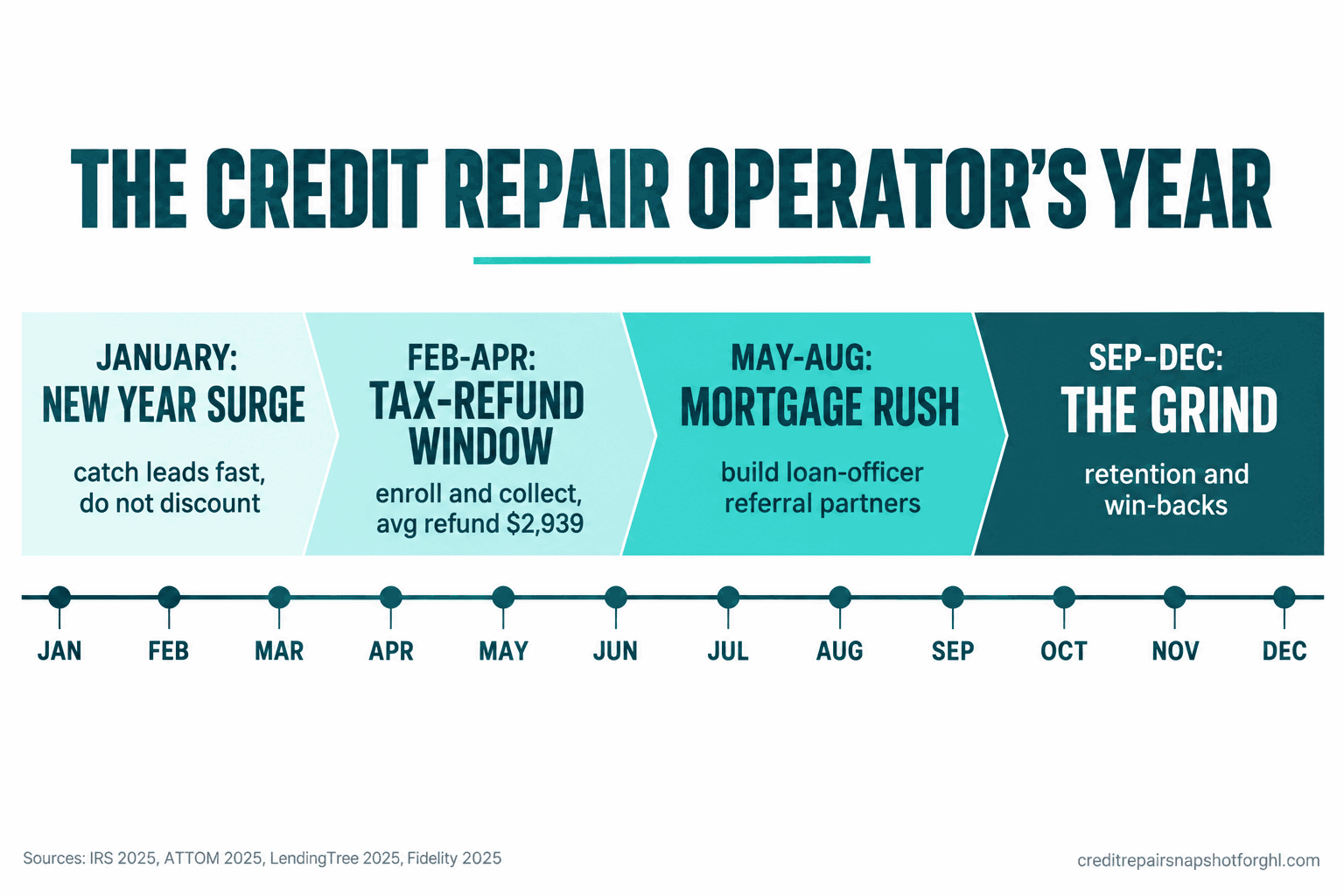
The answer up front: credit repair is seasonal whether you plan for it or not. Demand spikes in January on money resolutions, clients have cash from February through April on tax refunds, the highest-value clients arrive in spring to qualify for a mortgage, and enrollment slows while spending climbs in Q4. Because CROA bars you from charging a cent before the work is done, the season you sign a client decides when you actually get paid.
Table of contents
- Why the season exists
- The CROA cash-flow problem
- January: the New Year surge
- February to April: the tax-refund window
- May to August: the mortgage rush
- September to December: the grind
- Steal this: the message copy
- The same year at three shop sizes
- The compliance line
- Objections
- Frequently asked questions
Why credit repair has a season at all
Demand is not random. It tracks the moments when people are forced to look at their credit: New Year’s Day, a tax refund landing, a loan officer saying “you need a 640 to close,” the holidays running the card up. Those moments cluster, repeat every year, and move in a pattern you can set your watch by.
The underlying demand is huge and constant. In 2024 the CFPB received roughly 3.19 million consumer complaints, and 85% were about credit or consumer reporting, the single largest category by far, with credit reporting complaints up 182% year over year (CFPB, 2025). That is a country full of people with something on a report they want looked at.
What changes with the season is when people act, and whether they can pay you when they do. Intent and cash almost never peak in the same month. Intent peaks in January, cash peaks in tax season, and the highest-stakes intent, a mortgage, peaks in spring. Line your effort up with those peaks instead of spreading it evenly and hoping.
The cash-flow problem the calendar fixes or worsens
Here is the rule that shapes everything. Under the Credit Repair Organizations Act, you cannot collect any fee before the service it pays for is fully performed. No setup fee at signing, no first month in advance. The day you sign a client is not the day you get paid: you do a round of work, then you bill. Most operators run a monthly model for this reason (how to price credit repair services).
That creates a lag. You spend to acquire a client in one month, and revenue trickles in over the months after, if they stay. Sign a wave in a cash-poor month and you carry the cost while you wait; sign them when they have money and you collect sooner and churn less, which is why credit repair startup costs are about how many months you can float.
The plan writes itself: catch leads when intent is high, enroll and collect when cash is high, protect your base when both are low.
Season 1: January, the New Year surge
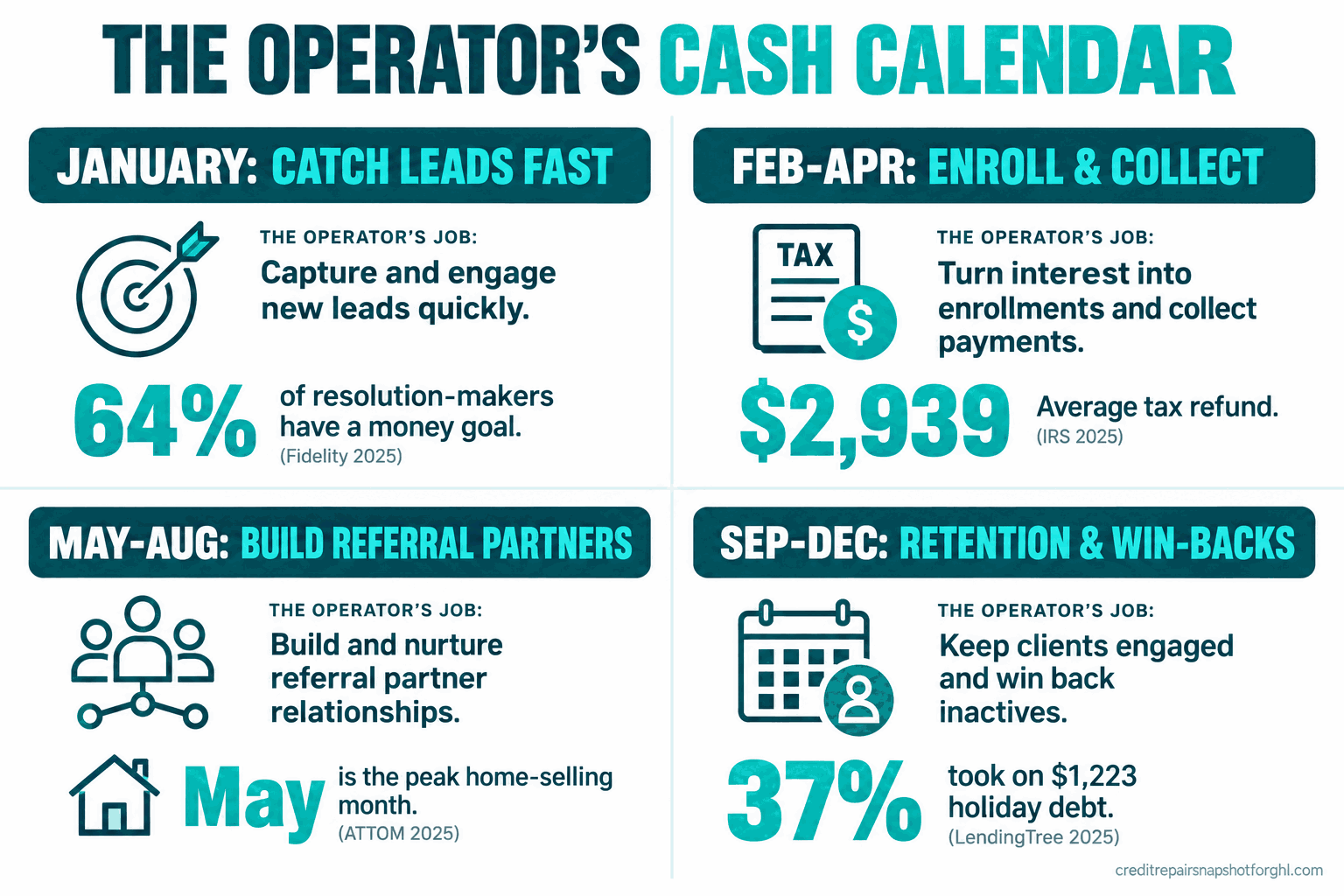
What happens. The first three weeks of January are the most predictable lead spike of your year. People make money resolutions, and credit is near the top. Fidelity found 64% of those considering a 2026 resolution were weighing a financial one, up from 56% the year before (Fidelity, 2025). The inbound arrives motivated.
The setup. This is a speed game, not a discount game. The operator who answers first wins the consult. Make sure no inbound sits: a missed-call text-back, an instant form auto-reply, and a booking link in every first response, the whole point of a credit repair sales funnel. The other January move is to wake up your old list. Everyone who inquired last year and never signed is thinking about credit again this week, and a simple reactivation text catches them in the mindset they lacked in October (database reactivation).
How it breaks. You stay in holiday mode until February. Leads sit in an inbox for six hours and book with whoever texted back in six minutes. January punishes slow response worse than any month because volume is high and intent is fragile. The second failure is discounting away margin on demand you did not pay for.
Season 2: February to April, the tax-refund window
What happens. This is the most important stretch of your financial year, and most operators sleep on it. The refunds land. The average 2025 federal refund was $2,939, and the IRS issued 93.6 million refunds totaling nearly $275 billion, most within about three weeks of an e-filed return (IRS, 2025; IRS refund timing). For a slice of your market, that is the only spare cash all year.
Why it beats January. January gives you intent. Tax season gives you what intent cannot buy: a client who can pay the monthly fee without it being a stretch. A client enrolled in February with a refund in the bank is far less likely to miss a payment in March, where most involuntary churn lives. This is the window to enroll hard and collect.
The setup. Two plays at once. Enrollment: name the refund directly in consults, not “can you afford it” but “your refund just landed, this is the month to start while the cash is there.” Recovery: any slow-paying client is now sitting on a refund, so this is the best month to clear a past-due balance (recurring billing without chargebacks).
How it breaks. You treat February like a normal month. The refund hits, your client spends it elsewhere because you did not ask, and by April you are chasing a stretched budget again. The window is roughly eight weeks and does not return until next year. The other break is implying the refund buys a result, which crosses a CROA line.
Season 3: May to August, the mortgage rush
What happens. Spring and summer are home-buying season, which makes them mortgage-prep season for you. Home sales and prices peak in late spring: an analysis of more than 47 million sales found May carries the highest seller premium of the year at 9.5% (ATTOM, 2025). More closings means more buyers, and buyers need scores. A borrower 20 points short of a rate tier is the most motivated client you will meet.
Why these clients are different. A mortgage client has a deadline, a loan officer on them, and a concrete reason the work must happen now. They pay on time because the stakes are real, and they refer. This is the season to build referral relationships with the people who send you buyers (mortgage-prep credit).
The setup. Line up loan-officer and realtor referral partners before the rush, in March and April, not in June when it is already here. One loan officer who trusts you can feed you qualified clients all summer. And be ruthless about compliance, because the pressure to promise is highest. A mortgage client will beg you to guarantee a 640 by closing, and the relationship dies the first time you overpromise and miss.
How it breaks. You wait until summer to build relationships, so you cold-pitch during the busy season instead of receiving warm handoffs. Or you cave to deadline pressure and promise a score you do not control. The honest pitch is process and effort, never a number, and it is the only one that keeps a referral partner.
Season 4: September to December, the grind and slowdown
What happens. Enrollment cools through fall and drops in December. People are spending, not fixing, and taking on debt doing it: in the 2025 holiday season, 37% of shoppers took on holiday debt averaging $1,223, the highest since 2022 (LendingTree, 2025). Balances climb into year-end, with total U.S. credit card debt at $1.21 trillion by mid-2025 (New York Fed, Q2 2025).
Average holiday debt among shoppers who took it on, by season, in dollars. Source: LendingTree holiday debt studies, 2023 to 2025.
Why the job changes. When new enrollment is hard, the money is in keeping the clients you have. A client who cancels in November is one you replace in January at full acquisition cost. Retention beats acquisition every month, but in Q4 it is the whole game. The classic churn moment is the quiet client who stops seeing progress and drifts (why clients go quiet at month two).
The setup. Lean on progress updates and milestone touches so clients feel the work happening even mid-round. Plant the seed for January, since the holiday debt building now becomes the New Year problem you solve in six weeks. And work your win-back list (win back cancelled clients).
How it breaks. You chase new enrollment in December with February energy, burn cash on ads nobody clicks with intent, and ignore the clients quietly deciding to cancel. December is for defense and loading the spring. Spend it on offense and you pay twice.
Steal this: the message copy for each season
Here is the text for the four moments that matter most. Swap the brackets for your details. None of it promises a result, because none of it can; all of it is process and effort, the only language CROA allows.
January, cold-lead reactivation text:
Hi [First name], it is [Your name] at [Company]. You reached out last year about your credit and we never got you started. New year is a good time to take another look. Want me to pull together what the process would involve for your situation? No cost to talk: [booking link]
February, tax-season enrollment follow-up (for a consult who stalled on price):
Hi [First name], quick thought. A lot of folks use their tax refund to get started on their credit this time of year, since it is cash already set aside. If the monthly was the sticking point, this is the easier month to begin. Happy to walk you through the first 90 days of work: [booking link]
Spring, loan-officer referral partner outreach:
Hi [Name], I work with [Company] on credit for people getting mortgage-ready. When a buyer comes in a tier short on their score, I lay out the dispute and rebuild process so they know what is realistic before closing. I never promise a number or a date, just the work. Open to being a resource for your borrowers?
Q4, at-risk client retention check-in:
Hi [First name], checking in. We are mid-round on your disputes and I wanted you to know the work is moving even though the report has not updated yet. Reinvestigations run on the bureaus’ clock, not ours. Anything on your mind about where things stand? I am here.
These four messages, at the right four moments, do more for a small shop than any ad spend. Load them into your CRM once and they fire on the calendar, not your memory.
The same year at three shop sizes
The calendar is the same for everyone. What you do with it depends on how many hands you have.
The solo operator. Pick one job per season and let automation cover the rest. January: answer fast while a reactivation sequence works your old list. February to April: enroll and collect personally, because this is where your year is won. Summer: build two or three referral partners. Q4: automate retention and protect your base. A system for a solo runs the season you are not personally working.
The small team of two to five. Now you run two seasons at once: in tax season, one person enrolls while another handles collection and billing recovery; in summer, one services mortgage clients while another keeps the referral pipeline warm. The risk is everyone chasing the same shiny season while the base gets neglected, so make retention someone’s real job.
The larger firm of five-plus. The seasons become a staffing and cash-planning exercise. Forecast January and tax-season volume and staff up before it, not during. Run paid acquisition heavier in Q4, when cost-per-lead is lower and competitors pull back, so your January pipeline is already full, and carry enough runway that the CROA lag is a spreadsheet line, not a panic.
The compliance line through every season
Every play above lives inside the same boundary, and the pressure to cross it changes by season.
You cannot charge before the work is done. Not at signing, not in advance, not as a deposit. 15 U.S.C. §1679b is explicit, and the tax-season urge to grab a big upfront payment while the refund sits there is when operators slip. Bill for work performed, monthly.
You also cannot promise a result or a timeline. The spring mortgage client will push hardest for a guaranteed score by a closing date, the most dangerous promise in this business. Describe the process and what is realistic for their file. Never a number, never a date. And every client gets the written contract and the three-business-day right to cancel, no matter how busy you are (CROA-compliant onboarding checklist).
Objections
“My business is steady all year, I do not see seasons.” Pull your own numbers. Count signed clients by month for two years, lead volume in January versus July, payment success in March versus December. The seasons are almost always there, hidden under the noise of a small sample, and catching one extra tax-season wave pays for the effort many times over.
“Chasing their refund in tax season feels pushy.” You are not chasing it, you are being honest about timing. A client who keeps stalling on money is helped, not harmed, by someone pointing out the one month the money is there. The pushy version promises the refund buys a result. The honest version says this is an easier month to start.
“Referral partners sound like a big-firm thing. I am solo.” The opposite. A solo operator cannot outspend anyone on ads, so warm referrals are the most efficient leads you will get. One loan officer who trusts you can replace a chunk of your ad budget, and you need two or three partners, not twenty.
“I already pay for dispute software and a CRM. Why a seasonal system too?” Your dispute tool runs the letters. It does not watch the calendar, wake your cold list in January, name the refund in a February follow-up, or fire retention touches in December. The seasonal plays are workflows that live in your CRM and run on dates, on top of the dispute work. That layer turns a predictable calendar into predictable revenue.
Credit repair seasonality: FAQ
When is the busiest season for credit repair?
January brings the biggest lead spike, as people make New Year money resolutions (Fidelity found 64% of those considering a 2026 resolution weighed a financial one). But February through April is the most important cash window, because tax refunds land and clients can afford to stay current. January gives you intent; tax season gives you clients who can pay.
Why does credit repair have a slow season?
Enrollment cools in fall and drops in December because people spend on the holidays rather than fixing their credit; 37% of 2025 holiday shoppers took on debt averaging $1,223 per LendingTree. New enrollment is hard in Q4, so the move is to keep the clients you have and set up the January surge.
How does CROA affect credit repair cash flow?
CROA (15 U.S.C. §1679b) bars charging any fee before the service is fully performed, so you cannot collect in advance. That creates a lag between acquiring a client and getting paid as work is performed. The season you sign a client therefore decides when revenue arrives, which is why enrolling into tax season, when clients have cash, reduces missed payments and churn.
Is spring really better for mortgage-related credit repair clients?
Yes. Home sales peak in late spring, with an ATTOM analysis of 47 million-plus sales finding May carries the highest seller premium of the year at 9.5%. That means more borrowers who need a higher score to qualify. These clients have a real deadline and a loan officer involved, so they pay on time and refer, as long as you never promise a specific score or closing date.
Should I run discounts during the January rush?
Generally no. January leads arrive already motivated, so discounting gives away margin on the easiest demand of the year and trains people to wait for the next sale. Spend January on speed instead: answer inbound fast, reactivate last year's cold leads, and book consults the same day.
What should a solo operator automate for each season?
Automate speed-to-lead capture and cold-lead reactivation for January, tax-season enrollment and billing-recovery follow-ups for February through April, referral-partner nurture for summer, and retention touches for Q4. The system should run whichever season you are not personally working, so you never choose between prospecting and protecting your base.
It is the second week of January again. The phone is buzzing the same way it did last year, but this time the inbound is not sitting in a cold inbox, the reactivation texts went out at 6am, and you already know the people you sign this week will be paying comfortably in February when their refunds land. The calendar did not change. You just stopped letting it run you.