
It is the third week of month two. A client who signed in a rush of hope, replied to every text in the first fortnight, and thanked you twice, has gone silent. No reply to your last message. No portal login in eleven days. Her payment is still going through, so your dashboard looks fine. Then on the first of the month the card declines. You text her. Nothing. Three days later the subscription cancels itself, and you never got the chance to say a word.
That client did not leave because your disputes were slow. She left because the line went dead and nobody noticed in time. In this business, a cancellation almost never starts with an angry phone call. It starts with silence.
The answer up front: you cannot stop every client from drifting, but you can build a system that treats silence as an event, not an absence. Define exactly what “going quiet” looks like, detect it automatically, and fire a human-paced re-engagement ladder before the quiet turns into a failed payment. Most of your saves then happen in a window you used to miss entirely, because nobody was watching it.
One line first: this is about communication and retention operations. Nothing here disputes an item or promises a score change. That stays with you, the firm, and inside the law.
Table of contents
- Why do credit repair clients go quiet?
- What silence actually costs a small firm
- The silence-to-save system, stage by stage
- Stage 1: Set the expectation on day one
- Stage 2: Define what “quiet” actually means
- Stage 3: The between-rounds progress cadence
- Stage 4: The re-engagement ladder
- Stage 5: The human save conversation
- Stage 6: The billing firewall
- Solo operator vs small team vs bigger shop
- Keeping it compliant: CROA and TCPA
- Common objections
- FAQ
Why do credit repair clients go quiet?
Kill the flattering explanation first. Clients do not go quiet because they stopped caring about their credit. They go quiet because the gap between what they expected and what they can see got too wide, and nobody filled it.
Look at the shape of the first ninety days. Week one is all momentum: they sign, send documents, you pull the report and explain the plan. Then the first round goes out and the clock starts. Under the Fair Credit Reporting Act, a bureau gets 30 days to complete its reinvestigation, extendable to 45 if the client sends more information mid-window. So for a month, from the client’s side of the glass, nothing visibly happens. No email, no score jump, just a card charge on the first.
Now layer on who these clients are. Credit and consumer reporting is the single largest complaint category in the country. In its 2024 report, the CFPB logged roughly 3.2 million complaints, and about 2.7 million of them, the large majority, were about credit or consumer reporting, with most naming Equifax, Experian, or TransUnion (CFPB Consumer Response Annual Report, 2025). Your client arrives primed to believe the system ignores them, so a month of your silence does not read as “the process is working.” It reads as “here we go again.”
2024 complaints to the CFPB, in millions. Of roughly 3.2M total, about 2.7M were about credit or consumer reporting, the largest category by a wide margin. Source: CFPB Consumer Response Annual Report, 2025.
So the root cause is not a bad client. It is an information vacuum during the slowest, least visible stretch of the program, hitting a person who is anxious by default. For this customer, silence is not neutral. Silence is bad news.
What silence actually costs a small firm
A solo or two-person shop lives on monthly recurring revenue, and the math is unforgiving. Because CROA bars you from charging before the work is done, you carry the cost of winning a client for weeks before their payments turn profitable. A client who cancels in month two often leaves before they ever repaid that cost, which is the quiet killer of cash flow in credit repair. We broke the full acquisition math down in what it really costs to start a credit repair business; the short version is that keeping a wavering client is far cheaper than replacing one.
Those three numbers tell the story: the law makes you wait to get paid, the process makes the client wait to see results, and your client was the most complaint-prone customer in the economy before they ever met you. The one variable you fully control in that stretch is communication, so that is what you systematize.
The silence-to-save system, stage by stage
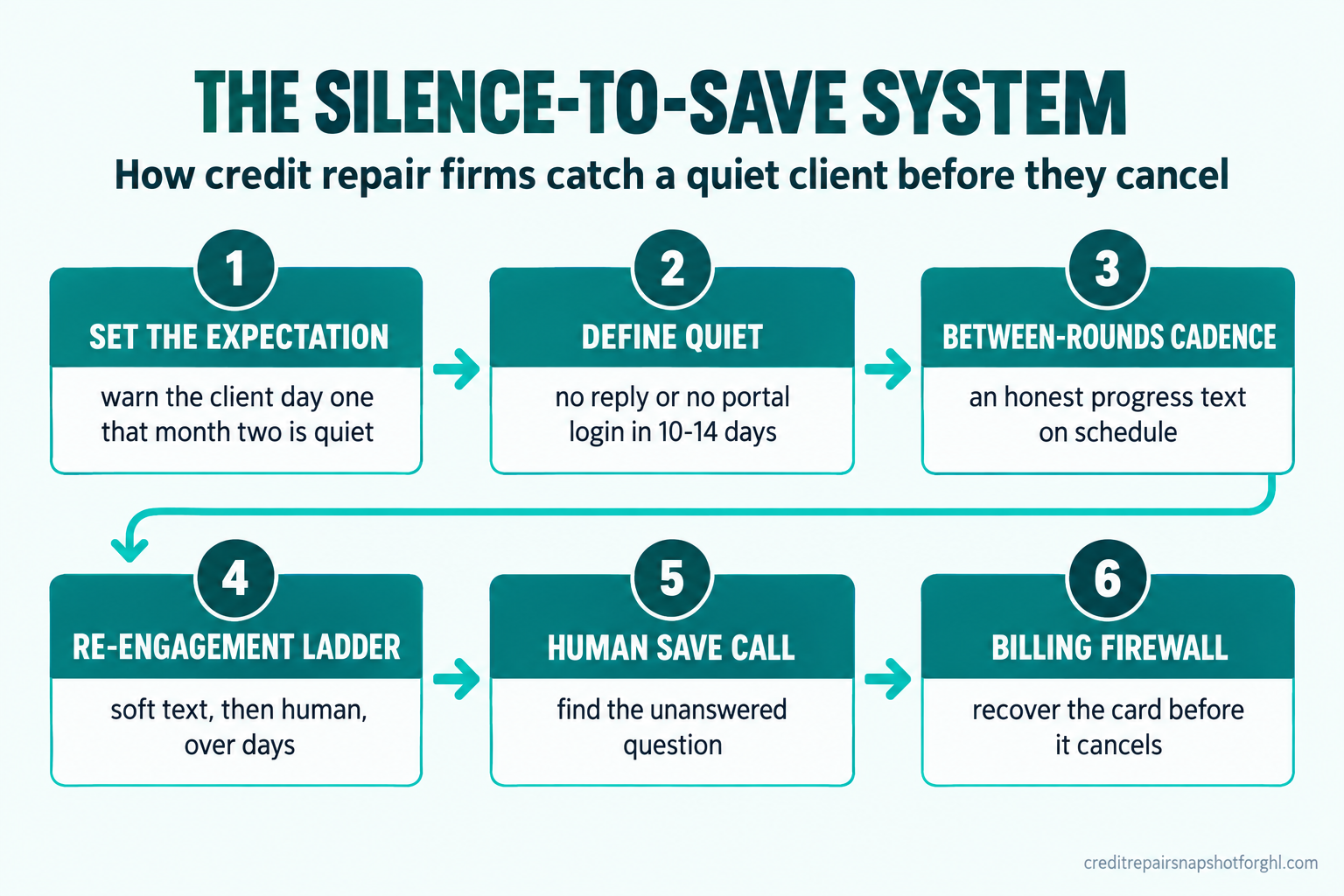
Here is the whole system, from the day a client signs to the moment a payment would have failed. Six stages, each with a setup, the real copy or trigger that makes it work, and the way it breaks when you skip it. You can build every piece inside GoHighLevel, the platform our own system runs on, or any CRM that does workflows, two-way SMS, and a client portal.
| Stage | Left manual, it breaks when | Built as a system, it |
|---|---|---|
| 1. Set the expectation | you promise speed you cannot control | tells the client the timeline before it disappoints them |
| 2. Define “quiet” | you notice silence only at the failed payment | flags a client the day they cross a silence threshold |
| 3. Between-rounds cadence | the client hears nothing for 30 days | sends a steady, honest progress touch on schedule |
| 4. Re-engagement ladder | you send one panicked text, or none | escalates softly from reminder to human over days |
| 5. Human save call | nobody ever actually calls | routes a quiet client to a real conversation |
| 6. Billing firewall | the card fails and it cancels silently | gives you a warned, recoverable window |
The thread through all six: software watches, times, and prompts; a human reads the room and makes the call. That division is what keeps the system both effective and compliant.
Stage 1: Set the expectation on day one
The setup. The best defense against month-two silence is a month-one conversation. On the enrollment call and in the first welcome message, tell the client plainly how the next ninety days will feel, including the quiet part. Name the 30-day bureau window. Say the first stretch is paperwork and patience, not fireworks, and name the exact day they will next hear from you. A client who was warned about the quiet does not panic in it.
Steal this (day-one welcome text).
Hi {{first_name}}, this is {{your_name}} at {{firm}}. You’re enrolled and we’ve pulled your report. Here’s what’s normal: your first round goes to the bureaus this week, and they have about 30 days to respond, so the next few weeks are quiet on purpose. I’ll check in on {{date}} no matter what, and sooner if anything changes. Save this number. Reply STOP to opt out anytime.
How it breaks. The failure here is overpromising to close the sale. Hint that results come fast and you have built the disappointment into month two yourself, and drifted toward a results claim CROA prohibits. Set a slow, honest expectation. It feels less exciting on the sign-up call and it saves the account sixty days later. The compliant version of the whole intake is in the CROA-compliant client onboarding checklist.
Stage 2: Define what “quiet” actually means
The setup. You cannot save a silence you cannot see, so turn “going quiet” from a vibe into a trigger. Pick two or three signals you can track and set a threshold for each. The usual three: no inbound reply to your last two messages, no client-portal login in 10 to 14 days, or a missed scheduled check-in. When a client crosses a threshold, your CRM tags them “at risk” and starts the ladder in Stage 4. That tag is the whole game. It turns an invisible drift into a dated event a workflow can act on.
The trigger. In GoHighLevel, a workflow watches for inactivity: a last-reply date older than N days, or no portal session inside a rolling window, adds an “at-risk” tag and enters the contact into the re-engagement sequence. If the client replies or logs in, the tag clears and the ladder stops. Wiring portal and CRM signals together uses the same mechanics as connecting credit monitoring to your CRM.
How it breaks. Two ways: picking signals you cannot measure, like “seems less enthusiastic,” or setting a threshold so tight that a client who is busy for a weekend gets flagged and over-messaged. Give silence a few days of room before you treat it as a signal. The goal is to catch real drift, not to nag someone who went camping.
Stage 3: The between-rounds progress cadence
The setup. The deepest fix is to never let the gap open. Between the day a round mails and the day the bureau responds, send a short, honest progress touch on a fixed schedule, so the client always knows the case is alive even when there is no result yet. This is not a results update. It is a “here is where your case stands and what happens next” update, and it does more for retention than any discount.
Steal this (mid-window progress text).
{{first_name}}, quick update: your first round is with the bureaus and inside the standard 30-day response window. There’s nothing you need to do right now. I’m tracking the deadline and I’ll tell you the moment anything comes back, good or not. Questions? Just reply here.
How it breaks. The cadence dies when every message needs you to hand-write it, so you skip it the week you are busy, which is every week. It has to be scheduled and templated, triggered off the mail date, so it runs whether or not you remember. Note what it does not say: no deletion, no score bump, because that would cross CROA’s line on guaranteed results. It reports process, and process is what quiet clients actually want. For status messaging that celebrates real progress without taking credit for it, see score-milestone texts that keep clients paying.
Stage 4: The re-engagement ladder
The setup. When a client trips the at-risk tag, do not send one desperate message. Send a ladder that starts gentle and automated, then gets more personal as the silence continues, each rung giving an easy way back in before the next, firmer rung fires. Space the rungs over several days so it feels like care, not pressure.
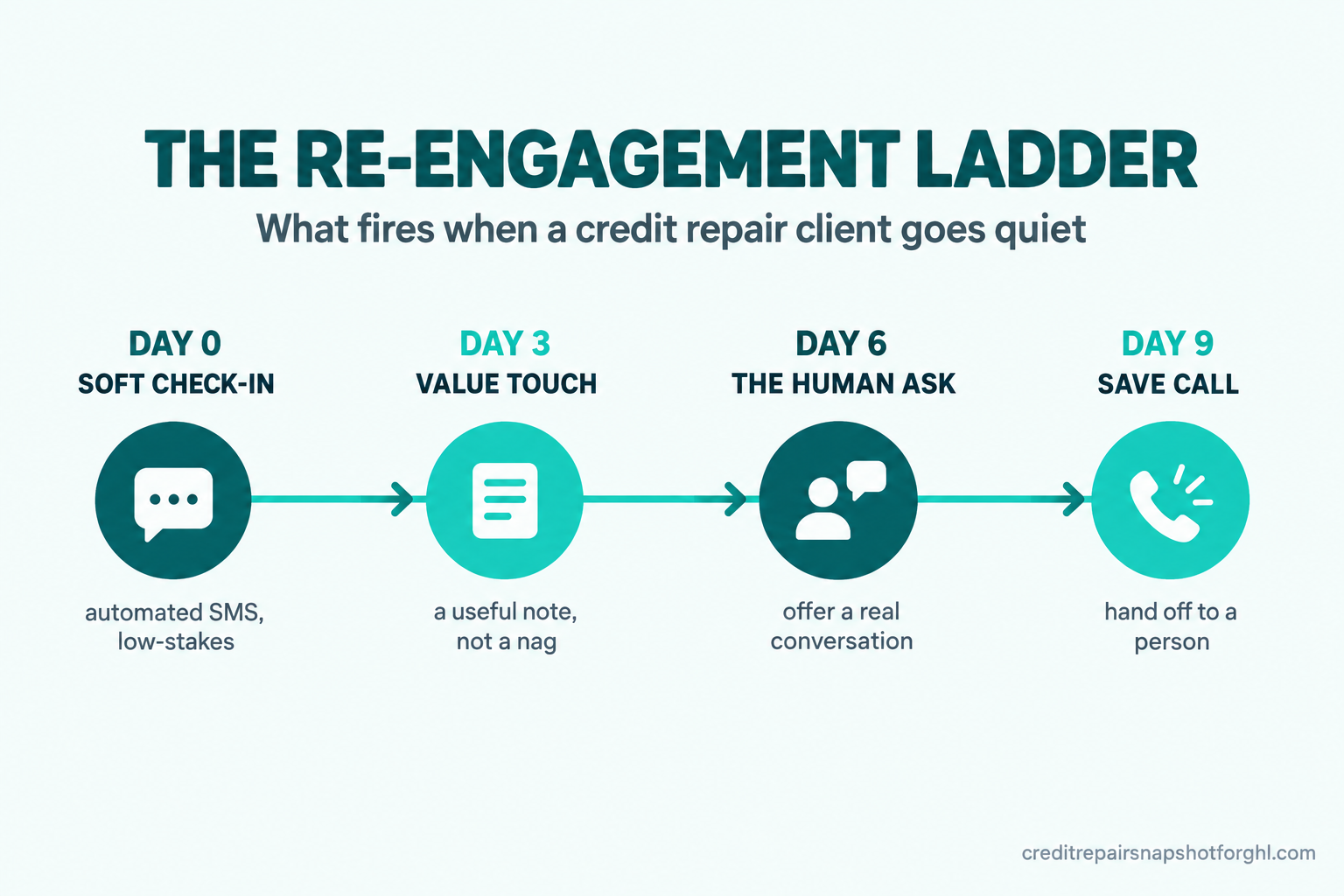
- Rung 1, day 0 (soft check-in, SMS). Low-stakes, easy to answer.
- Rung 2, day 3 (value touch). Something useful, not a nag: a plain note on where the case sits.
- Rung 3, day 6 (the human ask, SMS). Offer a real conversation; automate only the reminder, not the words.
- Rung 4, day 9 (the save handoff). Route the contact to a person for a call. No more texts until a human has tried.
Steal this (the three message rungs).
Rung 1: Hey {{first_name}}, haven’t heard from you in a bit and want to make sure you’re good. Anything you need from me on your case? Reply anytime.
Rung 2: {{first_name}}, no action needed, just a heads-up: the bureaus are still inside their response window on your round. That quiet stretch is normal and does not mean nothing is happening. I’m on it.
Rung 3: {{first_name}}, I’d rather not leave you guessing. Can I grab five minutes to walk you through exactly where your case stands? Here’s my calendar: {{booking_link}}. If texting is easier, reply here.
How it breaks. The ladder fails when it is all automation and no human, or all human and no automation. Pure automation means a wobbling client gets four robotic texts and churns anyway; pure human means you mean to call and never do. The reminder is automated, the save is personal. Keep every message consent-based with a working opt-out, because these count as the messaging TCPA governs. The adjacent play, re-warming clients who already left, is its own system in win back cancelled credit repair clients.
Stage 5: The human save conversation
The setup. By rung four, software has done its job: it found the silence and handed you a named client at a known risk level, with a reason. Now a person calls, and the goal is not to pitch. It is to find the unanswered question. Most quiet clients are not angry. They are confused, embarrassed about money, or they quietly decided this was not working and never said so. You are there to surface that and address it honestly.
Steal this (call opener).
“Hi {{first_name}}, it’s {{your_name}} from {{firm}}. No alarm, I just noticed we hadn’t connected in a few weeks and I don’t like leaving clients in the dark. Where’s your head at on the whole thing right now?”
Then listen. If the issue is “I don’t see anything happening,” walk them through the timeline and the current round, factually. If it is money, talk about the plan honestly and never dangle a result to keep them. If they are done, let them go cleanly and do not threaten their report or data. A respectful exit is a future referral.
How it breaks. The call breaks the moment it becomes a pitch built on a promise. Save a client by implying a deletion or a score jump and you have traded a compliance problem for a cash-flow one, and CROA does not care that you meant well. Save them with clarity and service, or let them leave. There is no compliant version of “stay and I guarantee results.”
Stage 6: The billing firewall
The setup. The last line of defense is the payment itself. A quiet client whose card fails will cancel silently unless you have a buffer, so build one: a pre-charge reminder a few days before the monthly bill, an automatic retry schedule when a charge fails, and a short dunning sequence that reaches the client on a second channel before the subscription lapses. The firewall turns a silent auto-cancel into a warned, recoverable event.
The trigger. A failed-payment event kicks off a sequence: an immediate card-update link by SMS and email, a retry in two to three days, a second reminder, then a human task before you let it lapse. Keep the tone administrative and calm, not threatening. This is also where you confirm you are only billing for work already performed, which keeps the whole thing inside CROA’s advance-fee rule. The full version, including how to keep failed payments from turning into chargebacks, is in recurring billing without chargebacks.
How it breaks. The firewall fails when the only channel is the card on file and the only actor is the processor. If a decline just retries three times and quits, you learn about the lost client after they are gone. Put a human task at the end. A two-minute call after a failed payment saves accounts no automated retry ever will.
Solo operator vs small team vs bigger shop
The system is the same. The staffing and the thresholds change.
Solo operator (you are everyone). You cannot watch for silence by hand, so lean hardest on Stage 2 detection and Stage 3 cadence. Automate everything up to rung three and make rung four, the human call, the only manual step. Keep the at-risk threshold a little looser, maybe 14 days, so you are not generating save calls faster than one person can make them. Your edge is that the call comes from the owner, which lands harder than any team can fake.
Small team (two to five, a VA or a client-success person). Tighten the threshold to 10 days and route save calls to a named person, not a general queue. Assign the at-risk tag to a human owner so nothing sits unclaimed, and clear a simple at-risk dashboard daily. This is the size where silence detection pays for itself fastest, because someone finally owns the list.
Bigger shop (dozens of clients per person). At volume you cannot read every quiet client individually, so you score them: a missed payment plus no login is a hotter save-call lead than a slow reply. Route only the highest-risk contacts to a live call and let the ladder handle the rest. The risk here is that the system gets so automated the human save disappears. Protect the call. It saves the hardest accounts and it is the first thing a busy team cuts. This is the exact bottleneck in why you can’t scale past 50 credit repair clients.
Keeping it compliant: CROA and TCPA
Retention work is where good operators drift into bad claims, because saving a client is emotional and a promise is an easy lever to reach for. Do not reach for it.
The Credit Repair Organizations Act bans two things that matter here. First, you cannot charge for a service before it is fully performed, which is why your billing is monthly for work already done and why a saved client is not a prepaid one. Second, you cannot make untrue or misleading claims about your services, which is where a guaranteed result or a promise to remove accurate information lands. That rule does not switch off during a save call, so every message in this system reports process, never promises outcomes.
Then there is the texting layer. The ladder and the cadence are automated messaging, so they live under the Telephone Consumer Protection Act. Get consent at enrollment, honor STOP instantly, and keep the messaging program itself clean, which for credit repair means getting through carrier registration, a hurdle we cover in why credit repair texts get rejected at A2P 10DLC. The honest version of this system is simple: be relentlessly present and relentlessly truthful. Presence is what quiet clients are missing; truth is what keeps you licensed.
Common objections
“Won’t clients find all these automated check-ins annoying?” They find silence more annoying. The messages here are low-frequency and useful, a scheduled progress note and a gentle check-in, not a daily blast. Annoyance comes from volume and empty hype, not from a firm that keeps you informed during a slow process. Keep the cadence honest and spaced, honor every opt-out, and the reply rate tells you it is working.
“What if there’s genuinely no update to share between rounds?” That is exactly when the message matters most. “Nothing has come back yet, you are inside the 30-day window, I am tracking it” is an update. It tells the client the case is alive and in competent hands. The absence of a result is not the absence of news.
“I already send milestone texts. Isn’t that enough?” Milestone texts fire when something good happens. But in credit repair, weeks pass with no milestone, and those are exactly the weeks clients quit. Milestone messaging and silence detection solve different halves of the same problem: one celebrates progress, the other holds the line when there is none to celebrate yet.
“Do I need to be technical to build this?” No. Inactivity tags, scheduled sequences, and failed-payment flows are standard workflow and two-way SMS features in GoHighLevel and most modern CRMs. You are configuring triggers, not writing code. If building it from scratch is not how you want to spend your month, that is what a prebuilt system is for.
Frequently asked questions
When do credit repair clients most often cancel?
The highest-risk stretch is roughly month two to three. The opening excitement has worn off, the first dispute round is still inside the bureaus' 30-day reinvestigation window, so there is little visible result yet, and the client has now paid for a stretch without seeing movement. Cancellations in that window usually begin as silence, not a complaint.
How do I know a client is about to cancel if they haven't said anything?
Track measurable silence signals: no reply to your recent messages, no client-portal login in 10 to 14 days, or a missed check-in. When a client crosses a threshold you set, tag them 'at risk' automatically and start a re-engagement sequence. You are converting an invisible drift into a dated event a workflow can act on.
Is it compliant to automate retention messages for credit repair clients?
Yes, with guardrails. The Credit Repair Organizations Act bans charging before work is done and bans untrue or misleading claims about your services, but it does not ban helpful, factual messages. Automated texts also fall under the TCPA, so you need consent at enrollment and an instant STOP opt-out. Keep every message focused on process and status, never on promised outcomes.
How many times should I message a quiet client before I stop?
Use a short ladder of about four touches over roughly nine days: a soft check-in, a value touch, a human ask, then a handoff to a real call. If the client replies or logs in at any point, the sequence should stop. The goal is a few well-spaced, useful touches ending in a human conversation, not an endless drip.
What should I actually say on a save call?
Open without alarm and ask an open question about where their head is at. Your job is to find the unanswered question, not to pitch. If the issue is 'I don't see progress,' walk them through the timeline and current round factually. If it is money, be honest about the plan. Never offer to keep them by implying a deletion or score result, which would cross CROA's line on guarantees.
Does a failed payment mean the client decided to cancel?
Often not. Many 'cancellations' are just a card that expired or a declined charge on a client who went quiet, not a deliberate decision to leave. That is why a billing firewall matters: a pre-charge reminder, an automatic retry, a dunning sequence on a second channel, and a human task before the subscription lapses recover accounts that would otherwise cancel silently.
The client you didn’t lose
Run the client from the top through the system instead. On day one she was told the first stretch would be quiet and when she would next hear from you. On day fifteen a scheduled message reminded her the case was alive inside the 30-day window. When she stopped logging in, the at-risk tag fired and a soft check-in reached her before she ever thought about the card. When she still did not answer, you got a task to call, and in two minutes you found the real issue: she thought nothing was happening and was too deflated to ask.
You did not save her with a promise. You saved her with presence, and presence here is a system, not a personality trait. Build the silence detection, run the between-rounds cadence, keep a human at the end of the ladder, and put a firewall on the billing. The quiet window stops being where clients disappear and starts being where you prove you are different from every firm that left them in the dark.
If you would rather deploy that system than build it trigger by trigger, the tagging, cadences, ladder, and billing recovery are already wired for credit repair in the Credit Repair Snapshot. Either way, start watching the quiet. It is where the business is won or lost.