For a credit-repair firm, the choice between building your own GoHighLevel setup and buying a done-for-you snapshot is not really a choice between “$997” and “free.” It is a choice between two very different total costs of ownership. The build-it-yourself path looks cheaper because the snapshot has a price tag and your own time doesn’t — but once you add the recurring platform fee, the weeks of configuration, the labor to wire dispute rounds and billing, and the cost of getting one CROA rule wrong, the math usually flips. This comparison lays both paths side by side so you can decide with numbers instead of vibes.
We sell the operating system, never the outcome. Nothing here promises a score change or a deleted item — the comparison is strictly about how you assemble the operational machinery that runs around your disputes: onboarding, progress updates, billing, and retention.
Table of contents
- The real question: total cost of ownership, not sticker price
- Option A — Build it yourself in GoHighLevel
- Option B — Deploy a done-for-you credit-repair snapshot
- Build vs. buy, side by side
- The hidden cost most owners miss: CROA compliance
- Why the setup decision matters right now
- When building it yourself is the right call
- A simple build-vs-buy decision framework
- Frequently asked questions
- About the author
- Sources
The real question: total cost of ownership, not sticker price
Most “build vs. buy” arguments die on the first number: the snapshot costs money, doing it yourself feels free. That framing is wrong because both paths run on the same platform. Whether you build every workflow by hand or install a prebuilt snapshot, you are paying GoHighLevel’s subscription either way — so the platform fee is not a point of difference. It cancels out.
What actually differs between the two paths is everything around the subscription: how many weeks until you can enroll a paying client, how many hours of skilled labor it takes to wire dispute-round tracking and recurring billing, how much rework you eat when a workflow misfires, and who is on the hook when a CROA rule is broken. Those are the numbers that decide the real cost — and none of them show up on a pricing page.
Think of it the way you’d think about a storefront. The rent (the GHL subscription) is fixed no matter what. The question is whether you frame, wire, and stock the space yourself over two months, or move into a space that’s already built out and start serving customers this week. The rent is identical. The time-to-revenue is not.
Option A — Build it yourself in GoHighLevel
Building your own credit-repair operation inside GoHighLevel is entirely doable — the platform is powerful and flexible, which is exactly why so many firms choose it. But “doable” and “cheap” are not the same word. Here’s what the build path actually involves.
You still pay the subscription — every month. GoHighLevel publishes three retail tiers, and the build-it-yourself path starts at the same recurring platform fee as any other:
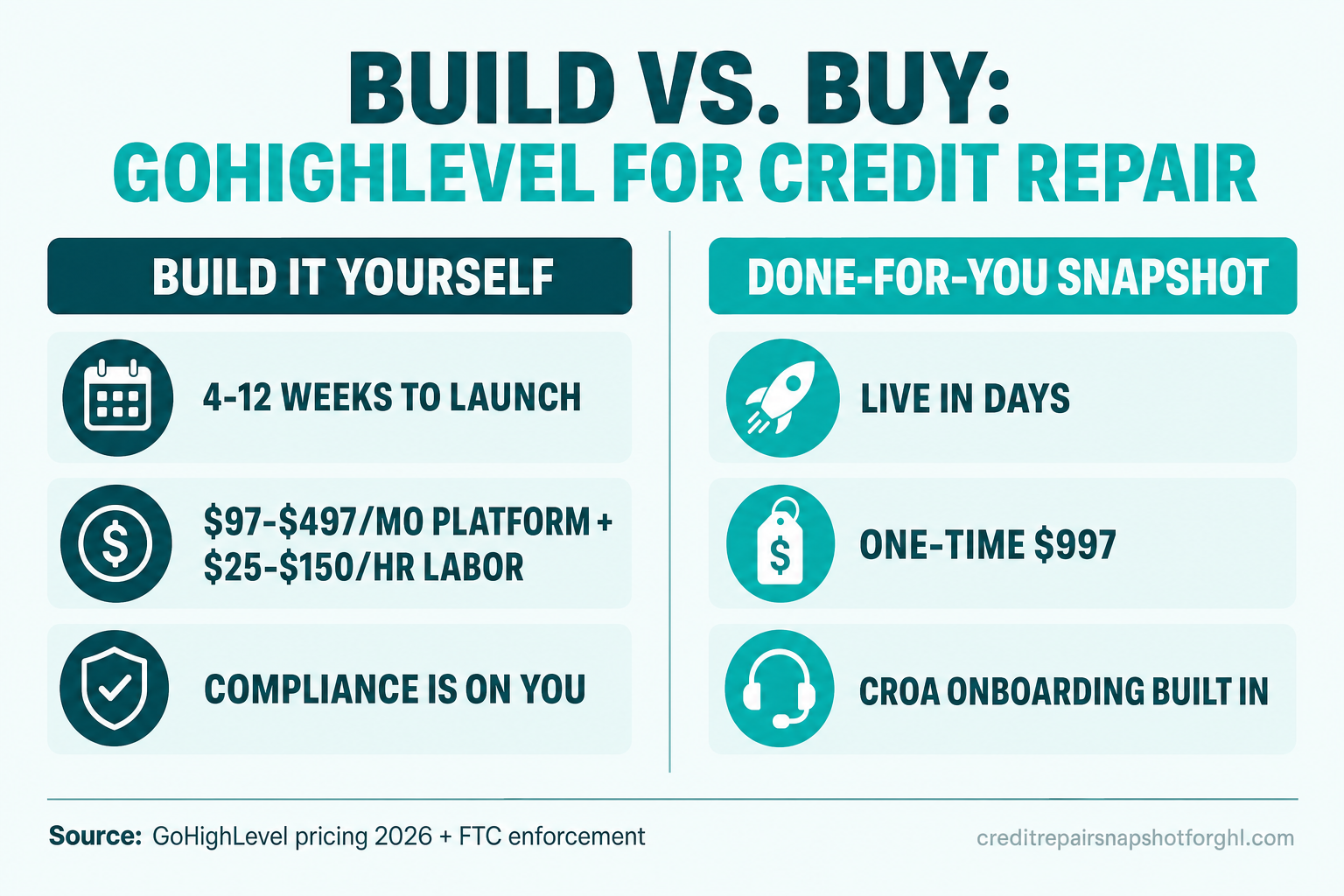
The labor is the real spend. A functioning credit-repair setup is not one workflow — it’s onboarding with a signed, CROA-compliant agreement and the required disclosures; a dispute-round pipeline that tracks each client to the day; report-change monitoring; recurring billing with dunning; and review and referral flows. If you build it yourself, you either learn all of that or you hire it out. On marketplaces like Upwork, GoHighLevel specialists commonly range from roughly $25 to $150 an hour depending on experience, and a full custom snapshot build is a multi-thousand-dollar, multi-week project rather than an afternoon.
Time-to-launch is measured in weeks. There’s no authoritative stopwatch on “build a credit-repair CRM,” but the closest proxy is broad: small businesses typically spend on the order of 4 to 12 weeks standing up a CRM/marketing-automation system, and larger or messier builds stretch to three to six months. During those weeks, you’re configuring instead of enrolling.
The DIY builders I talk to rarely regret the subscription. They regret the six weekends. The platform fee was always going to be there — the weekends were the part they could have bought back.
The abandonment risk is real. Building software you’ll actually adopt is harder than it looks: analysts have long estimated that somewhere between 30% and 70% of CRM implementations fail to meet their objectives, usually because the system is over-built, under-adopted, or never finished (analyst summary). A half-built GHL account that never quite launches is the most expensive outcome of all, because you paid the subscription the whole time.
Option B — Deploy a done-for-you credit-repair snapshot
A done-for-you snapshot is the same GoHighLevel account, arriving pre-built. Instead of a blank workspace, you import a package where the pipeline, the onboarding agreements and disclosures, the dispute-round workflows, the billing sequences, and the review and referral flows already exist and are wired together. Your job shifts from building the machine to running your business inside it.
The Credit Repair Snapshot for GHL is one such package, priced as a single one-time $997 purchase (currently reduced from $1,997). The relevant comparison isn’t “$997 vs. free” — it’s “$997 once vs. 4–12 weeks of your time plus contractor labor plus abandonment risk.” For most owners, the snapshot is cheaper than the labor it replaces, and it’s dramatically cheaper than the weeks of forgone client enrollment.
Three things change on the buy path:
- Launch collapses from weeks to days. Because the workflows are already built, the work becomes customization — your branding, your pricing, your calendar — not construction. You can be enrolling clients this week instead of next quarter.
- Compliance is designed in, not bolted on. The onboarding sequence is built around CROA guardrails from the start: written agreements, the Consumer Credit File Rights disclosure, and the three-day cancellation right are part of the flow rather than something you remember to add later. (You remain the credit-repair organization responsible for compliance — the snapshot just makes the compliant path the default one.)
- The stack consolidates. Small firms routinely juggle a spreadsheet, a separate billing tool, an email platform, and a disconnected phone system — the average small business runs on the order of 42 SaaS apps (BetterCloud). A snapshot pulls onboarding, disputes, billing, and reviews into one place, which is its own quiet cost saving. (For the deeper version of that argument, see our breakdown of what disconnected software costs a firm.)
Build vs. buy, side by side
Here is the honest, line-by-line comparison. Neither column is “wrong” — they suit different firms — but the trade-offs are concrete.
Building your own GHL setup vs. deploying a done-for-you snapshot
| Plan | Build it yourself | Done-for-you snapshot recommended |
|---|---|---|
| Price | Weeks + labor | $997 once |
| Feature 1 | GHL subscription: $97–$497/mo (same either way) | GHL subscription: $97–$497/mo (same either way) |
| Feature 2 | Labor: your hours, or $25–$150/hr for a GHL specialist | Labor: prebuilt — customization, not construction |
| Feature 3 | Time to launch: ~4–12 weeks of configuration | Time to launch: days, not weeks |
| Feature 4 | Compliance: you design CROA onboarding from scratch | Compliance: CROA-aware onboarding built in by default |
| Feature 5 | Risk: 30–70% of CRM builds under-deliver or stall | Risk: proven, deployed workflows — nothing to finish |
| Feature 6 | Best when: you have GHL expertise and a unique process | Best when: you want to enroll clients now, not build tooling |
| Get build help | See the snapshot |
The hidden cost most owners miss: CROA compliance
Every build-vs-buy spreadsheet I’ve seen leaves out the most expensive line item: the cost of getting compliance wrong. In credit repair, that cost is not theoretical. The Credit Repair Organizations Act draws bright lines — most famously, you cannot charge for services before they’re fully performed — and the FTC enforces them.
This is where the build path carries an invisible tax. When you wire your own onboarding at 11 p.m. after a full day of client work, the compliance details — collecting the signed agreement before billing, presenting the disclosure, honoring the cancellation window — are exactly what slips. A snapshot built around those guardrails doesn’t make you compliant on its own (you’re still the credit-repair organization, and you still own the obligation), but it makes the compliant sequence the default one, so the fastest path is also the safe one. For the full onboarding checklist, see our CROA-compliant client onboarding guide.
Why the setup decision matters right now
The build-vs-buy question isn’t academic, because the demand for credit-repair services is large, measurable, and growing. Whichever path gets you live faster captures more of it.
Nearly three in ten American consumers carry a subprime score, the average FICO slipped to 713 in 2025 as credit conditions tightened, and the U.S. credit-repair market reached $6.8 billion, up 6.3% year over year (Experian; IBISWorld). At the same time, there are 41,053 credit-repair businesses competing for that demand (IBISWorld) — which is precisely why time-to-launch matters. Every week your workflows sit half-built is a week your competitors are enrolling the clients searching right now.
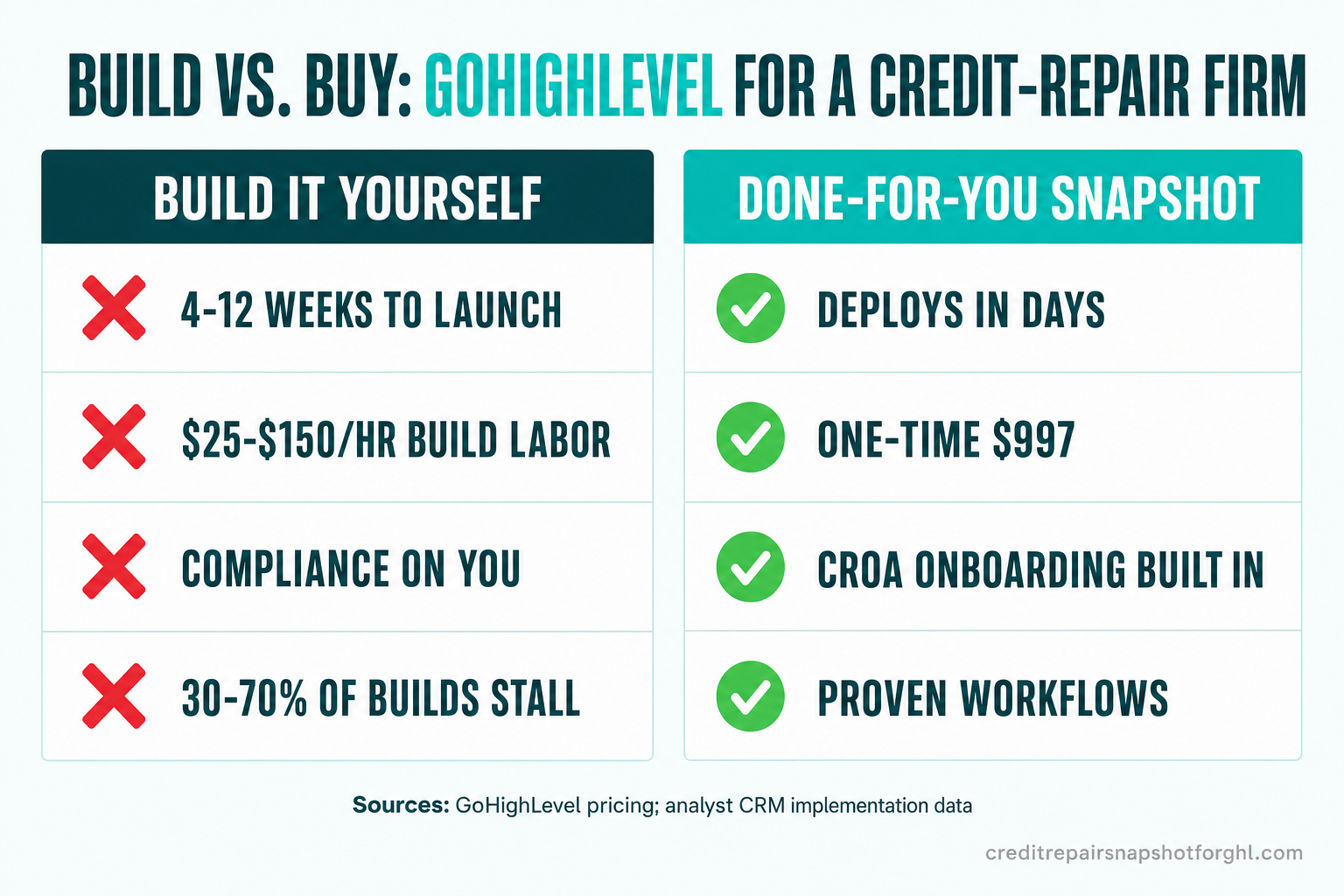
The launch-speed gap is the whole argument in one picture:
When building it yourself is the right call
This comparison isn’t a disguised sales page — sometimes DIY genuinely wins, and it’s worth being straight about when. Build it yourself when:
- You already have deep GoHighLevel expertise on your team, so the labor is truly “free” and fast rather than a learning tax paid in weekends.
- Your process is genuinely unusual — a niche dispute methodology, an unconventional pricing model, or an integration a prebuilt snapshot wouldn’t anticipate.
- You’re pre-revenue and time-rich — no clients waiting, and you’d rather spend the runway learning the platform than spending cash.
Even then, many firms land in a hybrid: start from a done-for-you snapshot to get live compliantly, then commission custom GoHighLevel development for the parts that are truly unique to you. That’s usually the lowest-total-cost path — you buy the 80% that every credit-repair firm needs and build only the 20% that’s actually yours.
A simple build-vs-buy decision framework
Strip away the noise and the decision comes down to three questions:
- How fast do you need to enroll clients? If the answer is “this month,” buy. If it’s “eventually,” building is defensible.
- What’s your hour actually worth? If your time is better spent on clients, sales, or strategy than on workflow configuration, the snapshot is buying that time back. Owners already lose roughly 11 hours a week to admin — DIY setup adds to that pile.
- Who can afford to own the compliance risk? If a CROA misstep would be catastrophic for your firm, starting from a compliance-aware foundation is cheap insurance.
If you land on “buy,” the fastest route is to start with the snapshot and, if you don’t want to run the platform day to day, hire a GoHighLevel VA to operate it for you. If you land on “build,” at least don’t build the compliance layer from a blank page.
Frequently asked questions
Is it cheaper to build my own GoHighLevel setup than to buy a snapshot?
Only if your time is worth nothing. Both paths pay the same GoHighLevel subscription ($97–$497/month), so that cancels out. The build path then adds 4–12 weeks of configuration plus either your hours or $25–$150/hour for a specialist, while a done-for-you snapshot is a one-time cost that deploys in days. For most firms with clients to serve, the snapshot is cheaper once you price in the labor and the forgone enrollment.
Do I still pay GoHighLevel if I buy a done-for-you snapshot?
Yes. A snapshot is a prebuilt package that installs onto your own GoHighLevel account — it isn't a replacement for the platform. You pay GoHighLevel's monthly plan either way; the snapshot just saves you the weeks of building the workflows yourself.
How long does a custom GoHighLevel build actually take?
There's no official figure specific to credit repair, but small businesses typically spend on the order of 4–12 weeks standing up a CRM and marketing-automation system, with more complex builds running three to six months. A prebuilt snapshot compresses that to days because the workflows already exist and the work becomes customization.
Does a snapshot make my firm CROA-compliant automatically?
No — and any vendor who claims otherwise is a red flag. You remain the credit-repair organization responsible for CROA compliance, including written agreements, the required disclosures, the three-day cancellation right, and the ban on charging before services are performed. A well-built snapshot makes the compliant sequence the default path, but the legal obligation stays with you.
Can I start with a snapshot and customize it later?
Yes, and that's often the lowest-total-cost route. You deploy the snapshot to get live compliantly, then commission custom GoHighLevel development only for the parts that are genuinely unique to your firm. You buy the 80% every credit-repair operation needs and build the 20% that's actually yours.
About the author
Marcus Pennington is a retention and recurring-revenue consultant based in Dallas, TX, who advises credit-repair business owners and the GoHighLevel agencies that serve them on the unglamorous side of growth: getting live fast and keeping clients enrolled past month three. A former SaaS churn analyst, he is allergic to hype and partial to a total-cost-of-ownership spreadsheet. He writes about recurring billing, win-back sequences, and the operational decisions — like build vs. buy — that quietly decide whether a firm scales or stalls.
Related posts
- How to Migrate Your Credit-Repair Business to GoHighLevel: A Zero-Downtime Playbook
- Why Disconnected Software Quietly Costs a Credit-Repair Firm Hours a Week
- The CROA-Compliant Client Onboarding Checklist
- 7 Retention Automations That Keep Credit-Repair Clients Paying
- Recurring Billing Without Chargebacks for Credit-Repair Firms
Sources
- GoHighLevel — Pricing (Starter $97 / Unlimited $297 / Agency SaaS Pro $497 per month, 2026)
- Experian — 2025 Consumer Credit Review (average FICO 713; subprime share)
- Experian — How to know if you’re a subprime borrower (29.6% subprime, 2025)
- IBISWorld — Credit Repair Services market size ($6.8B, +6.3% in 2025)
- IBISWorld — Credit Repair Services number of businesses (41,053 in 2025)
- CFPB — Borrower Risk Profiles (credit-tier definitions)
- FTC — $10.9M returned to 443,048 consumers, credit-repair upfront-fee scheme (2026)
- FTC — $3.5M returned to 9,224 consumers, “The Credit Game” (2025)
- BetterCloud — SaaS statistics (SMB app counts)
- Johnny Grow — CRM failure-rate analysis (30–70% analyst range)
- SME Business Barometer via Asian Trader — Small-business owners’ admin burden (~11 hrs/week)
- Upwork — GoHighLevel experts marketplace (live specialist rates)