If you run a credit repair firm in San Jose, GoHighLevel probably felt like a superpower the day you launched it. Onboarding agreements, progress texts, recurring billing, and review requests all fired on their own, and your team stopped drowning in manual follow-up. Then you grew — more clients, more staff, more tools — and somewhere around a few hundred active files, the platform that used to save you time started quietly costing it back.
Here’s the short answer: GoHighLevel isn’t “not enough” for most credit repair firms — it’s the right operating system. The ceiling you hit isn’t the platform, it’s the gap between GHL and everything around it: your dispute software, your credit-monitoring feed, your document vault, your client’s need for a real login. Custom software doesn’t replace GoHighLevel. It extends it — closing those gaps so your firm scales without adding headcount. This article shows you where that ceiling is, what it costs, and what a custom build actually adds.
Table of contents
- When is GoHighLevel not enough? The short answer
- Why San Jose firms scale into a software ceiling
- 5 signs you’ve outgrown your GoHighLevel setup
- The hidden cost of disconnected tools
- What custom software adds on top of GoHighLevel
- Extend GHL or commission custom software? A build-vs-buy guide
- The compliance line custom software must respect
- Frequently asked questions
- About the author
- Related reading
When is GoHighLevel not enough? The short answer
GoHighLevel stops being enough the moment your firm needs behavior the platform was never designed to deliver: a branded, login-protected client experience with self-serve dispute-round progress; two-way data sync with a credit-monitoring or bureau-import tool; granular role permissions for a growing team; or automation that reasons across your data instead of following a fixed if-this-then-that path.
None of that means leaving GoHighLevel. It means building on top of it. GHL keeps running the pipeline, the workflows, the billing, and the messaging — the operating system you already trust. Custom software fills the gaps at the edges, usually through the GHL API, webhooks, and a small application layer that connects the tools GHL can’t natively reach.
The reason this matters now is scale. A solo operator with 40 clients can paper over every gap with copy-paste and a spreadsheet. A firm with three staff and 400 active files cannot — the manual seams that were invisible at 40 become the thing that caps your growth at 400.
Why San Jose firms scale into a software ceiling
San Jose is a distinctive market for credit repair operations, and it changes the build-vs-stall calculation in three ways.
Labor is the most expensive input you have. Software developers in the San Jose–Sunnyvale–Santa Clara metro earn roughly $221,700 a year, about $106.59 an hour (U.S. Bureau of Labor Statistics, May 2025). Even your non-technical admin staff cost more here than almost anywhere in the country. That means every hour a team member spends re-keying a client’s data from your dispute tool into GoHighLevel is worth more in San Jose than in most metros — so the ROI on automating that hour away is higher, too.
The customer base is deep. California is home to about 4.2 million small businesses — 99.9% of all businesses in the state, employing roughly 7 million people (U.S. SBA Office of Advocacy, 2024). Business-credit and personal-credit clients are everywhere, and Bay Area credit scores run slightly above the U.S. average — California’s mean is about 722 versus a national ~715 (Experian) — which means a large share of local prospects are mortgage-prep and funding-readiness clients, not just distressed files. Those clients expect a polished, self-serve experience.
The whole market runs on a scarce, expensive workforce. In a metro where a competitor might be paying six figures for ops talent, the firm that automates its back office wins on margin. Custom software is how you get enterprise-grade capability without an enterprise-grade payroll.
The firms that stall aren’t the ones with the worst GoHighLevel setup. They’re the ones whose best setup finally ran out of room — and who kept hiring people to do what software should.
5 signs you’ve outgrown your GoHighLevel setup
You don’t need a diagnostic tool to know you’ve hit the ceiling. You need to recognize these five patterns.
1. Your team is a human integration layer
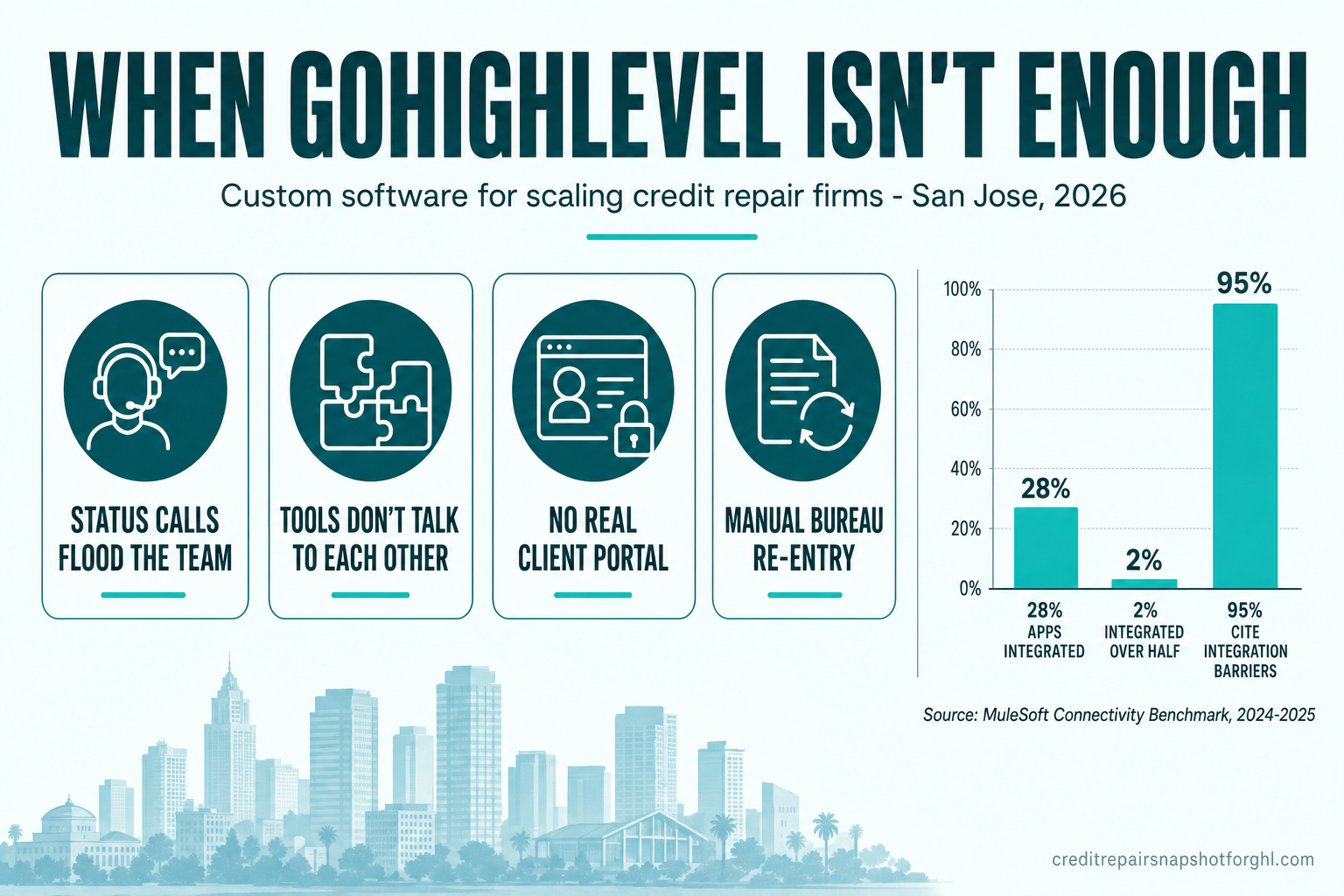
If a staff member’s daily job includes exporting a report from your dispute software and re-typing it into GoHighLevel — or copying a client’s monitoring update from one screen to another — you have people doing what an API should. This is the single most common ceiling, and it scales linearly with your client count: double the files, double the re-entry.
2. Clients keep asking “any update?”
GoHighLevel can text a progress update, but it can’t give a client a real, branded portal to log into and self-serve their dispute-round status, documents, and score milestones on demand. When your team fields the same status question all day, the fix isn’t another automated text — it’s a client portal that most GHL setups can’t fully deliver on their own.
3. Your tools don’t talk to each other
Credit Repair Cloud (or Dispute Fox), a monitoring feed, QuickBooks, a spreadsheet, and GoHighLevel — five systems, five sources of truth, zero automatic sync. This is the exact problem disconnected software creates: the same client data, entered five times, wrong in at least two of them.
4. You can’t give staff the right level of access
As you add specialists, you need role-based permissions — a dispute processor who sees files but not billing, a closer who sees the pipeline but not documents. GoHighLevel’s native permissions are coarse; firms that need true granular access control usually need a custom application layer on top.
5. Your automations have outgrown “if this, then that”
Fixed workflows are perfect for onboarding and reminders. But when you want automation that reasons — reading an uploaded report, summarizing what changed, flagging the next action, drafting a client update for human approval — you’ve reached the edge of what rule-based workflows do and the start of what agentic AI does.
The hidden cost of disconnected tools
The reason this ceiling is so expensive is that the cost is invisible. It doesn’t show up as a line item; it shows up as a slower team, a bigger payroll, and errors you find out about from an angry client.
The research on “swivel-chair” work is blunt. A Pega study of roughly five million hours of desktop activity found employees toggle between apps more than 1,100 times a day and lose up to about 30% of their time to searching for information and re-entering data across systems (Pega, 2019). And the errors that manual re-entry introduces aren’t free: Gartner estimates poor data quality costs organizations an average of $12.9 million a year (Gartner) — a figure that scales down to real money even for a small firm, in the form of the wrong client texted the wrong update.
The integration gap is the root cause, and it is worse than most owners assume. In the average organization, only 28% of applications are integrated, and 95% of IT leaders report integration challenges as a barrier to adopting new technology like AI (MuleSoft Connectivity Benchmark, 2024). By MuleSoft’s 2025 update, only 2% of organizations had integrated more than half of their applications (MuleSoft, 2025). The tools exist; connecting them is the hard part — and the part most firms skip until it hurts.
Source: MuleSoft Connectivity Benchmark 2024 and 2025. Figures reflect all organizations surveyed, not credit repair firms specifically — but the integration gap applies to any multi-tool stack.
None of this is an argument against software. It’s an argument for connected software. Automation is now table stakes: 66% of small and mid-sized businesses say automation is essential to running the business, and 88% say it lets them compete with larger companies (Zapier, 2021). The firms pulling ahead aren’t the ones with more tools — they’re the ones whose tools are wired together.
What custom software adds on top of GoHighLevel
Custom development for a credit repair firm is rarely a rip-and-replace. It’s a set of targeted builds that sit on top of GoHighLevel and close the specific gaps above. Here’s what that actually looks like.
- A real client portal. A branded, login-protected hub where clients self-serve their dispute-round progress, upload documents, and see score milestones — synced from GoHighLevel and your dispute tool, so your team stops fielding “any update?” calls. This is the highest-ROI build for most firms and the clearest thing GHL can’t fully do alone.
- Bureau and monitoring integrations. Two-way connectors between GoHighLevel and your credit-monitoring feed, dispute software, or an import pipeline — so a report change updates the client record, triggers the right workflow, and never gets re-typed by a human.
- Granular role permissions. An access layer that lets you scale the team safely: processors, closers, and admins each see exactly what their job requires and nothing more.
- Agentic AI that reasons over your data. Beyond fixed workflows: an AI layer that reads an uploaded report, summarizes what changed, drafts a compliant client update for human approval, and flags the next action — the kind of custom AI system that turns a rules engine into an assistant.
- Document and e-sign at volume. Onboarding agreements, CROA disclosures, and file management wired so nothing is manual and nothing is missing from the audit trail.
Share of consumers who found at least one credit-report error. Sources: FTC (2013, random sample of 1,001 consumers); Consumer Reports (2021); Consumer Reports / WorkMoney (2024). The 2021 and 2024 studies used self-selected volunteers, so their rates run higher than the FTC’s random sample.
Why build on top instead of switching platforms? Because the demand isn’t going anywhere. The FTC’s landmark accuracy study found 1 in 5 consumers had an error on at least one credit report, and 5% had errors serious enough to raise their borrowing costs (FTC, 2013). More recent volunteer studies from Consumer Reports found error rates of 34% in 2021 and 44% in 2024 (Consumer Reports). Combined with the CFPB’s 2.7 million reporting complaints, the pipeline is structural — the firms that win it are the ones whose operations can absorb the volume without breaking.
Extend GHL or commission custom software? A build-vs-buy guide
Not every ceiling needs a custom build. The right move depends on where you are. Here’s the honest decision framework, with real numbers.
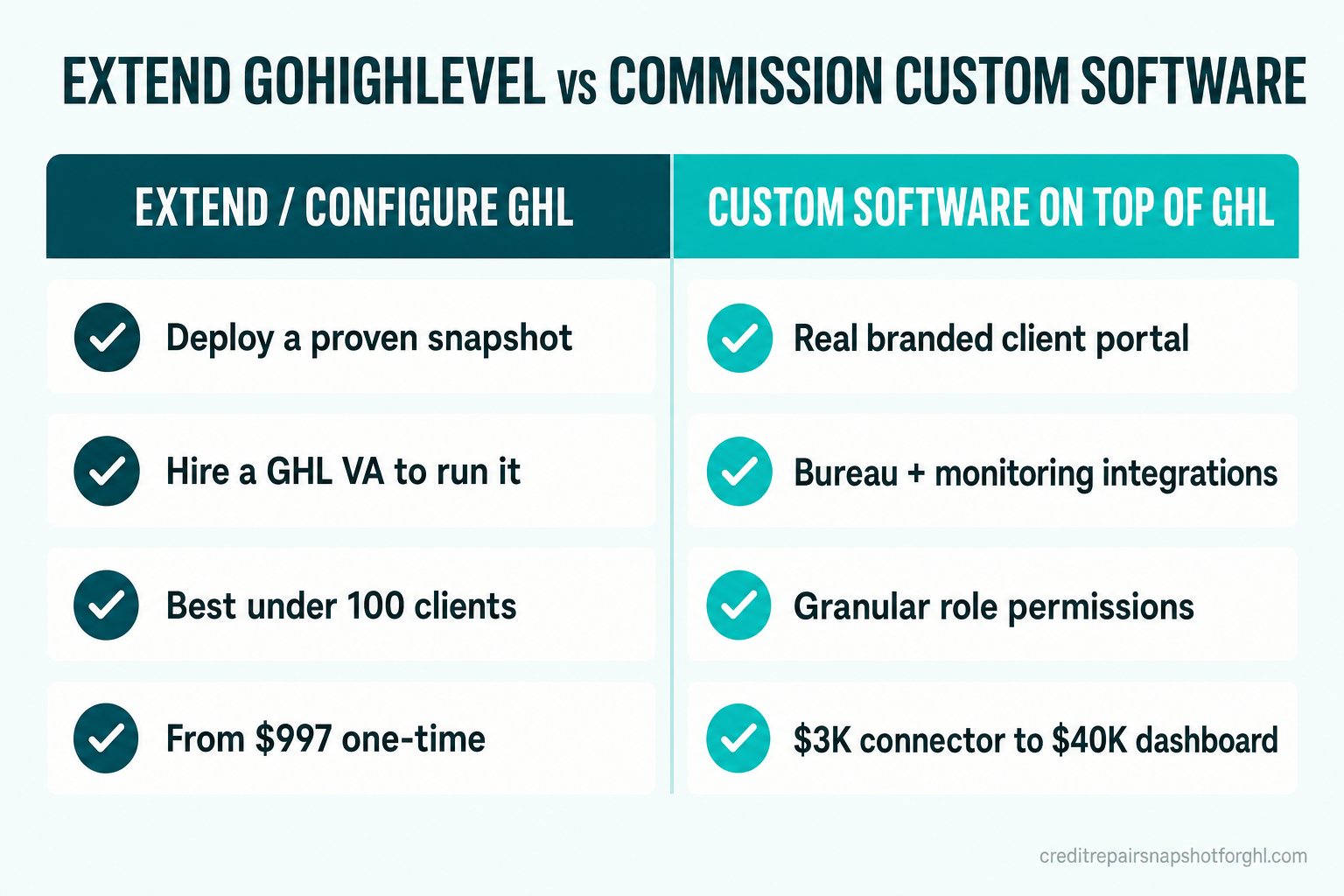
| Your situation | The right move | Typical cost |
|---|---|---|
| Launching or under ~100 clients; gaps are annoying, not structural | Deploy a proven credit repair snapshot and configure GHL well | $997 one-time snapshot; GoHighLevel from $97–$497/mo |
| GHL is set up but nobody has time to run it | Hire a trained GHL VA to operate it | from $747/mo |
| One or two specific tools won’t sync | A custom connector / integration | fixed quotes from ~$3,000 |
| You need a client portal or a platform migration | A custom GHL development project | $5,000–$15,000 |
| You need a full client-management dashboard | A custom software build | $15,000–$40,000 |
| You want ongoing builds and a dedicated engineer | A full-stack GHL developer engagement | $2,000–$5,000/mo |
The test is simple: if the gap costs you a hire, a build usually costs less than the hire. A single admin role in San Jose can run well past what a one-time connector costs — and the connector doesn’t take PTO or make typos. If the gap is just “our GHL could be better,” you don’t need custom software yet; you need a better configuration or someone to run it.
The compliance line custom software must respect
This is non-negotiable, and it’s where a credit-repair-native developer matters more than a generalist. Custom software extends your operations — it never touches the parts of the business that CROA governs.
That means a portal, an integration, or an AI layer can show a client their dispute-round status, sync their data, and draft an update for a human to approve. It must never promise a deletion, estimate a score increase, quote a guaranteed timeline, or give credit or legal advice. Your firm remains the credit repair organization responsible for full CROA compliance — the written contract, the Consumer Credit File Rights disclosure, the three-day cancellation right, and the prohibition on charging for services before they’re performed. Software is the operating system around that work; it is never a substitute for the firm’s judgment or its legal obligations.
A well-built system actually strengthens compliance: every action is logged, every disclosure is timestamped, and the audit trail builds itself. That’s the difference between software that scales you and software that exposes you.
Frequently asked questions
Does custom software mean leaving GoHighLevel?
No — and it usually shouldn't. For most credit repair firms, GoHighLevel is the right operating system for the pipeline, workflows, billing, and messaging. Custom software is built on top of it, through the GHL API and webhooks, to close the specific gaps GHL can't natively fill: a real client portal, two-way sync with your dispute or monitoring tools, granular role permissions, and agentic AI. You keep GHL; you extend it.
How do I know if my San Jose firm actually needs a custom build?
Use the cost-of-a-hire test. If a gap — like a staff member re-typing client data between systems all day — is expensive enough that you're considering hiring someone to handle it, a custom build usually costs less than the hire and doesn't take PTO. In San Jose, where even non-technical staff are costly, that threshold is reached sooner than in most metros. If the gap is just 'our GHL could be better configured,' you don't need custom software yet.
What does custom software for a credit repair firm cost?
It scales with scope. A single connector or integration typically starts around $3,000 as a fixed-price project. A custom GHL development project like a client portal or migration runs roughly $5,000–$15,000, and a full client-management dashboard $15,000–$40,000. If you want ongoing builds with a dedicated engineer, a full-stack GoHighLevel developer engagement runs about $2,000–$5,000 per month. The fastest way to a real number is a scoping call that ties the price to the specific gap.
Isn't off-the-shelf credit repair software enough?
Off-the-shelf tools like dispute software are excellent at what they do — but they rarely talk to your CRM, your billing, or your client-facing experience out of the box. In the average organization only about 28% of applications are integrated (MuleSoft, 2024). Custom development is usually the connective tissue between the off-the-shelf tools you already use and GoHighLevel, not a replacement for any of them.
Will a custom build create CROA compliance risk?
Not if it's built by someone who understands the niche. Custom software must be scoped to extend operations only — show status, sync data, draft updates for human approval — and to never promise a deletion, estimate a score, quote a guaranteed timeline, or give credit or legal advice. Your firm stays the credit repair organization responsible for CROA compliance. Done right, a custom system strengthens compliance by logging every action and timestamping every disclosure into a self-building audit trail.
Can custom software use AI, or is that overkill for a small firm?
It can, and for the right task it isn't overkill. Agentic AI is useful when you need automation that reasons rather than follows fixed rules — reading an uploaded report, summarizing what changed, and drafting a compliant client update for a human to review. McKinsey estimates a large and growing share of work activities are technically automatable with current technology. The key is scoping it to assist your team, with a human approving anything client-facing, never to make credit-repair decisions on its own.
About the author
Simone Braxton is a GHL Automation Strategist specializing in credit repair operations, based in Atlanta, GA. She spent eight years running back-office operations for credit-repair firms before moving full-time into GoHighLevel implementation, and she specializes in turning client onboarding and follow-up into repeatable workflows that keep firms inside CROA guardrails while cutting the manual follow-up that burns out small teams. She writes about onboarding sequences, compliance documentation, and the operational details that decide whether a firm scales or stalls.
Editorial note: author personas are original editorial bylines for this publication and are not licensed legal or financial professionals. Nothing here is legal or financial advice.
Related reading
- Why Seattle Credit-Repair Firms Lose Hours to Disconnected Software (and the Integration Fix)
- Credit Repair Client Portal for San Antonio Firms: End the “Any Update?” Drain
- Build vs. Buy: The Real Cost of a GoHighLevel Setup for Credit Repair
- Credit Repair Industry Statistics (2026)
- Migrate Your Credit Repair Business to GoHighLevel (Atlanta)