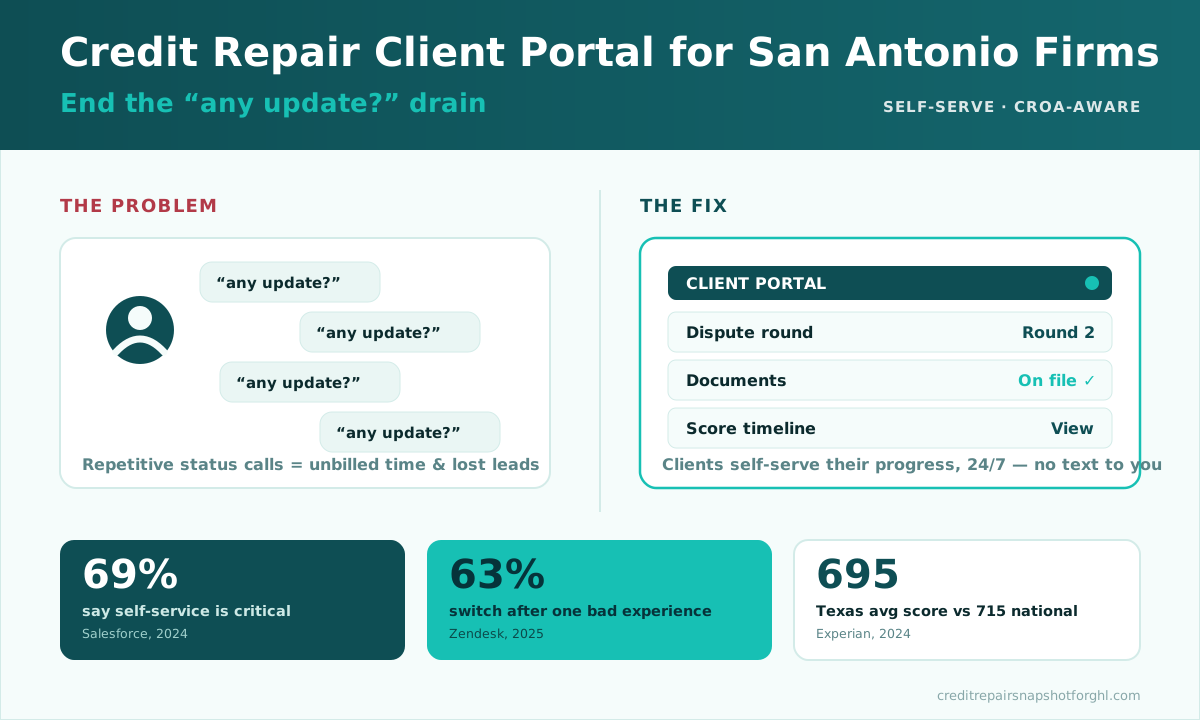
For a San Antonio credit repair firm, the most expensive question your clients ask isn’t “will this work?” — it’s “any update?” Multiplied across a book of enrolled clients who each text, call, and DM to check where their file stands, that one question quietly eats your team’s day, buries new leads under old status requests, and pushes anxious clients toward cancelling. The fix is not answering faster. It’s a branded client portal where every client logs in and sees their own dispute-round progress, documents, and next step — on their own, at 11 p.m., without pinging you at all.
This is a pain-points breakdown written for owners and the GoHighLevel agencies that serve them. We sell the operating system, never the outcome: nothing here promises a score change or a deletion, and neither should your portal. What a portal does is make your effort visible — which is exactly what keeps a San Antonio client paying past month three instead of assuming nothing is happening.
Table of contents
- The “any update?” loop: San Antonio’s hidden operating tax
- Pain #2: silent clients cancel
- Pain #3: the new lead you lose while answering old ones
- What San Antonio clients actually expect: self-service
- Where GoHighLevel’s native portal stops — and a custom one begins
- Anatomy of a portal that ends the status calls
- The compliance bright line
- Build vs. buy for a San Antonio firm
- Frequently asked questions
- About the author
- Sources
The “any update?” loop: San Antonio’s hidden operating tax
Walk into any small credit repair operation on the North Side and you’ll find the same scene: an owner or a single VA fielding a steady drip of “just checking in — any movement?” texts, each one requiring someone to stop, open a file, read the last note, and reply with some version of “still in your current round, I’ll update you when the bureau responds.”
None of that work is billable. None of it moves a dispute forward. And it never appears on an invoice — which is exactly why it’s so easy to ignore until it’s eating half a workday. This is the “any update?” loop, and it scales linearly with your success: the more clients you enroll, the more status questions you field, until answering them is the job and the actual work gets done at night.
The loop has three properties that make it uniquely corrosive for a credit repair firm:
- It’s repetitive. The same handful of questions — what round am I in, did you get my documents, when’s my next payment, why hasn’t my score moved — come in over and over, from different clients, all week.
- It’s asynchronous and impatient. A client texts at 9:40 p.m. and expects an answer tonight. Your team sees it at 8 a.m., by which point the client has already stewed.
- It’s emotionally loaded. Credit is stressful. A slow or vague reply doesn’t read as “busy” — it reads as “they forgot about me.”
Pain #2: silent clients cancel
Here’s the part that turns an annoyance into a revenue problem. In a subscription credit repair model, your margin lives in month four and beyond — after acquisition cost is recovered and the client is simply paying while you work. The client who cancels in month two because “I never heard anything” doesn’t just stop paying; they take every future month with them.
And modern consumers have almost no patience for feeling ignored. 63% of consumers say they’d switch to a competitor after a single bad experience — a figure that grew 9% year over year (Zendesk CX Trends, 2025). A two-day-late reply to “any update?” is, to that client, a bad experience. It doesn’t matter that you were heads-down disputing their collections — they can’t see it, so as far as they know, nothing happened.
Most credit repair cancellations aren’t about results. They’re about the client concluding, in silence, that no one is working their file. Visibility is retention. A portal that shows the work already done answers the cancellation before the client thinks to make it.
This is why we’ve written before about score-milestone texts that keep clients paying and winning back cancelled clients. But the cheapest cancellation to prevent is the one that never gets contemplated — because the client can log in any time and see that their file is active, their documents are in, and their next round is scheduled.
Pain #3: the new lead you lose while answering old ones
There’s a second, less obvious cost to the “any update?” loop: it steals the attention you need for new leads. Every San Antonio credit repair firm is fighting the same speed-to-lead math, and the data is brutal.
The MIT / InsideSales Lead Response Management Study found that the odds of contacting a web lead drop by 100× when a firm waits 30 minutes instead of 5 minutes to respond, and the odds of qualifying that lead drop by 21× (InsideSales). Leads decay in minutes, not hours.
Now picture the collision: a prospect fills out your form at 2:15 p.m. asking about credit help, and at that exact moment your VA is three messages deep in status replies to already-enrolled clients. By the time anyone gets to the new lead, they’ve messaged two other firms and booked with whoever answered first. The status loop didn’t just cost you time — it cost you the client you hadn’t closed yet.
What San Antonio clients actually expect: self-service
The instinct is to solve the loop by answering faster — hire another VA, add another phone line. But your clients aren’t actually asking for a person. They’re asking for an answer they could get themselves if you’d let them.
The research on this is unambiguous. 69% of customers say it’s critical or very important for companies to offer self-service options they can use to solve their own problems (Salesforce State of the Connected Customer, 2024). And 81% of people try to resolve an issue on their own before reaching out to a live representative (Harvard Business Review). Given a way to check their status without texting you, the majority of clients will take it — gladly.
There’s a local angle here too. Texas runs a 695 average credit score against a 715 national average (Experian, 2024), which means San Antonio has a deep pool of exactly the consumers credit repair serves. But it’s a crowded field — IBISWorld counts more than 41,000 credit repair businesses nationally, a number that’s been shrinking about 4.4% a year as weaker operators fold (IBISWorld, 2025). The firms that survive that shakeout are the ones that keep the clients they win. Self-service transparency is a retention moat.
Where GoHighLevel’s native portal stops — and a custom one begins
If you already run on GoHighLevel — the platform the Credit Repair Snapshot is built on — you have a starting point. GHL ships a native client portal with magic-link login, memberships, documents, and communities. For a solo operator, that plus automated client progress updates may be enough, and we’ve published a full walkthrough of building a progress-tracking portal inside GHL if that’s your path.
But there’s a ceiling. GHL’s native portal was built to be generic across every industry, so a credit-repair-specific experience — a round-by-round dispute tracker, a score-timeline view, a bureau-and-furnisher item status board, a document checklist keyed to your exact enrollment stages — is something you have to assemble on top of it with custom fields and workarounds, and even then it looks and behaves like GHL, not like your firm.
That ceiling is where a custom-built client portal earns its keep. A bespoke portal is designed around how your San Antonio firm actually runs: your stages, your rounds, your branding, your domain. Clients log in to something that looks like your business, not a white-labeled CRM. It can plug into your GHL data so your team still sees everything in one place, or stand on its own — and because it’s yours, you own the code and the roadmap.
Anatomy of a portal that ends the status calls
A client portal only kills the “any update?” loop if it answers the questions clients actually ask, before they ask them. Here’s the anatomy of one built for a credit repair firm.
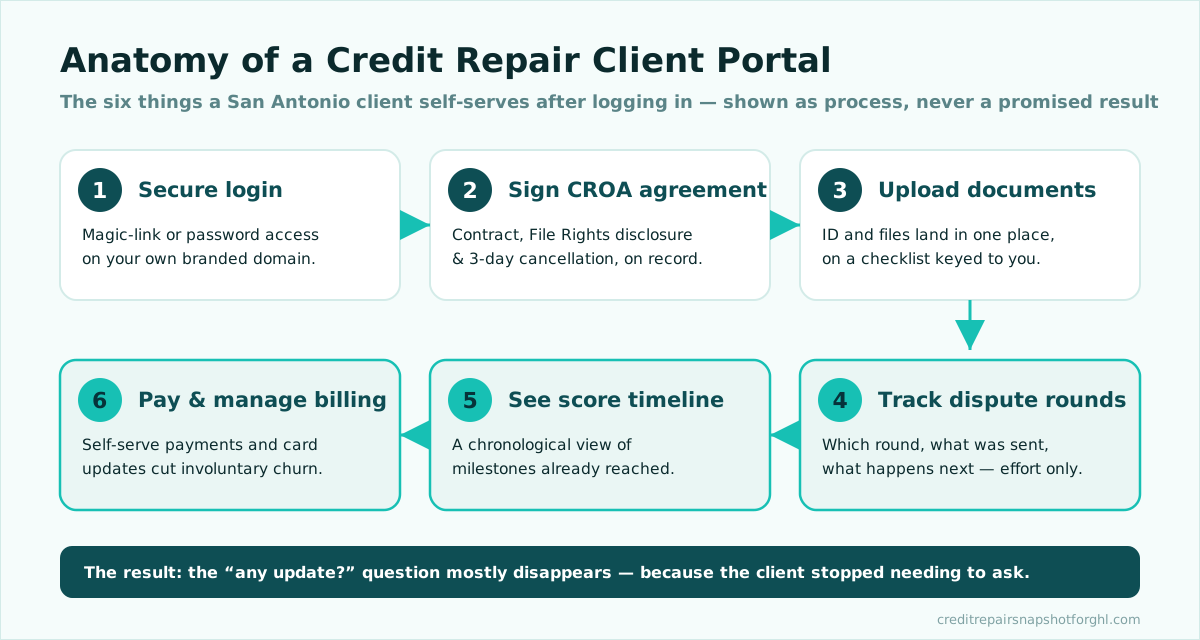
- Secure login. Magic-link or password access on your own branded domain — the client’s first impression is your firm, not a generic tool.
- Sign the CROA-compliant agreement. Onboarding paperwork, the required Consumer Credit File Rights disclosure, and the three-day cancellation notice, captured and stored with an audit trail.
- Upload ID and documents. No more document chaos over email and text. Everything the client owes you lands in one place, on a checklist keyed to your process.
- Track dispute-round progress. The centerpiece: which round they’re in, what was sent and when, and what happens next — described as process and effort, never a promised result.
- See the score timeline. A simple chronological view of milestones reached, so the client experiences progress instead of guessing at it.
- Pay and manage billing. Self-serve payments and card updates, which quietly reduces the involuntary churn we cover in recurring billing without chargebacks.
Do those six things well and the status question mostly disappears — not because you got faster, but because the client stopped needing to ask.
The compliance bright line
A portal makes your work more visible, which makes compliance more important, not less. Everything on every screen must stay inside CROA’s guardrails.
Built this way, the portal is a compliance asset: a timestamped, self-documenting record of the process you followed for every client — the kind of audit trail that protects your firm as much as it reassures your client.
Build vs. buy for a San Antonio firm
Once you decide status volume is a real problem, the question is how to solve it. Here’s an honest comparison of the three realistic paths.
| Path | What it is | Best for | Roughly costs |
|---|---|---|---|
| GHL native portal (DIY) | Configure GoHighLevel’s built-in portal + progress-update automations yourself | Solo operators, low client volume, tight budget | Your time + existing GHL plan |
| Custom-built portal (done-for-you) | A bespoke, branded portal designed around your stages, rounds, and brand — built and delivered for you | Growing firms where status is now a staffing problem | A one-time build; you own the code |
| Hire another VA to answer faster | Throw labor at the loop | A stopgap, not a fix | ~$700+/mo, recurring, and it doesn’t scale |
The DIY path is the cheapest in dollars and the most expensive in your time. Hiring more people to answer status questions treats the symptom and grows your payroll forever. A custom portal is the only option that actually removes the loop instead of staffing around it — and because you own it, it keeps paying back long after the build. If you’d rather run the whole GHL operation with a dedicated hand instead, our hire-a-VA option covers ongoing maintenance from $700/month.
Frequently asked questions
Credit repair client portals in San Antonio — answered
What is a credit repair client portal?
It's a secure, login-protected page where your enrolled clients see their own progress — which dispute round they're in, what documents you have on file, which score milestones they've reached, and what happens next — without calling, texting, or emailing your team. It shows process and effort, never a promised result.
Will a portal really cut down on 'any update?' messages?
Yes, because most status questions are self-serve questions in disguise. With 81% of people trying to resolve an issue themselves before contacting a rep (Harvard Business Review) and 69% saying self-service is critical (Salesforce, 2024), giving clients a place to check their own status removes the reason to ping you in the first place.
Do I need a custom portal, or is GoHighLevel's native one enough?
If you're a solo operator with low volume, GHL's native portal plus progress-update automations may be plenty — we have a full guide to building one in GHL. If status volume has become a staffing problem, or you want a branded, credit-repair-specific experience (round-by-round tracker, score timeline, item status board) competitors can't copy, a custom-built portal is the better investment.
Is a client portal CROA-compliant?
It can and must be. A compliant portal displays process and effort — rounds active, documents received, milestones reached — and never promises or implies an outcome. It also preserves the written contract, the Consumer Credit File Rights disclosure, and the three-day cancellation right. You remain the credit repair organization responsible for full CROA compliance; the software organizes information, it doesn't dispute or advise on your behalf.
How does a portal help me keep San Antonio clients longer?
Most cancellations in this niche come from clients concluding, in silence, that nothing is happening. A portal makes your ongoing work visible, which directly answers that assumption. Since 63% of consumers say they'd switch after a single bad experience (Zendesk, 2025), reducing the 'I never hear anything' feeling is one of the highest-leverage retention moves you can make.
Can a custom portal connect to my existing GoHighLevel setup?
Yes. A custom portal can plug into your GHL data so your team still works from one source of truth, or run independently if you're moving off GHL. Either way, you own the code and the roadmap. Book a discovery call and we'll scope the integration with you.
About the author
Marcus Pennington is a retention and recurring-revenue consultant based in Dallas, TX, who advises credit repair business owners and the GoHighLevel agencies that serve them on keeping clients enrolled and paying past month three. A former SaaS churn analyst, he reverse-engineers cancellation triggers and builds the progress updates, milestone communications, and self-serve experiences that protect monthly recurring revenue — without ever overpromising a result. He is allergic to hype and partial to dunning logic.
Related reading: Build a progress-tracking client portal in GoHighLevel · Score-milestone texts that keep clients paying · Recurring billing without chargebacks · Win back cancelled credit repair clients
Sources
- Salesforce — State of the Connected Customer (Sixth Edition, 2024): 69% say self-service options are critical/very important. salesforce.com
- Harvard Business Review — Kick-Ass Customer Service (2017): 81% try to resolve an issue themselves before contacting a rep. hbr.org
- Zendesk — CX Trends 2025: 63% of consumers would switch to a competitor after one bad experience (up 9% YoY). zendesk.com
- MIT / InsideSales — Lead Response Management Study (Dr. James Oldroyd, MIT Sloan): contacting odds fall 100× and qualifying odds fall 21× at 30 minutes vs 5 minutes. insidesales.com
- Experian — What Is the Average Credit Score in the U.S.? (2024): Texas 695 vs 715 national average. experian.com
- IBISWorld — Credit Repair Services in the US (2025): market size $6.8bn; 41,000+ businesses, declining ~4.4%/yr 2020–2025. ibisworld.com