It is the first of the month and you are reconciling the numbers. Your ad account says you spent a little over two thousand dollars last month and got twenty-eight leads. Not bad, you think. Then you open your enrollment list. Three new clients signed. You do the division in your head and it stops you cold: you paid roughly seven hundred dollars to land each paying client, and because of how credit repair billing works, not one of them has given you a dollar yet. The money went out. The money has not come back. And you are about to load the ad account again because the pipeline is thin.
That gap, between what a lead appears to cost and what a client actually costs you to acquire and carry, is the single most misread number in a credit repair business. Most operators track cost per lead, feel fine about it, and quietly go broke anyway.
The answer up front: a credit repair lead is not the $74 your ad platform charges for the click. The number that decides whether you survive is your fully loaded cost per enrolled client, and then the number of months you have to wait before that client pays it back, because the Credit Repair Organizations Act bars you from charging a cent until the work is done. Get those two numbers in front of you and most of your “lead problem” turns out to be a math problem you can actually fix.
One line before we dig in. This is about the economics of running the business, not about credit outcomes. Nothing here disputes an item, decides what to dispute, or promises a score change. That stays with you, the firm, and inside the law.
Table of contents
- Why “cost per lead” is the wrong number
- What a credit repair lead actually costs
- The CROA cash-flow trap
- Where your lead money leaks
- Steal this: the response math and the first texts
- Run the numbers for your size
- Staying compliant while you chase cheaper leads
- Common objections
- FAQ
Why “cost per lead” is the wrong number
Open any ad dashboard and the headline number is cost per lead, so that is the number operators obsess over. It is the wrong one to live by, for one simple reason: a lead is not a customer. It is a stranger who filled in a form or tapped a call button. Between that moment and a signed, paying client sit three or four more steps, and every step throws some people away.
Here is the benchmark to anchor on. In the 2026 search advertising data, the finance and insurance category averaged a $74.44 cost per lead at a 2.64% conversion rate and a $3.39 cost per click, against a $66.69 cost per lead across all industries (LocalIQ, 2026 Search Advertising Benchmarks). Credit repair is a high-intent, heavily-regulated, heavily-competed slice of that category, so your real cost per lead is often higher than the published average, not lower.
But even that $74 is only the entry price. What matters is what happens to the lead after it lands. Call it the funnel:
- A lead becomes a booked consult only if someone follows up and they agree to a time.
- A booked consult becomes a showed consult only if they actually turn up.
- A showed consult becomes an enrolled client only if they say yes and sign.
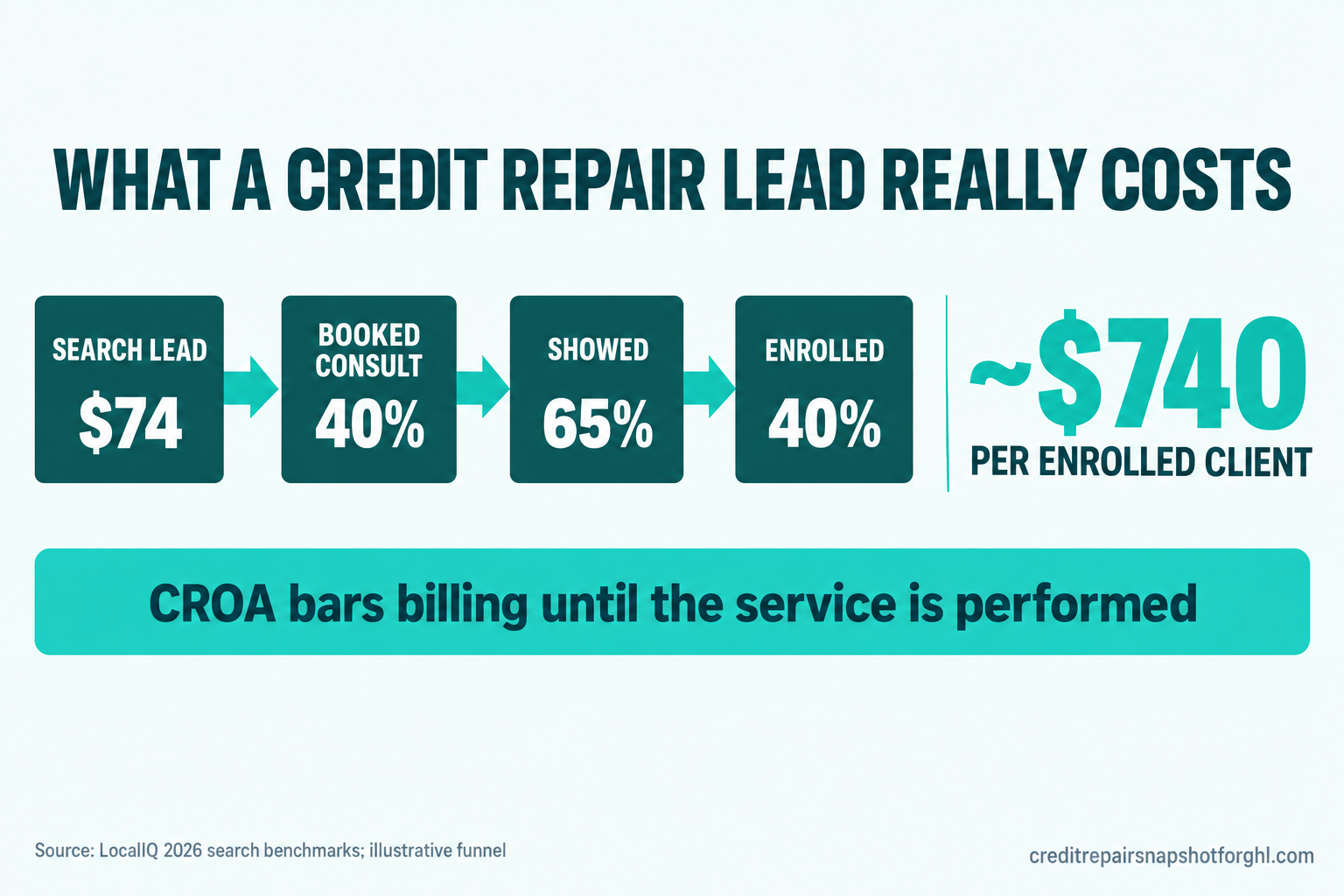
Multiply realistic rates for each step and the survivors are few. If 40% of leads book, 65% of those show, and 40% of those enroll, then about ten percent of your leads become paying clients. That turns a $74 lead into roughly $740 of ad spend per enrolled client. Your own rates will differ, and you should measure them, but the shape is always the same: the number that pays your bills is cost per enrolled client, and it is always many times your cost per lead.
What a credit repair lead actually costs
Let us make the $740 concrete, because the gap between “I spent $74” and “this client cost me $740 and has paid me nothing” is where operators get hurt.
Then stack on the costs that never show up in the ad account. Your time is real money: every hour you spend on consults that no-show, on leads nobody followed up with, on tire-kickers who were never going to sign, is an hour you did not spend on paying clients or on the business. If you pay for a setter or a VA to work the phones, that is a direct line item on top of the media. So is the software that runs your pipeline, your calendar, your texting, and your billing.
A fair way to think about it: your fully loaded cost per enrolled client is the ad spend per enrollment plus a share of the people-and-tools cost it took to convert them. For a lot of solo shops that lands somewhere between $600 and $1,000 per signed client. You do not need my number. You need yours. But you need it as a real figure, not a feeling.
And here is the part that makes credit repair different from almost any other local service business. In a typical trade, you do the work and invoice, so cash comes in fast and your acquisition cost is recovered in the first job. In credit repair, you are not allowed to do that.
The CROA cash-flow trap
The Credit Repair Organizations Act is explicit: a credit repair organization may not charge or receive any money for a service “before such service is fully performed” (15 U.S.C. §1679b(b)). No matter how you structure it, you cannot take an advance fee for future work. You bill as work is performed, which in practice means monthly, in arrears, once something has actually been done.
Now layer in how long the work takes. A credit bureau has 30 days to complete a reinvestigation after you file a dispute (15 U.S.C. §1681i), and a real engagement runs round after round across several of those windows. So a client you paid roughly $740 to acquire does not repay that in week one. They repay it slowly, a month at a time, over the length of the engagement.
Consumer guides put typical credit repair fees at $50 to $150 a month, with a first-work or setup fee often around one month of service (BadCredit.org, 2026). Take a middle example of $99 a month. Against a $740 acquisition cost, you do not break even on that client until somewhere around month seven or eight, and that is before you have paid yourself a dime of profit on them.
Illustrative breakeven on a single client. Cumulative amount collected at a $99 monthly fee against an assumed $740 fully loaded acquisition cost. Breakeven arrives around month eight. The monthly fee range is from BadCredit.org; the acquisition figure is an example, not a published statistic. Your own numbers will move the crossover point.
This is the trap. You pay for the lead today, you are legally barred from front-loading the revenue, and you wait more than half a year to get your acquisition money back. Scale that across twenty or thirty new clients a month and you can be profitable on paper and dead broke in the bank at the same time. It is why so many credit repair owners describe the same feeling: the business “works,” but there is never any money. The money is real. It is just months out in front of you, and your ad spend is now.
That changes the whole game. When every new client is a seven-month loan you make to yourself, you cannot afford to waste a single lead you paid for. Which is exactly what most shops do.
Where your lead money leaks
Most operators try to fix the cost problem by hunting for cheaper leads. That is the hard way and usually the wrong way. The faster win is to stop leaking the leads you already bought. Here are the five leaks, worst first, and how each one breaks.
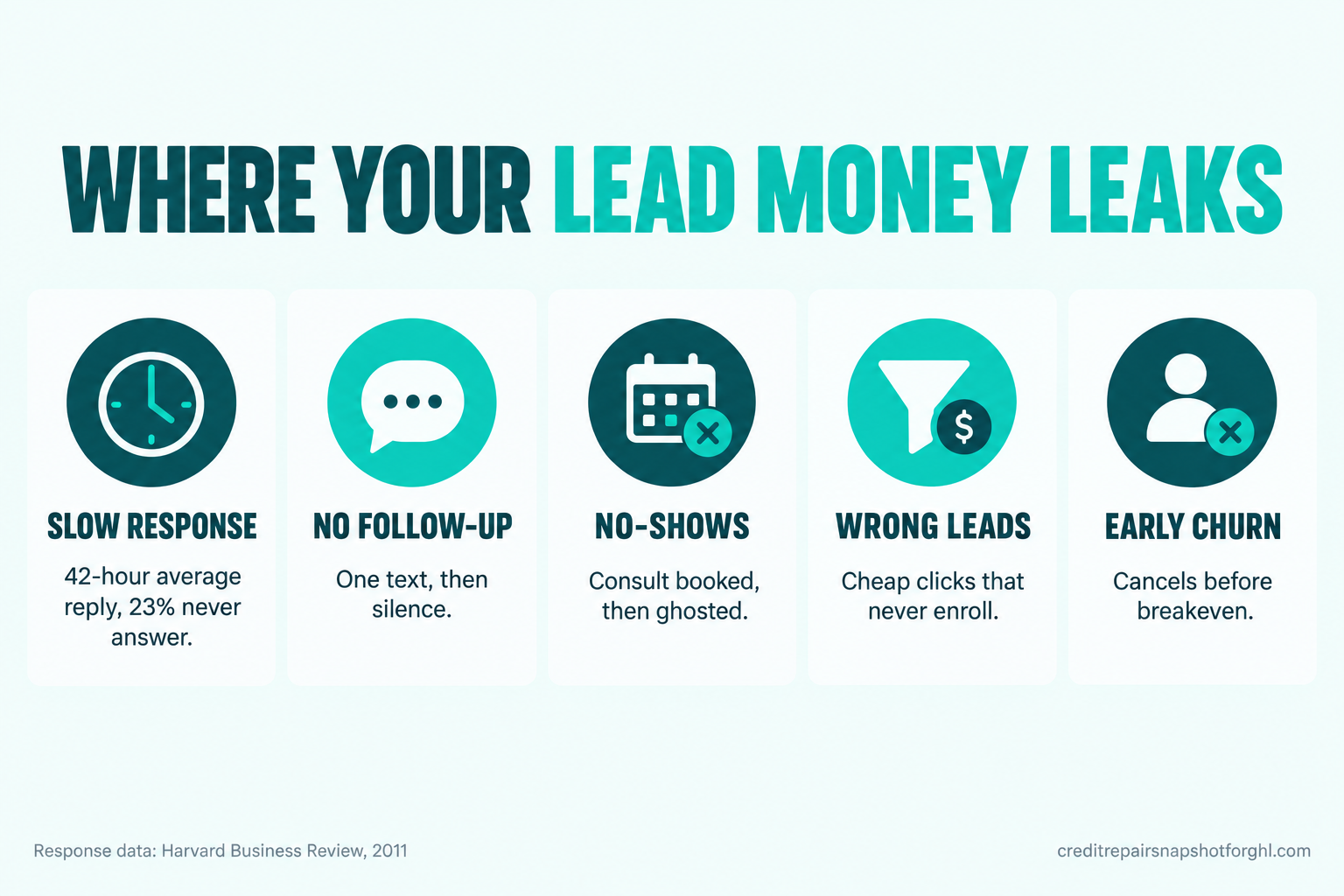
Leak 1: slow response, which quietly voids most of your spend. This is the big one. The research is blunt: across 2,241 companies audited, the average time to respond to a web lead was 42 hours, and 23% never responded at all (Harvard Business Review, 2011). Speed is not a nicety. Firms that reached a lead within an hour were nearly seven times more likely to qualify it than firms that waited just one more hour, and more than sixty times more likely than firms that waited a day. A credit repair lead is often shopping three or four firms at once, in a moment of real stress. Whoever answers first usually wins. If you answer in four hours because you were on the phone with another client, you paid $74 to warm up a lead for a competitor.
How fast companies actually respond to inbound web leads: share of firms by first-response time. Nearly a quarter never respond at all. Source: Harvard Business Review, “The Short Life of Online Sales Leads” (2011), based on an audit of 2,241 U.S. companies.
Leak 2: no follow-up after the first touch. A lead who does not answer the first text is not a dead lead. Most operators treat them as one. One message goes out, nobody replies, the lead is abandoned, and the $74 is gone. A simple, spaced sequence of a few more touches recovers a meaningful slice of leads you have already paid for, at zero extra media cost.
Leak 3: no-shows at the consult. You did the hard part. The lead booked. Then they ghost the call, and the whole acquisition cost evaporates at the last step. No-shows are almost always a reminder problem, not an interest problem. People forget, their day runs away, and nothing nudged them. Layered reminders are the cheapest money you will ever make back. We go deep on this in the guide to cutting credit repair no-shows.
Leak 4: chasing the wrong leads. Not every cheap lead is a good lead. A lead source that delivers people who cannot pass a basic intake, or who are looking for a “guaranteed deletion” you legally cannot promise, has a low real conversion rate, which quietly triples your true cost per enrolled client even though the cost per lead looks great. Track enrollment rate by source, not just cost by source, and kill the sources that look cheap but never convert.
Leak 5: churn before breakeven. This is the most expensive leak of all, because it happens after you have paid the full acquisition cost. If a client cancels in month two or three, you never recovered what you spent to get them. You lost money on that human being. Retention is not a “nice to have” in credit repair, it is the back half of your unit economics, and it is why clients going quiet around month two is a financial emergency, not just a service annoyance.
Notice the pattern. Four of the five leaks have nothing to do with how much you pay for traffic. They are about what happens to the lead after it arrives. That is where the money is.
Steal this: the response math and the first texts
Two tools, both free to copy. First, the math you should run every month. Second, the exact messages that plug Leak 1 and Leak 2, which are the two biggest.
Run this once a month with your real numbers:
1. Cost per lead          = ad spend ÷ leads
2. Booking rate           = booked consults ÷ leads
3. Show rate              = showed consults ÷ booked consults
4. Enroll rate            = enrolled ÷ showed consults
5. Cost per enrolled      = (1) ÷ [ (2) × (3) × (4) ]
6. Months to breakeven    = cost per enrolled ÷ your monthly fee
7. Enrollment by source   = enrolled ÷ leads, for EACH source
Line 7 is the one almost nobody runs, and it is the one that tells you which “cheap” source is actually your most expensive. Line 6 tells you how long your cash is tied up per client, which is the number your bank balance actually feels.
Now the messages. The instant reply fires the moment a lead comes in, day or night, before a human can get to the phone. Keep it human, name the next step, and never promise an outcome.
Instant reply (fires within seconds of the lead):
"Hi {FirstName}, this is {YourName} at {FirmName}. Thanks for reaching
out about your credit. I'd love to walk you through how our process
works and answer your questions, no pressure. What's a good time today
or tomorrow? You can grab a slot here: {BookingLink}"
Follow-up 1 (about 1 hour later, no reply):
"{FirstName}, still happy to help whenever you're ready. Most folks
have questions about the process and the timeline, totally normal.
Want me to hold a quick 15-min call for you? {BookingLink}"Follow-up 2 (next day):
"Hi {FirstName}, I don't want your inquiry to fall through the cracks.
If now isn't the right time, just reply PAUSE and I'll check back later.
Otherwise here's that link again: {BookingLink}"Follow-up 3 (day 4, soft close):
"{FirstName}, last note from me for now. When you're ready to look at
your options, we're here. Reply STOP to opt out anytime. {BookingLink}"Three rules make these safe and effective. Keep them inside the law: describe your process and your effort, never a score change or a guaranteed deletion. Honor consent: every sequence needs a clear opt-out, and you must have the consent to text in the first place, which is its own hurdle worth understanding before you send a single message (why credit repair texts get rejected at A2P 10DLC). And automate the timing, because “I’ll follow up when I get a chance” is how Leak 2 happens. A system sends these on schedule whether or not you are buried in client work. That is the entire point of running your front end inside a platform like GoHighLevel, which is where our own credit repair sales funnel lives.
Run the numbers for your size
The same math applies at every size, but the stakes and the fixes shift. Here is how the picture changes for three shops. The figures are illustrative examples built on the $74 cost-per-lead benchmark, not promises.
Lead economics by shop size (illustrative)
| Plan | Solo operator | Small team recommended | Bigger shop |
|---|---|---|---|
| Price | ~10 leads/mo | ~40 leads/mo | ~120+ leads/mo |
| Feature 1 | ~$740 ad spend, 1 new client | ~$3,000 ad spend, 4 new clients | ~$9,000+ ad spend, 12+ new clients |
| Feature 2 | You are the responder: Leak 1 is worst | Leads slip between people: Leak 2 and 3 | No single view: every leak compounds |
| Feature 3 | One month of float can hurt; cash is king | Float is 4x; retention now decides survival | Float can exceed $60k in flight at once |
| Feature 4 | Fix first: instant auto-reply + reminders | Fix first: shared pipeline + source tracking | Fix first: automation + churn defense |
| Feature 5 | Breakeven ~7-8 months per client | Needs enrollment-by-source data (line 7) | Cheap-but-dead sources quietly drain budget |
For the solo operator, the whole game is speed and float. You cannot be on a client call and answer a fresh lead in sixty seconds at the same time, so the instant auto-reply is not optional, it is the difference between landing the client and funding a competitor. And because one client is a seven-month loan you make to yourself, a couple of no-shows or an early cancellation can empty the account. Automate the front end first.
For the small team, the leak moves. Now leads fall into the gap between people. One person thinks another followed up, nobody did, and the lead dies in the crack. A shared pipeline where every lead sits in exactly one visible stage with one owner closes that gap. This is also the size where line 7, enrollment by source, starts paying for itself, because you are now spending enough that a bad source is burning real money every month.
For the bigger shop, the float is the headline risk. At a dozen or more new clients a month, each carrying hundreds of dollars of unrecovered acquisition cost for months, you can have tens of thousands of dollars in flight before a single one hits breakeven. At that scale, retention is not a service metric, it is the thing standing between you and a cash crunch. A point of churn costs you clients you already paid full price to acquire.
Staying compliant while you chase cheaper leads
Cutting cost per client is good. Cutting it by cutting corners on compliance is how you turn a cash-flow problem into a legal one. A few guardrails that cost nothing and protect everything.
Your ads, your landing pages, and your scripts cannot promise results. CROA bars untrue or misleading statements about what you can do for a consumer, so “we guarantee we’ll delete your collections” or “raise your score 100 points” is not aggressive marketing, it is a violation. Sell the process and the effort, never the outcome.
Your billing has to respect the no-advance-fee rule we covered, and your contract has to carry the required written disclosures and the consumer’s three-business-day right to cancel (15 U.S.C. §1679e) along with the separate Consumer Credit File Rights statement (15 U.S.C. §1679c). Those are not optional even when a lead is in a hurry to sign.
And your texting needs real consent, captured and logged, before the first message goes out. The fastest-looking lead funnel in the world is worthless if your number gets blocked at the carrier for messaging people who did not opt in. If any of this is fuzzy, the CROA-compliant sales script and the broader compliance guidance from the FTC are the place to start.
Common objections
“Shouldn’t I just buy cheaper leads?” Usually not. Cheaper leads almost always convert worse, so your cost per enrolled client stays flat or rises even as your cost per lead drops. Worse, bad leads eat your time, which is a cost that never shows up on the ad invoice. Measure enrollment by source. A source at $40 a lead that enrolls one in twenty-five is far more expensive than a source at $80 a lead that enrolls one in eight. Fix the funnel before you chase the price down.
“Can’t I just charge an upfront setup fee to cover acquisition?” No, and this is the one to be careful about. CROA bars charging for a service before it is fully performed (15 U.S.C. §1679b). A “setup fee” that is really payment for future work is exactly what the law prohibits. You bill for work as it is performed. Your acquisition cost has to be recovered through the engagement, not front-loaded, which is precisely why the float math matters so much.
“Isn’t organic the answer, since it’s free?” Organic traffic and referrals are not free, they are paid for in time and in reputation built over months, and they are the best long-term lever you have. But they are slow to spin up. While you build them, you are running paid traffic, and the whole point of this piece is to stop that paid traffic from leaking. Do both. Just do not pretend organic is instant or costless.
“I’m a one-person shop. Isn’t automation overkill?” It is the opposite. The solo operator is the one who physically cannot answer every lead in sixty seconds, cannot send four spaced follow-ups by hand, and cannot fire reminders at the right hour while also doing the actual client work. Automation is not for big teams. It is what lets one person stop leaking the expensive leads they cannot personally babysit.
Frequently asked questions
What does a credit repair lead cost in 2026?
In the 2026 search advertising benchmarks, finance and insurance averaged about $74.44 per lead at a 2.64% conversion rate, against a $66.69 all-industry average (LocalIQ). Credit repair is a high-competition slice of that category, so your real cost per lead is often higher. More importantly, that is the cost of a lead, not a client.
What's the difference between cost per lead and cost per enrolled client?
A lead is anyone who inquires. An enrolled client is someone who signed and pays. Only a fraction of leads enroll, so cost per enrolled client equals your cost per lead divided by your booking rate times your show rate times your enroll rate. In a typical funnel that turns a $74 lead into roughly $740 per signed client. Cost per enrolled client is the number that decides whether the business works.
Why does CROA make credit repair cash flow so hard?
The Credit Repair Organizations Act bars charging for a service before it is fully performed (15 U.S.C. §1679b), so you cannot take an advance fee. You bill monthly as work is done, and the work runs across multiple 30-day reinvestigation windows. So you pay the full acquisition cost today and recover it slowly over many months, which ties up your cash.
How fast do I need to respond to a new lead?
As fast as you can, ideally within minutes. Harvard Business Review found firms that reached a lead within an hour were nearly seven times more likely to qualify it than those that waited one more hour, yet the average company took 42 hours and 23% never responded at all. An instant automated reply closes that gap even when you are busy with other clients.
How do I lower my true cost per client without buying cheaper leads?
Plug the leaks in the funnel you already have: respond instantly, follow up several times instead of once, send layered reminders to cut no-shows, track enrollment by source to kill cheap-but-dead sources, and protect retention so clients stay past breakeven. Those fixes lower cost per enrolled client far more than cheaper traffic does.
Can I charge a setup fee to cover my advertising costs?
Not if it is really payment for future work. CROA prohibits charging before a service is fully performed, so a setup fee structured as an advance on future disputes is the kind of fee the law bars. You recover acquisition cost through the ongoing engagement, billed as work is performed, which is why managing the float is central to credit repair economics.
Back to the first of the month, and that stomach-drop when the division came out to seven hundred dollars a client with nothing collected yet. Nothing about that number was wrong. It was just invisible until you looked. Once you can see it, the moves are obvious: answer faster, follow up more, lose fewer at the door, keep people past breakeven, and cut the sources that look cheap but never convert. You do not need a bigger ad budget to fix a leaking funnel. You need to stop paying for leads you then throw away, which, when every client is a seven-month loan you make to yourself, is the most expensive habit in the business.
If you want the response, follow-up, reminder, billing, and retention flows already built for credit repair and running inside one system, that is exactly what we do. Start with a walkthrough, or see what is included and what it costs.