It is the 12th of the month. A referral just texted you, ready to sign, and you are already a few clients past the cap on your Client Dispute Manager plan. To take the new one you bump up a tier or pay the add-on, and while you are staring at that upgrade button the old thought comes back: maybe it is time to look at something else. Maybe one of the other tools is cheaper, or does more, or just feels less like 2014.
That thought is where most operators start shopping for a Client Dispute Manager alternative. Before you move a single client file, read this, because the honest version is not what the reviews tell you.
We sell the operating system, never the outcome. Nothing here promises a score change or a deletion, and no software should. Your firm stays the credit repair organization responsible for the contract, the disclosures, and CROA compliance.
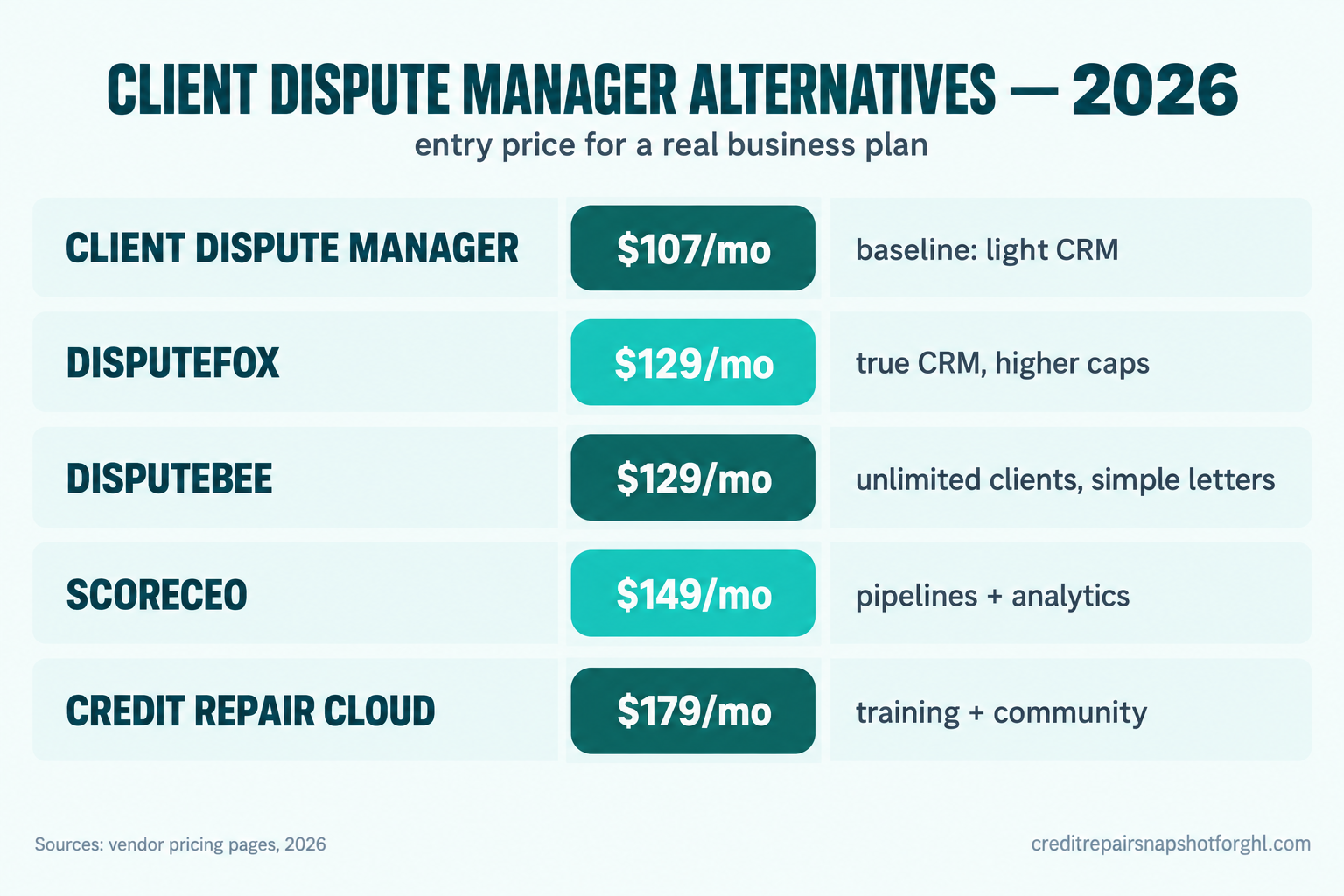
Table of contents
- The honest answer first
- What Client Dispute Manager is, and where it stops
- The real alternatives, and what they cost in 2026
- Which alternative fixes which Client Dispute Manager problem
- The three costs no alternative removes
- Solo operator, small team, scaling firm
- What switching from Client Dispute Manager actually costs
- Steal this: the messages that carry a tool switch
- Common objections, answered
- Frequently asked questions
- About the author
- Sources
The honest answer first
If you are leaving Client Dispute Manager because it feels too expensive, stop. Almost every serious alternative costs more once you price the plan that actually fits a working business. That is the single most common mistake in this niche: an operator jumps to a “cheaper” tool, rebuilds every client file by hand, and lands on a bigger bill.
Leave for a real reason, and the reason tells you where to go:
- You hit the client cap and the add-ons stack up. Look at DisputeFox or ScoreCEO, which carry more clients per tier.
- You want one login for leads, pipeline, and disputes. DisputeFox is built most like an all-in-one.
- You want the cheapest possible letter generation and nothing else. DisputeBee.
- You are brand new and want to be taught the work. Credit Repair Cloud, for the training and community.
- The disputes are fine and everything around them is the mess. The answer is not another dispute tool. It is an operations layer that runs lead response, onboarding, follow-up, billing, and reviews on top of the dispute tool you already trust.
Read the next two sections before you decide, because the thing that drains a small credit repair business is rarely the dispute tool. It is the per-client report fee stacking up, the texts that will not send, and the months you work for free because CROA says you cannot bill until the job is done.
What Client Dispute Manager is, and where it stops
Client Dispute Manager is dispute software with onboarding and some coaching bolted on. You import a report, it reads the tradelines, it builds AI and Metro 2 dispute letters, it runs a client portal under your branding, and it mails letters for you. On the middle and upper plans it adds billing and invoicing, an AI Coach, and a “Smart Interviewer” for intake (Client Dispute Manager).
Here is the pricing, straight from its page. Solo is $49 a month but caps at 3 clients with no team member, so it is a starter, not a business. Starting is $107 for 125 clients and 1 team member. Growing, marked most popular, is $169 for 250 clients and 2 team members. Enterprise is $329 for 500 clients and 4 team members. Extra users and extra 100-client blocks each cost $40 a month (Client Dispute Manager).
So where does it stop? Three places. The caps and add-ons climb fast once you are growing, since every extra seat or client block is another $40. It is a dispute tool, not a growth engine: the lead that waited two days for a callback, the client who went quiet in month two, the card that declined in silence, CDM is not built to fix those. And some operators find the interface dated next to newer tools, a point that shows up in reviews (Capterra), though that is subjective and a weak reason to move alone.
None of that makes CDM a bad tool. It makes it one you can outgrow in specific ways. Match the way you outgrew it to the right replacement.
The real alternatives, and what they cost in 2026
Prices move, so confirm on each vendor’s page before you buy. Here is the field right now, with the plan a real working business would actually run.
| Tool | Entry business price | Clients / team at entry | Built-in CRM and marketing | What it fixes vs CDM | The catch |
|---|---|---|---|---|---|
| Client Dispute Manager | $107/mo (Starting) | 125 clients / 1 user | Light | Baseline | Add-ons stack at $40 each (CDM) |
| DisputeFox | $129/mo (Starting) | 100 clients / 1 user | Strong, built in | A true CRM and higher client caps | Entry caps at 100 clients; seats add up (DisputeFox) |
| ScoreCEO | $149/mo (Kickstart) | 50 clients / 2 users | Pipelines + analytics | Reporting and team tooling | Entry client cap is low at 50 (ScoreCEO) |
| Credit Repair Cloud | $179/mo (Start) | 300 clients / 3 users | Light | Training and the biggest community | Costs more and jumps to $299, $399 as you grow (CRC) |
| DisputeBee | $129/mo (Business) | Unlimited clients + team | Minimal | Simple, fast letters, no caps | Few CRM or marketing features; needs separate monitoring (FinMasters) |
The headline reads clearly. Only the capped CDM Solo plan at $49 is cheaper than the field, and it is not a business plan. Every real alternative sits at $129 and up. DisputeBee removes the client cap entirely but strips the CRM down to almost nothing. DisputeFox and ScoreCEO add the CRM and the room to grow, and they charge for it.
Entry monthly price for a real business plan, 2026. Client Dispute Manager’s Starting plan is the cheapest working tier in the field; most alternatives cost more. Sources: Client Dispute Manager, DisputeFox, ScoreCEO, Credit Repair Cloud, FinMasters DisputeBee review.
Which alternative fixes which Client Dispute Manager problem
A comparison table tells you the prices. It does not tell you which tool solves your specific reason for leaving. Here is that mapping.
You outgrew the client cap: DisputeFox or ScoreCEO
If CDM’s add-ons stacked up every time you crossed a client block, you want tiers that carry more volume per dollar. DisputeFox Growing holds 1,000 clients and 5 users for $379, with extra 100-client blocks at $20 (DisputeFox). ScoreCEO Essential holds 800 clients and 10 users for $199, and Advanced climbs to 1,500 clients for $299 (ScoreCEO). Both clear CDM’s 500-client ceiling without a wall of per-block fees. Watch the entry, though: DisputeFox Starting caps at 100 clients and ScoreCEO Kickstart at just 50, so if you blew past 250 you are not buying the entry tier. Price the tier that matches your real book.
You want one login for leads and disputes: DisputeFox
CDM is thin as a CRM. If juggling a separate tool for leads and pipeline wears you down, DisputeFox is built most like an all-in-one. Its plans are priced around users, clients, and leads, which tells you where its head is. Starting carries up to 1,000 leads, Growing up to 10,000 (DisputeFox). For an operator who hates switching tabs, that single-login promise is a real answer to a real CDM gap.
You want the cheapest letters: DisputeBee
If you decided CDM does too much and you just want clean letters fast, DisputeBee is the stripped-down pick. Its Business plan is reported at $129 a month with unlimited client accounts and unlimited team members, which nothing else here offers at that price (FinMasters). The trade is that it is light on CRM and marketing, and you still pay for a separate monitoring subscription to import reports, which the same review puts at about $29.99 a month through IdentityIQ. For a lean solo who handles leads elsewhere, that can be the right shape.
You are brand new and want training: Credit Repair Cloud
If you are early and want to be taught the work, Credit Repair Cloud is the answer in the niche. Nobody has a bigger training library or a more active community. The cost is real: Start is $179 a month for 300 clients, and the ladder runs to Grow at $299, Scale at $399, and Enterprise at $599 (Credit Repair Cloud). You pay more than CDM for a school attached to the software, and early on that can be worth the difference.
The problem is everything around the disputes: an operations layer
Here is the case nobody selling you dispute software will make. Most operators who want to leave CDM do not have a dispute-tool problem. The letters go out fine. What breaks is everything around them: the lead that waited for a callback, the client who stopped replying, the review you never asked for, the payment that failed in silence.
No dispute tool, CDM or any alternative, is built to run that. That work is a separate job, and the tool that does it is a CRM and automation platform like GoHighLevel carrying a credit-repair operations layer on top. You keep your dispute tool for the disputes and add the layer that answers leads in seconds, onboards clients inside CROA guardrails, sends between-round updates, requests reviews when a client is happy, and recovers failed payments before they become cancellations. Switching dispute tools does nothing for any of that. Adding the operations layer fixes all of it.
The three costs no alternative removes
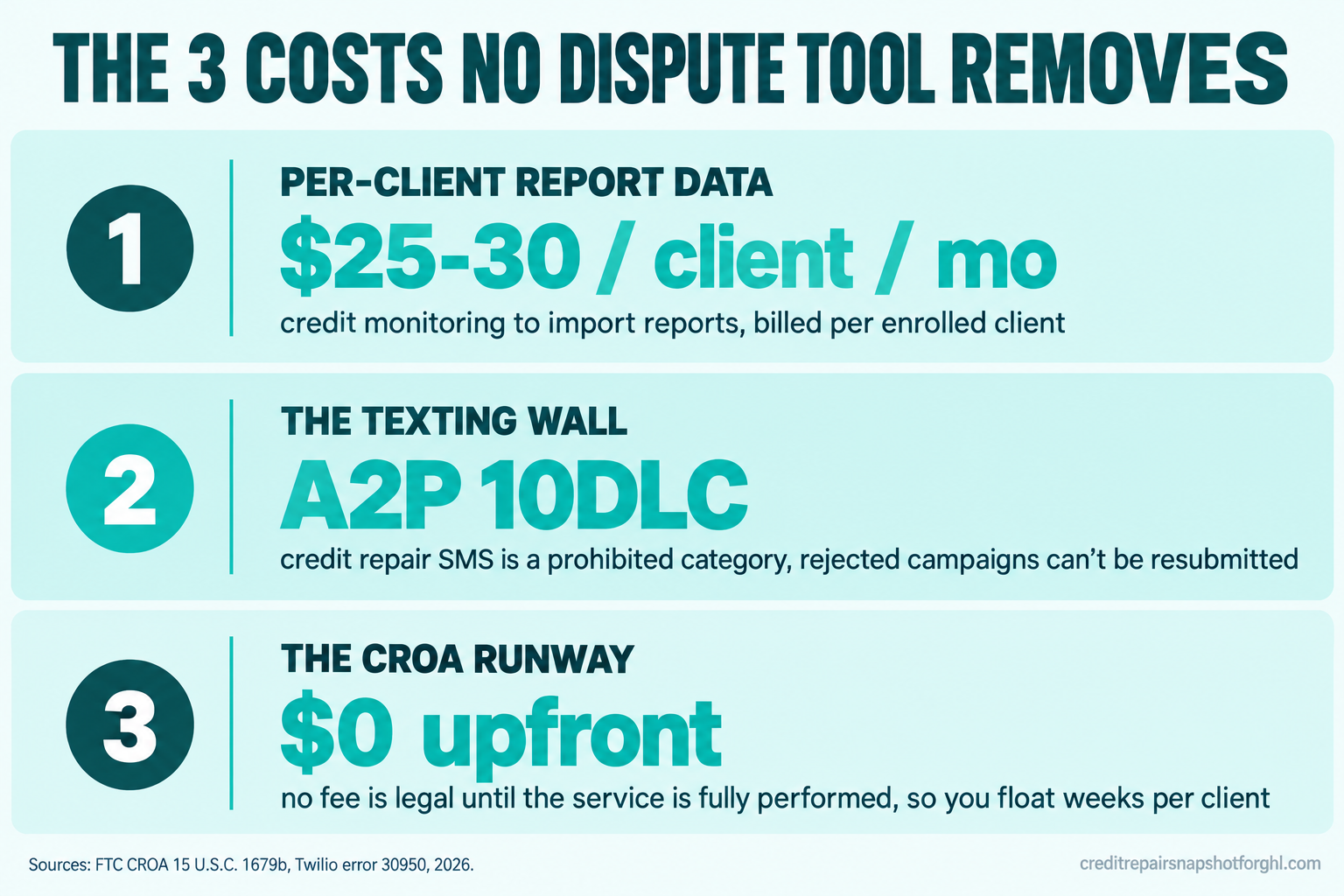
This is the part that matters more than which tool you pick, because it is identical across every option on the list.
Per-client report data
No tool here pulls a credit report on its own. Each imports one, but the report comes from a monitoring service the client subscribes to, and that bill lands every month per enrolled client. DisputeBee’s own documentation points operators at IdentityIQ at about $29.99 a month for that feed (FinMasters). Call it $25 to $30 a client. Carry 50 active clients and that is well over $1,000 a month in report data before you touch your software fee. That dwarfs the gap between a $107 CDM plan and a $129 DisputeFox plan, and it does not change when you switch tools.
The texting wall
Every one of these platforms assumes you can text your clients. In credit repair that assumption breaks. Carrier-level A2P 10DLC registration classifies credit repair as a prohibited content category, and Twilio’s own error documentation states plainly that a rejected credit-repair campaign “is not eligible for resubmission” (Twilio error 30950). So the reminders, updates, and failed-payment texts you counted on will not send until registration is handled right the first time. It is the most common surprise for new operators, and switching dispute tools does not move it an inch. We walk through clearing it in getting A2P 10DLC approved for credit repair.
The CROA runway
This one decides whether you survive year one. Under the Credit Repair Organizations Act you cannot charge or receive a fee for a service before that service is fully performed (FTC, codified at 15 U.S.C. 1679b). No deposits, no upfront enrollment fee for work not yet done. You sign a client, do a month of work, and only then is money legal to bill. The same law gives every client a written contract and a 3-business-day right to cancel (15 U.S.C. 1679e). Multiply that across a growing book and you are financing every new client for weeks. Your software costs $107 or $129. Your runway costs thousands, and it is the number that sinks firms. We break the math down in what a credit repair lead really costs you.
Solo operator, small team, scaling firm
The right answer changes with the size of your book. Run the same framework three ways.
The solo operator, 1 to 30 clients
You are learning the work and financing every client through the CROA window. To stay cheap and simple, CDM Starting at $107 or DisputeBee Business at $129 both work, and DisputeBee removes the cap entirely. To be taught, Credit Repair Cloud Start at $179 buys the training. At this size your real spend is software plus roughly $25 to $30 a client in report data plus the runway, so chasing a $20 software difference is noise. Pick the tool that teaches you or stays out of your way, and put your energy into answering leads fast.
The small team, 30 to 150 clients
Now seats and caps matter. CDM Enterprise at $329 carries 500 clients and 4 users, DisputeFox Growing at $379 carries 1,000 and 5, ScoreCEO Essential at $199 carries 800 and 10. Run the seat math against the client math for your exact shape, because the cheaper headline is not always the cheaper bill. More important, follow-up and billing are now a revenue lever and every dispute tool here is thin there. This is the stage to add an operations layer on top of whichever dispute tool you keep, because this is where firms lose money to churn and missed follow-up faster than any software fee.
The scaling firm, 150 clients and up
Here the dispute tool is the cheap part of your stack. DisputeFox Scaling at $499 holds 2,000 clients, ScoreCEO Advanced at $299 holds 1,500, Credit Repair Cloud climbs to 1,200 and 2,400. Pick on caps and seats, then stop thinking about it. Your cost center is people, report data across hundreds of files, and the revenue lost to churn and failed payments. The firm that wins here is the one whose operations run without a human chasing each step, the whole reason firms stall at 50 clients.
What switching from Client Dispute Manager actually costs
If you have decided to move, price the switch honestly before you jump, because the sticker price of the new tool is the smallest number involved.
Your client files do not transfer cleanly. Dispute history, round status, notes, and documents rarely export from CDM into a tidy import on the other side. Expect to rebuild active files by hand or run both tools in parallel for a month while live clients finish their rounds. That parallel month means paying for both.
Your automations and templates reset. The letter templates, intake flow, and any CDM automations you tuned have to be rebuilt. If you leaned on the Smart Interviewer or the billing setup, you reassemble that logic from scratch, and any staff fluent in CDM loses a week or two of speed on the new interface.
Your clients notice. A new portal, a new login, a different-looking update email. Handled badly, a switch reads as instability right when a client is deciding whether to keep paying you. Handled well, with a short, calm heads-up, it is a non-event, which makes the switch as much a communication job as a technical one.
The honest takeaway: switching is worth it when you have a specific, structural reason, a cap you keep hitting, a CRM you genuinely need, a training gap you want closed. It is not worth it to save $20 a month or chase a cleaner dashboard.
Steal this: the messages that carry a tool switch
The technical migration is the easy half. The half that protects your revenue is what you say to clients while you move. Copy these, change the details, send them.
The client heads-up (send before the switch, not after):
Quick heads-up from [Firm Name]. We are upgrading the system we use to manage your case so your updates and documents are easier to access. Nothing about your plan, your pricing, or the work on your file changes. You will get one new login link on [date]. Your case history and progress all carry over. Reply here any time with questions. Thanks for trusting us with this.
The new-portal welcome (send the day the new login goes live):
Your upgraded [Firm Name] client portal is ready. Here is your secure login: [link]. Everything on your case is inside, including your current round status and documents. Same team, same work, better tools. If anything looks off, reply and we will fix it the same day.
The between-round status update (the one that keeps clients from going quiet):
Update on your file: your current round of disputes was submitted on [date]. The bureaus have up to 30 days to respond under federal law, so the next real movement is expected around [date]. There is nothing you need to do right now. We are tracking it and will message you the moment anything changes.
The review request (send only after a genuine win or a positive reply, never with a promised outcome):
It has been great working with you so far. If you have a minute, a short review of your experience with [Firm Name] really helps other people find us: [link]. No pressure at all, and thank you either way.
The failed-payment recovery text (the quiet revenue leak most operators never automate):
Hi [First Name], this is [Firm Name]. Your payment for this month did not go through, which can happen when a card expires or a bank flags it. Your case is still active. You can update your card here in about a minute: [link]. Reply here if you would rather sort it over the phone.
Notice what every one of these does and does not do. None promises a score increase or a deletion. Each describes process and effort, which is the only language CROA allows. And each one is a message you can automate once and send forever, which is exactly the work a dispute tool does not do and an operations layer does.
Common objections, answered
“I have used Client Dispute Manager for years. Isn’t switching just a hassle for no reason?” Often, yes. If the letters go out and clients get served, the dispute tool is not your problem. The honest move for most long-time CDM users is to keep it and add the operations layer that fixes leads, follow-up, and billing, rather than rip out a tool that works.
“DisputeBee has no client cap for $129. Why would I pay more anywhere else?” Because the cap is not the only thing you buy. DisputeBee is deliberately light on CRM and marketing, and you still pay for separate monitoring to import reports (FinMasters). If you want unlimited clients and you handle everything else elsewhere, it is a strong pick. If you want the tool to also hold your leads and pipeline, it is not.
“Do I need to be technical to move to one of these?” No more than you did to learn CDM. All of them are built for non-technical operators. The real learning curve is not the software, it is rebuilding your templates and flows, which is the same on any platform.
“Can’t I just wait and figure this out later?” You can, but the costs that actually hurt you, the per-client report fees, the texting wall, and the CROA runway, are running whether you switch or not. Fixing those is more urgent than picking a new dispute tool, and it does not require switching at all.
“Is GoHighLevel a replacement for my dispute tool?” No, and anyone who tells you that is confusing two jobs. GoHighLevel and a credit-repair operations layer run the business around the disputes. Your dispute tool still builds and tracks the letters. Most firms past their first handful of clients run both.
Frequently asked questions
Client Dispute Manager alternatives: common questions
What is the cheapest Client Dispute Manager alternative in 2026?
Among real business plans, DisputeFox and DisputeBee both start at $129 a month, ScoreCEO at $149, and Credit Repair Cloud at $179. CDM's own Starting plan at $107 is actually the cheapest working tier, so switching for price alone rarely saves money. See DisputeFox pricing and Client Dispute Manager pricing.
Is DisputeFox or ScoreCEO better if I outgrew CDM's client cap?
Both carry more clients per tier than CDM's 500-client ceiling: DisputeFox Growing holds 1,000 clients and 5 users for $379; ScoreCEO Essential holds 800 and 10 for $199. Price the tier that matches your actual book, since the entry plans both cap low (DisputeFox at 100, ScoreCEO at 50).
Does switching from Client Dispute Manager move my client files automatically?
No. Dispute history, round status, notes, and documents rarely export cleanly from one credit repair platform to another. Expect to rebuild active files by hand or run both tools in parallel for a month while live clients finish their rounds, which means paying for both during the overlap.
Will my client texts work after I switch tools?
Only after you clear A2P 10DLC carrier registration, and that is independent of which dispute tool you use. Carriers classify credit repair as a prohibited content category, and Twilio's documentation states a rejected campaign is not eligible for resubmission, so it has to be done right the first time. Switching dispute tools does not help with this.
Do any of these tools let me charge clients upfront?
No tool changes the law. Under CROA you cannot collect a fee before the service is fully performed, and every client gets a written contract and a 3-business-day right to cancel. That is true on CDM, DisputeFox, ScoreCEO, Credit Repair Cloud, and DisputeBee alike.
If the disputes are fine, do I even need to switch?
Usually not. If the letters go out and clients get served, your dispute tool is not the problem. The more common fix is to keep it and add an operations layer that handles lead response, CROA-safe onboarding, between-round updates, reviews, and failed-payment recovery, the work no dispute tool is built to do.
About the author
Simone Braxton spent eight years running back-office operations for credit-repair firms before moving full-time into GoHighLevel implementation. She specializes in turning client onboarding and follow-up into repeatable workflows that keep firms inside CROA guardrails while cutting the manual follow-up that burns out small teams. She is based in Atlanta, writes about onboarding sequences and compliance documentation, and has watched more operators switch software for the wrong reasons than the right ones.
Sources
- Client Dispute Manager, pricing tiers, caps, and add-ons (2026): clientdisputemanagersoftware.com/pricing
- DisputeFox, pricing, user and client caps, add-ons (2026): disputefox.com/pricing
- ScoreCEO, plans and pricing (2026): scoreceo.com/plans-pricing
- Credit Repair Cloud, pricing plans and client caps (2026): creditrepaircloud.com/pricing
- FinMasters, DisputeBee review (pricing and monitoring requirement): finmasters.com/disputebee-review
- Capterra, Client Dispute Manager reviews: capterra.com Client Dispute Manager
- Twilio, error 30950, credit repair campaign not eligible for resubmission: twilio.com/docs/api/errors/30950
- FTC, Credit Repair Organizations Act (advance-fee ban, written contract, cancellation): ftc.gov CROA
- U.S. Code, advance-fee ban: 15 U.S.C. 1679b; 3-business-day cancellation: 15 U.S.C. 1679e
- Experian, average U.S. FICO score 713 in 2025: experian.com average credit score