
It is a Monday and a client you signed four months ago just emailed asking for every dollar back. She paid you $1,800. You did the work. You pulled her reports, ran three dispute rounds, kept her updated. None of it matters, because her lawyer read your contract and found it was missing one required line. Under federal law that contract is now void. Not weakened. Void. A court will not enforce it, and the money you earned is a number she can sue to recover, with her attorney fees on top.
That is the part most owners never hear until it happens. The credit repair contract is not the boring page you paste from a Facebook group. It is the one document that decides whether you can keep what you earn. Get a clause wrong and the law does not just fine you. It erases the agreement entirely.
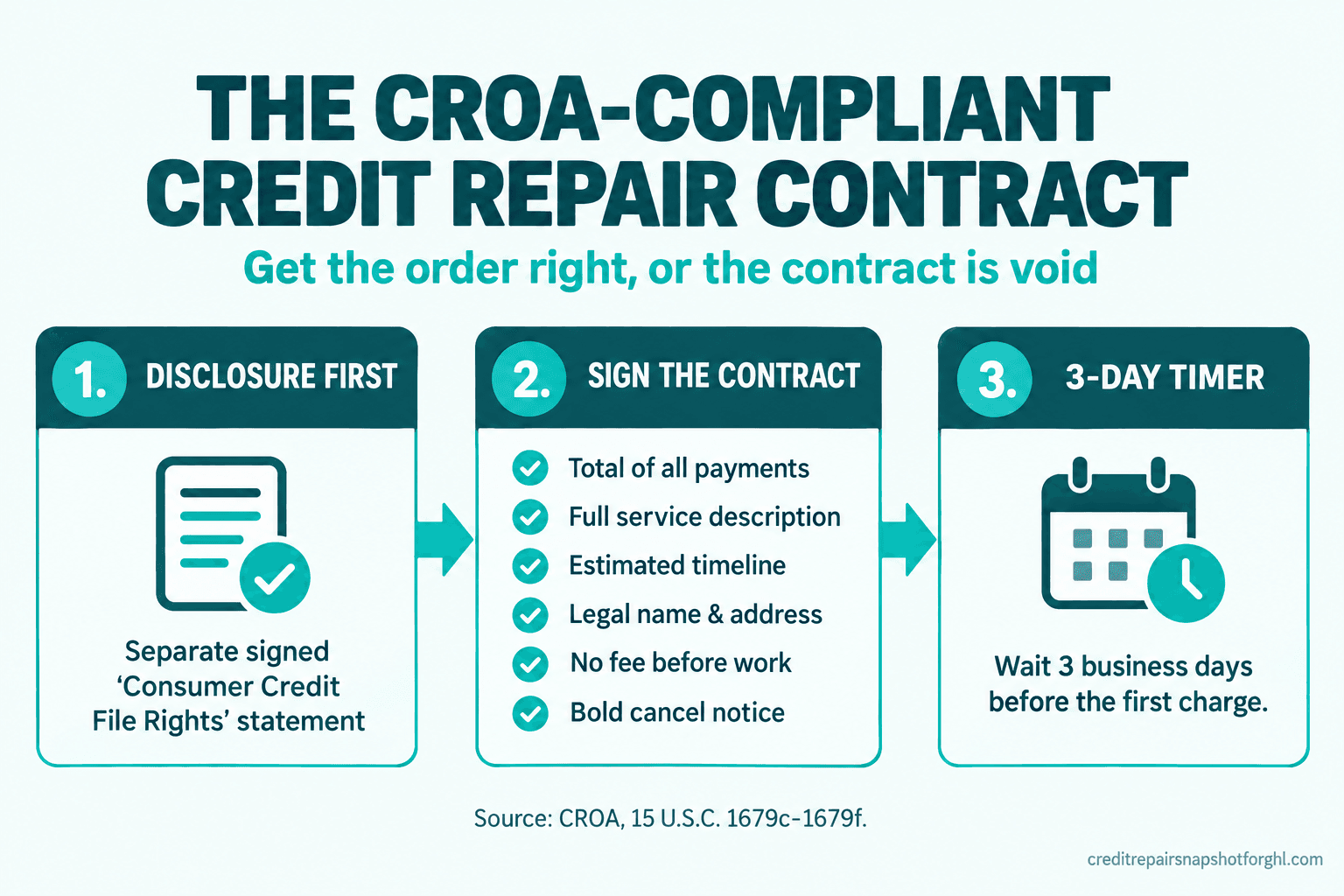
The answer up front: your contract has to carry six specific things CROA requires, a separate rights disclosure has to be signed before the contract, and a 3-business-day cancellation notice has to sit next to the signature with a form attached in duplicate. Miss any of it and the contract is void and unenforceable under 15 U.S.C. 1679f. This post walks every clause, gives you language to adapt, and shows how each one gets missed.
Nothing here is legal advice. This is an operations checklist. Have a CROA attorney licensed in your state review your final disclosure, contract, and cancellation form before you use them.
Table of contents
- What a non-compliant contract costs you
- The two documents, and their order
- The disclosure that comes first
- The six clauses your contract must contain
- The 3-day cancellation, done right
- The same contract at three sizes
- State rules that stack on top
- Objections operators have
- FAQ
What a non-compliant contract costs you
Most owners treat the contract as a formality and the disputes as the real work. The law sees it the other way. The dispute work is governed loosely. The contract is governed precisely, and the penalty for getting it wrong is the harshest in the statute.
Start with the void rule. 15 U.S.C. 1679f(c) is one sentence: a contract that does not comply with CROA “shall be treated as void” and “may not be enforced by any Federal or State court or any other person.” If your contract is missing the bold cancellation statement, or you never delivered the separate disclosure, the client owes you nothing, even for work you performed. You cannot sue to collect. You cannot send it to collections. The agreement legally never existed.
Then stack the liability. 1679g lets a client recover the greater of actual damages or the total they paid you, plus punitive damages the court adds, plus costs and attorney fees, and it allows class actions. The downside is not just a refund. It is the refund, a penalty on top, and the bill of the lawyer who sued you.
The same statute the regulators used against the biggest firm in the country is the one that voids your contract on a Monday morning. In August 2023 the CFPB announced a settlement imposing a $2.7 billion redress judgment against the Progrexion group behind Lexington Law and CreditRepair.com, after a court found earlier that year they violated the advance-fee provision of the Telemarketing Sales Rule. It added civil penalties of $45.8 million and $18.4 million, plus a 10-year telemarketing ban (CFPB, Aug 28 2023).
Those figures were built on the same two failures that sink small shops: taking money before the work was done, and papering it with agreements that did not hold up. Here is how the $2.7 billion settlement split between redress and penalties.
The 2023 Progrexion / Lexington Law settlement, in millions of USD. The $2.7B redress figure is a proposed stipulated judgment subject to court approval. Source: CFPB, August 28 2023.
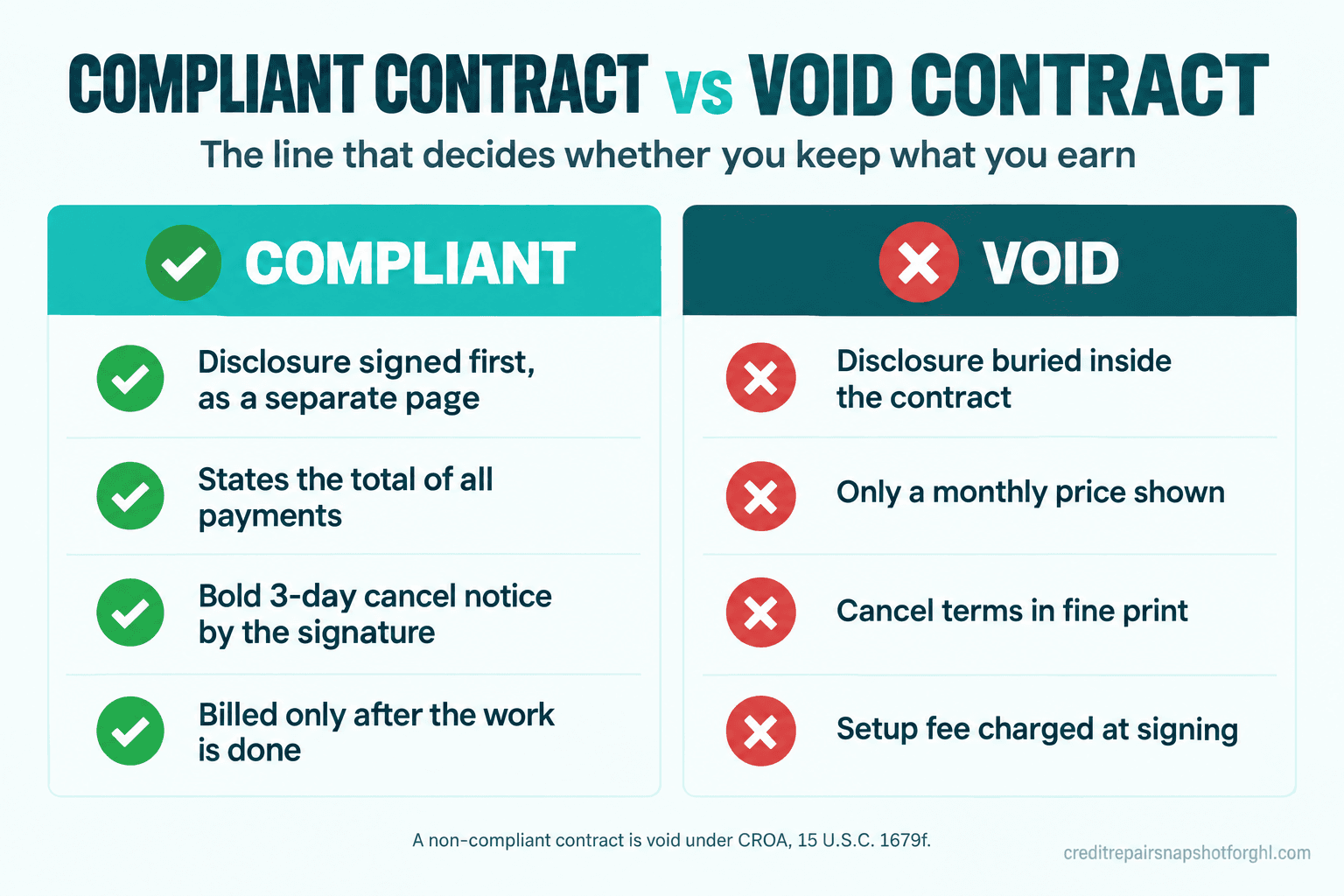
The difference between the two columns above is the whole post. Get one wrong and you are on the right side of the slide. Here is how to land every line of it, in order.
The two documents, and their order
CROA is not one piece of paper. It is two, and the order is mandatory. Document one is the disclosure, a standalone statement called “Consumer Credit File Rights Under State and Federal Law,” signed before the contract. 1679c(b) requires it to be “a document which is separate from any written contract.” Document two is the contract, carrying the six clauses and the cancellation notice.
Fold the disclosure into the contract, or sign the contract first, and you have broken the sequence the statute requires. The safe flow, which the CROA-compliant onboarding checklist walks step by step, is three separate, timestamped actions: sign the disclosure, present the contract, start the cancellation clock. This is why running onboarding by email is so error-prone, and why firms at volume move it into a workflow that will not release the contract until the disclosure acknowledgment is on file.
The disclosure that comes first
Its content is dictated by 1679c(a). You do not write your own version. The client has to be told:
- They can dispute inaccurate information in their own file directly with the bureau, for free, without paying anyone.
- They can get a copy of their credit report from a bureau, free in the circumstances the law allows.
- They have a right to sue a credit repair organization that violates CROA.
- They can cancel their contract within three business days.
- The FTC enforces the rules, and the client can report violations.
You deliver this as its own page, the client signs an acknowledgment of receipt, and you keep the signed copy two years (1679c(c)).
Failure mode: burying the disclosure as “Section 9” of the contract. That breaks the separate-document rule and feeds straight into the void outcome. Two pages, two signatures, disclosure first.
The six clauses your contract must contain
15 U.S.C. 1679d(b) is the controlling text. I have split it into six working clauses, because the fifth and sixth are where the lawsuits live. For each: the requirement, language to adapt, and how operators blow it.
| Required clause | What it must say | The common mistake |
|---|---|---|
| 1. Payment terms | Total amount of all payments, to you or anyone else | A monthly figure with no stated total |
| 2. Service description | Full, detailed description of services and guarantees | Vague “we dispute items on your report” |
| 3. Timeline | Estimated completion date or length of time | No date and no time estimate at all |
| 4. Identity | Your legal name and principal business address | A PO box or a brand name, not the entity |
| 5. Advance-fee reality | Payment collected only after services performed | A setup fee or first payment at signing |
| 6. Cancellation notice | Bold statement by the signature, form attached | Cancellation buried in fine print |
Clause 1: The total amount of all payments
The statute requires “the terms and conditions of payment, including the total amount of all payments.” A monthly number alone is not enough. If you charge $99 a month for an expected six-month engagement, state the structure and the total.
Failure mode: writing “$99/month” and stopping. An attorney reads that as hiding the real cost, and it fails the “total amount of all payments” test.
Clause 2: A full and detailed description of the services
“A full and detailed description of the services to be performed,” says the statute, “including all guarantees of performance.” Two traps. Vague beats you: “we fix your credit” describes nothing and promises everything. And “guarantees” cuts the other way, because 1679b(a) bars promising a result. Describe the work in detail and guarantee the work, never the outcome.
Failure mode: copying a description that promises deletions. That is 1679b(a)(1) territory, the same ban that governs the sales call. Guarantee the effort, never the result.
Clause 3: The estimated completion date or length of time
The contract must estimate either “the date by which such services will be complete” or “the length of period necessary to perform such services.” Not a result date, an honest estimate of how long the work runs. A dispute round and reinvestigation generally runs on a 30-day cycle under the FCRA, so an engagement built on a set number of rounds has a defensible estimate.
Failure mode: leaving the term blank because “every client is different.” That is exactly why the statute asks for an estimate. A blank fails 1679d(b) outright.
Clause 4: Your legal name and principal business address
“The name and principal business address of the credit repair organization.” The easiest clause to fail. The name has to be your legal entity, the one on your state registration, not just your brand or DBA. The address has to be a principal business address, which most authorities read as a real physical location, not only a PO box.
Failure mode: putting only the brand name and a PO box. It reads as hiding who you are, which is what this clause exists to prevent.
Clause 5: The advance-fee reality, in the payment terms
Not a separate line in 1679d, but the clause that gets small firms sued. 1679b(b) bans charging money “for the performance of any service before such service is fully performed.” Your payment terms have to reflect that. No setup fee at signing. No first month collected before the first month of work. If your sales call takes a card on the spot, your contract describes an illegal transaction, and the void rule follows. This is why compliant firms bill in arrears and lean on systems built for recurring billing without chargebacks, where the charge fires after the service period.
Failure mode: the “small enrollment fee” at signup. It feels harmless and it is the clearest advance-fee violation there is. The Progrexion case turned on this exact issue. Do not collect a dollar before a service period is performed.
Clause 6: The bold cancellation statement by the signature
1679d(b)(4) requires a “conspicuous statement in bold face type,” located “in immediate proximity to the space reserved for the consumer’s signature.” Not on page three. Right next to where they sign.
Failure mode: the cancellation language in regular type, in the body. The statute is specific: bold, next to the signature. Formatting is a compliance requirement here, not a design choice.
The 3-day cancellation, done right
Clause 6 points to an attached form, and 1679e spells it out almost word for word. The client gets it in duplicate, two copies, so they can mail one back and keep one. The window runs until midnight of the third business day that begins after the day they sign. Business days, not calendar days, so a Friday signature usually runs through the following Wednesday.
Failure mode one: not attaching the form, or attaching one copy instead of two. The statute says “in duplicate.” Two copies.
Failure mode two: starting work or billing inside the window. Let the three business days pass before the first service period and the first charge. This is the most common place a technically compliant contract gets undone by operations: the paperwork is perfect, and someone runs the first charge on signing day.
Failure mode three: counting calendar days. A client who signs Friday and cancels Tuesday is inside the window. Count business days, and write the real deadline date into the form so there is no argument.
The same contract at three sizes
The six clauses do not change with the size of your shop. What changes is how you keep the sequence from breaking, because the failures are almost never the words. They are the workflow.
The solo operator. You do everything, so your risk is the Friday-afternoon signing where you take the card to “lock them in.” Build one rule you never break: disclosure signed, contract signed, three-business-day timer, then the first charge. At minimum, put the cancellation deadline on a calendar the moment a client signs. You can run this on paper, but past a handful of clients the dates start slipping.
The two-to-five person team. Now the person who sells is not the one who sends the contract or runs billing, and the gap between them is where the disclosure gets skipped or the charge fires early. You need one source of truth showing, per client, whether the disclosure is signed, whether the contract is signed, and when the window closes. This is the size where firms move onboarding into a workflow that blocks the next step until the previous one is on file, the theme of why you can’t scale past 50 clients.
The larger firm with staff. You cannot watch every contract, so your exposure is systemic: one bad template, copied into every new file, is a class action, not a single refund. At this size the contract and disclosure are locked documents only compliance can edit, every signing is timestamped, and billing cannot fire before the window closes by system rule, not by someone remembering.
State rules that stack on top
CROA is the federal floor. Many states add Credit Services Organization statutes with registration, surety bonds, and sometimes their own required contract language. You have to satisfy both.
The sharpest example is Georgia. Under O.C.G.A. 16-9-59, operating a credit repair services organization is a misdemeanor, with narrow exemptions for 501(c)(3) nonprofits and licensed attorneys acting within their practice. A perfect CROA contract does not help there, because the issue is the business itself. Texas runs a regime under Finance Code Chapter 393 that requires registration and a surety bond, and operators cite a $10,000 bond figure you should confirm against the current statute before relying on it.
Check your own state before you adapt any language above, and re-check any state you expand into. We keep a running state licensing and bond checklist and a broader CROA compliance playbook for exactly this.
Objections operators have
“My template came from a successful firm, so it must be fine.” Maybe, or it came from a firm that has not been sued yet, or one in a state with different rules than yours. The void rule does not care where your template came from. It cares whether the six clauses, the separate disclosure, and the bold cancellation notice are all present and in order. Check it against this list, then have an attorney confirm.
“The disclosure and cancellation form feel like I’m talking clients out of signing.” They are legally required, and the premise is wrong anyway. Telling a client up front that they can cancel in three days and dispute items themselves for free does not kill deals. It builds the trust that closes skeptical buyers. Hiding a cancellation right just converts a clean cancellation into a chargeback and a complaint.
“I’ll just take a small deposit to keep clients committed.” That is the advance-fee violation, full stop. There is no compliant version of a fee collected before the work is performed. If commitment is the goal, get it from a signed agreement and a clear plan, not from money you are not allowed to hold yet.
Finishing Monday morning
Back to the client asking for her $1,800. If your contract carried the six clauses, if she signed the separate disclosure first, if the bold cancellation notice sat by her signature with the form attached in duplicate, and if you waited out the three business days before the first charge, then you did the work and the agreement holds. Her email is a conversation, not a lawsuit. If any one of those was missing, the law decided it before she emailed.
That is the reason to treat the contract as the most important document in your business. Get the six clauses right, keep the disclosure separate and first, attach the cancellation form in duplicate, and bill only after the work. Then have your attorney sign off. The paperwork is not the boring part of credit repair. It is the part that lets you keep what you earn.
What must a credit repair contract include under CROA?
Under 15 U.S.C. 1679d(b) the contract must include the total amount of all payments; a full description of the services and any guarantees; an estimate of the completion date or length of time; the organization's legal name and principal business address; and a conspicuous bold-type 3-business-day cancellation statement next to the signature, referring to an attached notice of cancellation form. Separately, before the contract is signed, the consumer must receive and sign the 'Consumer Credit File Rights Under State and Federal Law' disclosure required by 1679c.
What happens if my credit repair contract doesn't comply with CROA?
It is void. 15 U.S.C. 1679f(c) says a non-compliant contract shall be treated as void and may not be enforced by any court or any other person, so you cannot sue to collect or send it to collections, even for work you performed. On top of that, 1679g lets the consumer recover the greater of actual damages or everything they paid, plus any punitive damages the court allows and reasonable attorney fees, and it permits class actions.
Can I charge a setup fee or take the first payment when the client signs?
No. CROA 1679b(b) bans charging or receiving money for a service before that service is fully performed. A setup fee or first month collected at signing is an advance fee, the exact violation at the center of the federal case against the firms behind Lexington Law and CreditRepair.com. Bill after each service period is completed, and wait until the 3-business-day cancellation window closes before the first charge.
How long is the cancellation period, and how is it counted?
Three business days. Under 15 U.S.C. 1679e the consumer may cancel without penalty or obligation at any time before midnight of the third business day that begins after the day they signed. These are business days, not calendar days, so a Friday signing typically runs through the following Wednesday. You must attach a Notice of Cancellation form in duplicate, and the contract must carry a bold-type cancellation statement next to the signature.
Does the CROA disclosure go inside the contract?
No. 15 U.S.C. 1679c(b) requires the 'Consumer Credit File Rights Under State and Federal Law' statement to be a document separate from any written contract, and 1679c(a) requires it before any contract is signed. The consumer signs an acknowledgment of receipt, and you keep the signed copy two years. Folding the disclosure into the contract, or signing the contract first, breaks the sequence and can make the contract void.
Related reading
- The CROA-compliant client onboarding checklist for the full intake flow around these documents.
- The credit repair sales script: what you can and can’t legally say for the call that leads into the signature.
- Credit repair licensing and bond requirements by state for the state layer that stacks on CROA.
- Recurring billing without chargebacks for credit repair for billing that respects the advance-fee ban.