It is a Tuesday morning in Marietta and you have the LLC paperwork open in one tab and a half-built intake form on your second monitor. You are three weeks from your first paying client. Then a comment in a local Facebook group stops you cold: “You know credit repair is actually illegal in Georgia, right?” You assume it is a troll. You search the statute number someone drops in the replies. It is real.
Here is the short answer before you spend another dollar: in Georgia, operating a for-profit credit repair services organization is a criminal offense, a misdemeanor, under O.C.G.A. § 16-9-59. Georgia did not write a licensing law like most states. It wrote a ban. There are narrow exemptions, there is a legal way to build a credit business in the state, and there is a bill that might change this. The default today is that the model you were about to launch is a crime where you live.
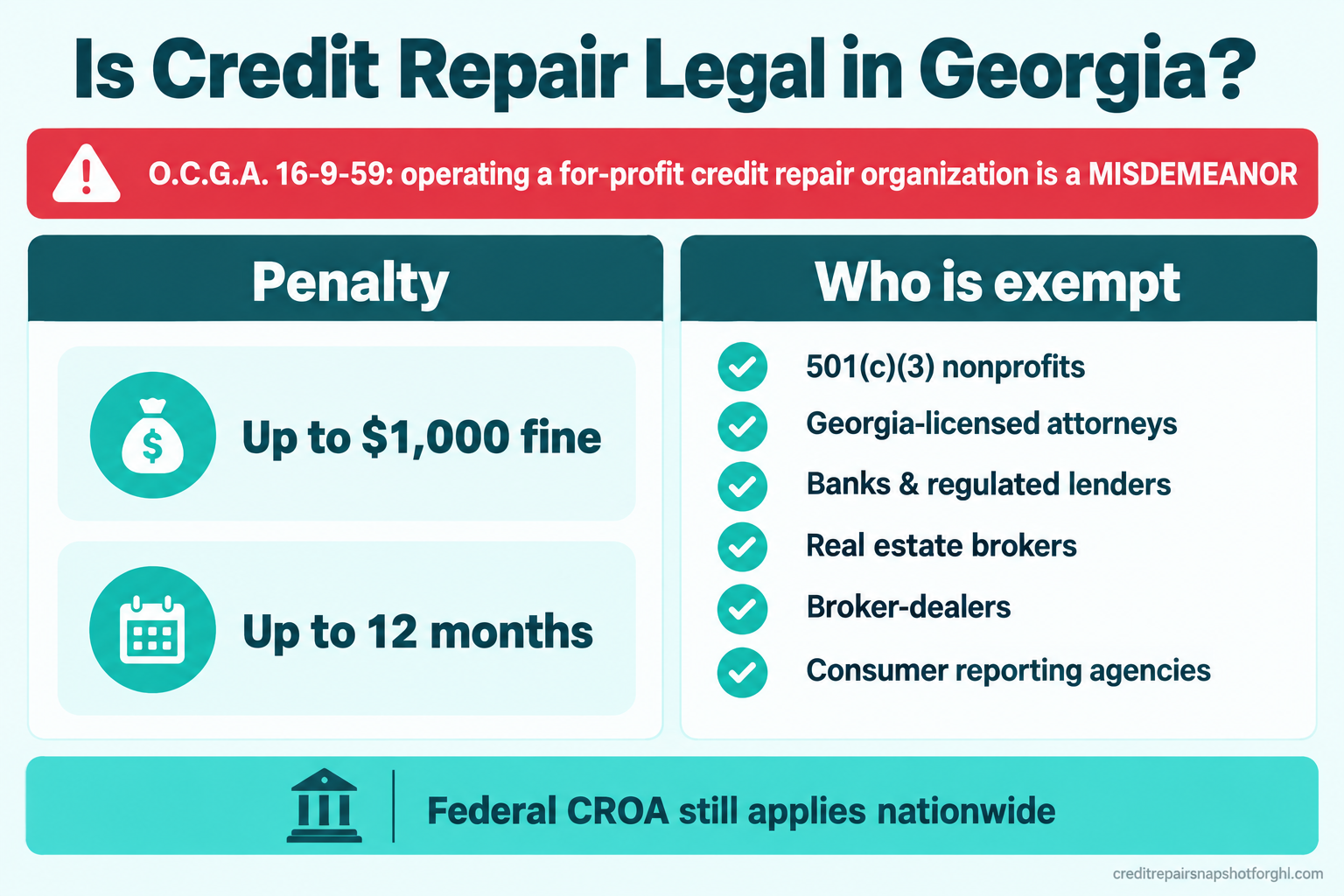
Table of contents
- Is credit repair legal in Georgia? The short answer
- What the Georgia credit repair statute says
- Who is exempt from the Georgia credit repair ban
- CROA still applies, even in Georgia
- The legal ways to run a credit business in Georgia
- Solo operator, out-of-state firm, or attorney-backed model
- Steal this: compliant language and positioning
- Objections and hard questions
- Frequently asked questions
Is credit repair legal in Georgia? The short answer
No, not the way most people mean it. The standard model, where you sign up consumers, charge a monthly fee, and dispute items on their reports for them, is prohibited in Georgia for a for-profit business. The state treats it as a criminal matter, not a regulated trade you can register for.
This surprises people because every neighboring state handles it differently. In Texas you register as a Credit Services Organization and post a surety bond. Most states register, bond, and allow the business. Georgia skipped that framework and criminalized the activity. An advocacy petition for a bill to change this calls Georgia the only state where for-profit credit repair is prohibited outright, and while that is an advocacy claim, it matches what the statute does on its face.
That one fact reshapes your launch plan. It decides what kind of business you are allowed to build.
The law targets a specific activity for a fee, carves out several categories, and sits under federal law. Once you see the boundaries, a legal path appears.
What the Georgia credit repair statute says
The law sits in Title 16, the crimes and offenses title, not a licensing title. That placement tells you how Georgia thinks about it.
Subsection (b) says a person “commits the offense of operating a credit repair services organization when he or she owns, operates, or is affiliated with a credit repair services organization.” Subsection (c) says anyone who does “shall be guilty of a misdemeanor” (Justia, 2021 Georgia Code). Note “affiliated”: the ban reaches not just the owner but employees, contractors, and partners.
A “credit repair services organization” is defined by what it sells: services to improve a buyer’s credit record, history, or rating, or to obtain an extension of credit for a buyer, in return for payment. The two triggers are a fee and a promise about credit. Strip either out and you are usually outside the definition, which is the doorway the legal models walk through below.
A misdemeanor is not trivial here. Under O.C.G.A. § 17-10-3, the penalty is a fine of up to $1,000, confinement of up to 12 months, or both. A “high and aggravated” misdemeanor under § 17-10-4 raises the fine ceiling to $5,000.
Maximum fine by Georgia misdemeanor class, in US dollars. Confinement can reach 12 months in both classes. Source: O.C.G.A. § 17-10-3 and § 17-10-4.
Who is exempt from the Georgia credit repair ban
The statute excludes several categories. Fall cleanly inside one and the ban does not apply. Georgia’s consumer protection office publishes the statute text and the exempt groups (consumer.georgia.gov):
- 501(c)(3) nonprofit organizations exempt from federal taxation.
- Georgia-licensed attorneys rendering services within the scope of their legal practice.
- Banks, savings institutions, and regulated lenders under state or federal supervision.
- Licensed Georgia real estate brokers acting within their license.
- Registered broker-dealers acting within SEC or CFTC regulation.
- Consumer reporting agencies under the federal Fair Credit Reporting Act.
The two that matter most to a small operator, the nonprofit and the attorney, both come with a catch. The nonprofit exemption is real, but a 1997 Georgia Attorney General opinion warns that a 501(c)(3), though exempt from the credit repair statute, is still barred from “debt adjusting” under a separate law, O.C.G.A. § 18-5-1 and following (Georgia AG opinion 1997-6). You cannot file for nonprofit status, keep the same fee-for-dispute model, and call yourself safe.
The attorney exemption is narrower than it looks. It covers a Georgia-licensed attorney rendering services “within the course and scope” of their practice. A lawyer running a subscription business staffed by non-lawyers is not obviously inside it. An exemption is a legal position you defend, not a label you slap on, so have a Georgia lawyer set up and document the structure before you rely on it.
CROA still applies, even in Georgia
Clearing the Georgia hurdle does not clear the federal one. The federal Credit Repair Organizations Act, 15 U.S.C. §§ 1679 to 1679j, applies to credit repair services nationwide, and the FTC enforces it. Operate under an exemption in Georgia, or legally from another state, and CROA still governs how you take money and what you promise. The three rules that break the most businesses:
- No advance fees. A credit repair organization “may not charge or receive any money or other valuable consideration for the performance of any service” before that service is fully performed, under 15 U.S.C. § 1679b(b). You bill for work already completed, which is why credit repair has a cash-flow problem other service businesses do not.
- A three-day cancellation right. The consumer can cancel within three business days of signing, for any reason, no penalty, under 15 U.S.C. § 1679e. You give them a separate, dated Notice of Cancellation.
- A written contract with disclosures. It must carry a conspicuous cancellation statement near the signature line, and you provide the “Consumer Credit File Rights” disclosure before anyone signs.
CROA also prohibits untrue or misleading claims. You cannot promise to remove accurate negative items or guarantee a score increase. That is federal, not Georgia-specific, and it is the fastest way a well-meaning operator ends up in an enforcement file.
The legal ways to run a credit business in Georgia
The ban exists. Now the useful part: the paths operators actually use to build a legitimate credit business in the state. None is a loophole. Each is a different business with its own rules, failure modes, and ceiling. Pick on purpose.
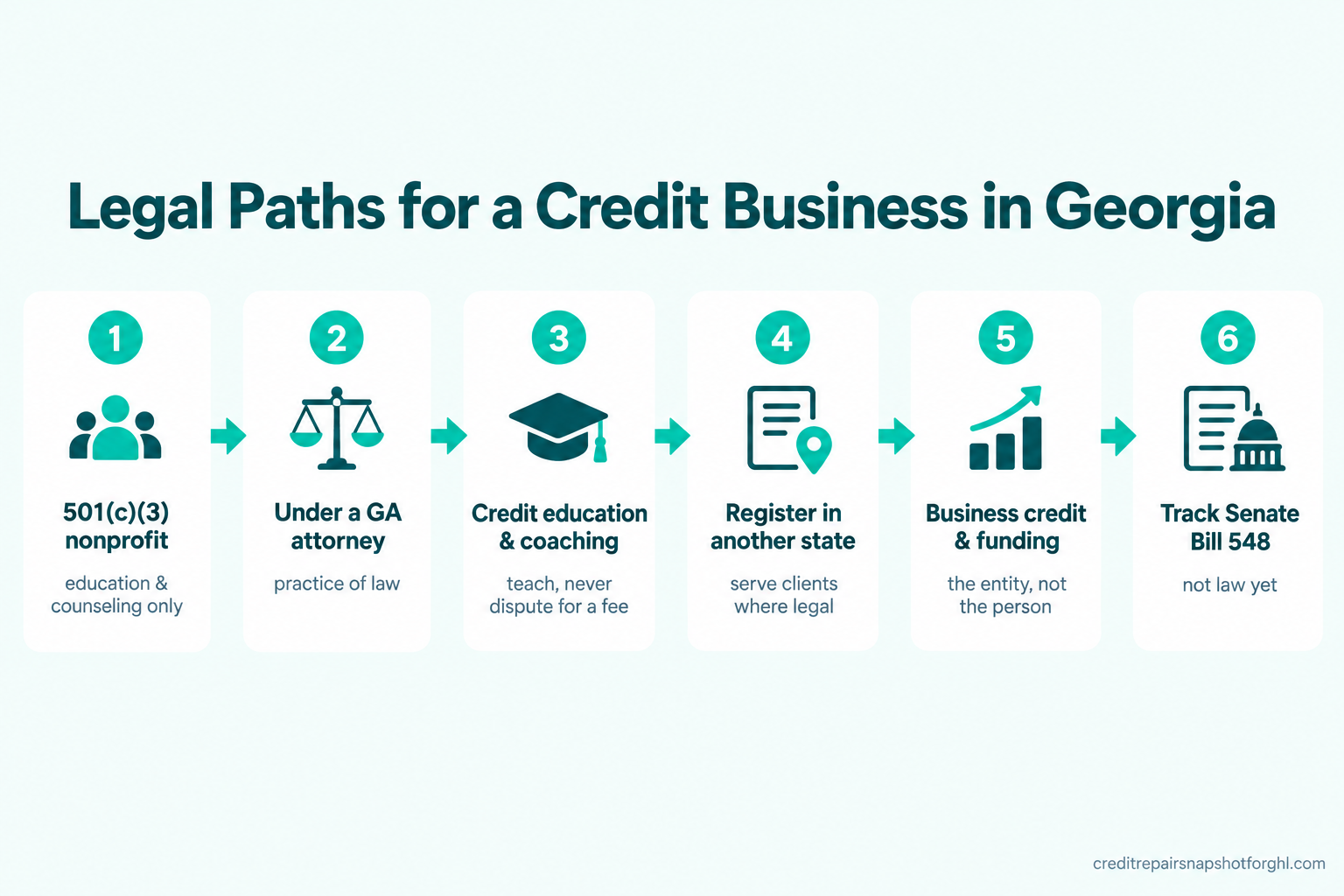
1. Operate as a genuine 501(c)(3) nonprofit
This fits the exemption on its face, and many legitimate credit counseling groups run this way. The catch, from the 1997 AG opinion, is that you still cannot do “debt adjusting,” so the model has to be education and counseling. Failure mode: treating the nonprofit as a tax trick while running the same fee-for-dispute business. A nonprofit has a board, a mission, and limits on how money moves.
2. Work under a Georgia-licensed attorney
A law firm practicing credit-related consumer law can do work a credit repair organization cannot, because the attorney exemption carves it out. Some operators partner with a Georgia attorney who supervises the file. Failure mode: a lawyer lending their name while non-lawyers run a subscription business untouched by any real legal practice. Regulators have seen that structure and do not love it.
3. Pivot to credit education and coaching
This is the most common clean path for a solo operator. You do not dispute items for a fee or promise to improve a person’s credit. You teach: how to read their own reports, dispute inaccuracies themselves, and build positive history. Priced and described as education, that sits outside the “improve a buyer’s credit for a fee” trigger. Failure mode: calling it coaching while quietly doing the disputes and promising results. The conduct decides it, not the label. Our CROA-compliant sales script shows how to describe this work without crossing into prohibited claims.
4. Register in another state and serve clients there
Some operators form and run a compliant credit services organization in a state that licenses the activity, register and bond there, and serve clients where the model is legal. Failure mode: forming an LLC elsewhere on paper while actually operating in Georgia with Georgia clients. Where you are “operating” and “affiliated” is a facts question, and a mailbox in another state does not move your operation out of Marietta. Our state-by-state licensing and bond checklist covers what each state requires.
5. Focus on business credit and funding readiness
Helping a business owner establish an EIN, build vendor tradelines, and get funding-ready is a different animal from consumer credit repair. It is about a business entity’s creditworthiness, not a consumer’s personal credit for a fee. Failure mode: blurring the line and quietly working on the owner’s personal report. Keep the work genuinely about the business. Our business credit building service outlines where that line sits.
6. Track Senate Bill 548 and the law’s direction
Georgia has tried to change this before. Senate Bill 548 in the 2025 to 2026 session would add an exemption for a category of for-profit credit repair organization, but as of the most recent action I could confirm it was still in committee and not enacted. An earlier 2021 bill, SB 371, also failed. Failure mode: launching on the assumption the law “is about to change.” Build for the law as written today and treat any future exemption as upside.
Solo operator, out-of-state firm, or attorney-backed model
The right answer differs depending on who you are. Three honest scenarios.
The Georgia solo operator working from home. No legal team, limited cash, no room for a criminal or civil problem. Your cleanest path is education and coaching, or a business-credit focus. Price your work as what it is, never promise a deletion or a score, and bill for work already performed. For classic dispute-based consumer work, you relocate the operation to a state that licenses it or you stop. The coaching pivot is not a consolation prize. It is a legitimate, scalable business that sidesteps your biggest risk.
The out-of-state firm with Georgia leads. You are registered and bonded in a state that allows credit repair, and Georgia residents keep filling out your form. Tread carefully, because “affiliated with” is broad. The safe version is a legal read on which clients you can take and documentation of where your operation actually lives, not treating Georgia like any other state because your paperwork is elsewhere.
The attorney-backed model. You have a real Georgia attorney who supervises files as the practice of law. This is the most defensible way to do dispute-based work in the state, and the slowest and most expensive to stand up. It only works if the attorney is genuinely practicing, not renting a license. Build it properly and it opens the door the solo operator cannot.
- ⚖️1997
AG opinion on nonprofits
Georgia AG confirms 501(c)(3) groups are exempt but still barred from debt adjusting under O.C.G.A. 18-5-1.
- 📜2021
SB 371 introduced
An effort to authorize for-profit credit repair; the statute was not changed.
- 🏛️2025-2026
SB 548 introduced
Would add a for-profit exemption to 16-9-59. In committee, not enacted.
- 🚦Today
The ban stands
For-profit credit repair remains a misdemeanor in Georgia. Build for the law as written.
Steal this: compliant language and positioning
You do not have to invent the words. Here is language operators use on the clean paths above. Adapt it and have your own lawyer bless it.
A coaching service description that stays outside the ban. It sells education and effort, never an outcome:
“I provide credit education and coaching. I teach you how to read your own credit reports, exercise your rights under the Fair Credit Reporting Act, dispute inaccuracies yourself, and build positive credit history over time. I do not dispute items on your behalf for a fee, and I cannot and will not promise that any item will be removed or that your score will reach any particular number.”
A CROA-safe intake disclaimer for any credit-related work, on your intake form and in your agreement:
“Results vary and are not guaranteed. No one can legally remove accurate, current, and verifiable information from a credit report. You have the right to dispute inaccurate information yourself for free. You may cancel this agreement within three business days, for any reason, at no cost, using the Notice of Cancellation provided to you.”
A billing statement that respects the advance-fee ban:
“You are not charged for work before it is done. Each month, you are billed only for the education, coaching, and services actually completed in the prior period. There is no setup fee or upfront payment required to begin.”
A referral line for when a lead wants dispute work you cannot provide:
“Georgia law limits how for-profit businesses offer credit repair, so I focus on coaching that puts you in control of your own disputes. If you want someone to handle disputes directly, I can point you to a nonprofit credit counseling agency or a licensed attorney.”
Telling a prospect the truth builds more trust than any pitch. For the full contract shape and federal disclosures, see our CROA-compliant contract template walkthrough, and for the cost of standing a business up compliantly, our credit repair startup cost breakdown.
Objections and hard questions
“Everybody in Atlanta is doing credit repair. How is it illegal?” Enforcement is uneven, and plenty of operators run until a complaint lands. That is not the same as legal. The ones named in an AG action are usually the ones who grew loud, promised results, and took money up front. “Most people do not get caught” is a risk description, not a compliance plan.
“Can I form an LLC in Florida and keep working from Georgia?” Maybe, and it turns on facts a blog post cannot settle. If your operation, staff, and daily work are in Georgia, a registered agent elsewhere probably does not move you out of reach of a statute that covers being “affiliated with” a credit repair organization. Put this to a Georgia lawyer first.
“Does this mean a CRM like GoHighLevel is off-limits in Georgia?” No. Software is neutral. The tools that run onboarding, billing, and client communication are not the issue. The business model they support is. A compliant credit coaching or nonprofit operation runs on the same systems a dispute shop would.
Frequently asked questions
Is credit repair illegal in Georgia?
Operating a for-profit credit repair services organization is a misdemeanor in Georgia under O.C.G.A. 16-9-59. The state criminalized the activity rather than licensing it. Narrow exemptions cover 501(c)(3) nonprofits, Georgia-licensed attorneys, regulated banks and lenders, licensed real estate brokers, registered broker-dealers, and consumer reporting agencies.
What is the penalty for operating a credit repair business in Georgia?
It is a misdemeanor. Under O.C.G.A. 17-10-3, a standard Georgia misdemeanor carries up to a $1,000 fine and up to 12 months of confinement. A high and aggravated misdemeanor raises the fine ceiling to $5,000, and civil exposure under consumer protection law and federal CROA can be larger.
Can I do credit coaching or credit education in Georgia?
Yes. Teaching people to read their reports, exercise their Fair Credit Reporting Act rights, dispute inaccuracies themselves, and build positive history is education, not fee-for-dispute credit repair, as long as you do not promise outcomes or dispute items for a fee. Price and describe it as education and keep your claims CROA-clean.
Does the Georgia ban apply if my company is registered in another state?
It can. The statute reaches anyone who owns, operates, or is affiliated with a credit repair organization, and where you actually operate is a facts question. An LLC in another state while you run the business from Georgia with Georgia clients does not reliably put you outside the statute. Get a Georgia lawyer's read first.
Is it legal for a nonprofit to do credit repair in Georgia?
501(c)(3) nonprofits are exempt from the credit repair statute, but a 1997 Georgia Attorney General opinion warns they remain barred from debt adjusting under O.C.G.A. 18-5-1. It has to be a genuine nonprofit doing education and counseling, not a fee-for-dispute business using nonprofit status as a label.
Does federal CROA still apply if I operate legally in Georgia?
Yes. The federal Credit Repair Organizations Act applies nationwide regardless of state law. Even an exempt Georgia operator owes the written contract, the Consumer Credit File Rights disclosure, the three-day cancellation right, the advance-fee ban, and the ban on misleading claims. The FTC and state attorneys general enforce it.
This is operational and educational information for business owners, not legal advice. Credit repair law is state-specific and changes. Confirm the current text of O.C.G.A. § 16-9-59 and consult a Georgia-licensed attorney before launching or changing a credit-related business in the state.