For a Charlotte credit repair firm, the honest answer to “should I do my own social media or pay someone to do it?” comes down to two numbers: the cost of building an in-house content team (roughly $270,000 a year in salaries) versus the cost of a done-for-you service ($397 a month). If you have the payroll and the appetite to manage four creative hires, DIY can work. If you don’t — and most owners running dispute rounds don’t — a done-for-you service publishes more consistently, across more channels, for a fraction of the price.
This is a practical, numbers-first comparison written for owners and the GoHighLevel agencies that serve them. We sell the operating system, never the outcome: nothing here promises a score change or a deletion, and neither should your social content. What good social media does do is put a compliant, trustworthy firm in front of the anxious Charlotte consumer who just got denied — before they scroll to a competitor.
Table of contents
- DIY vs done-for-you: what each actually means
- The real cost of DIY social media
- The hidden cost DIY never shows: your time and consistency
- Why social media matters for credit repair specifically
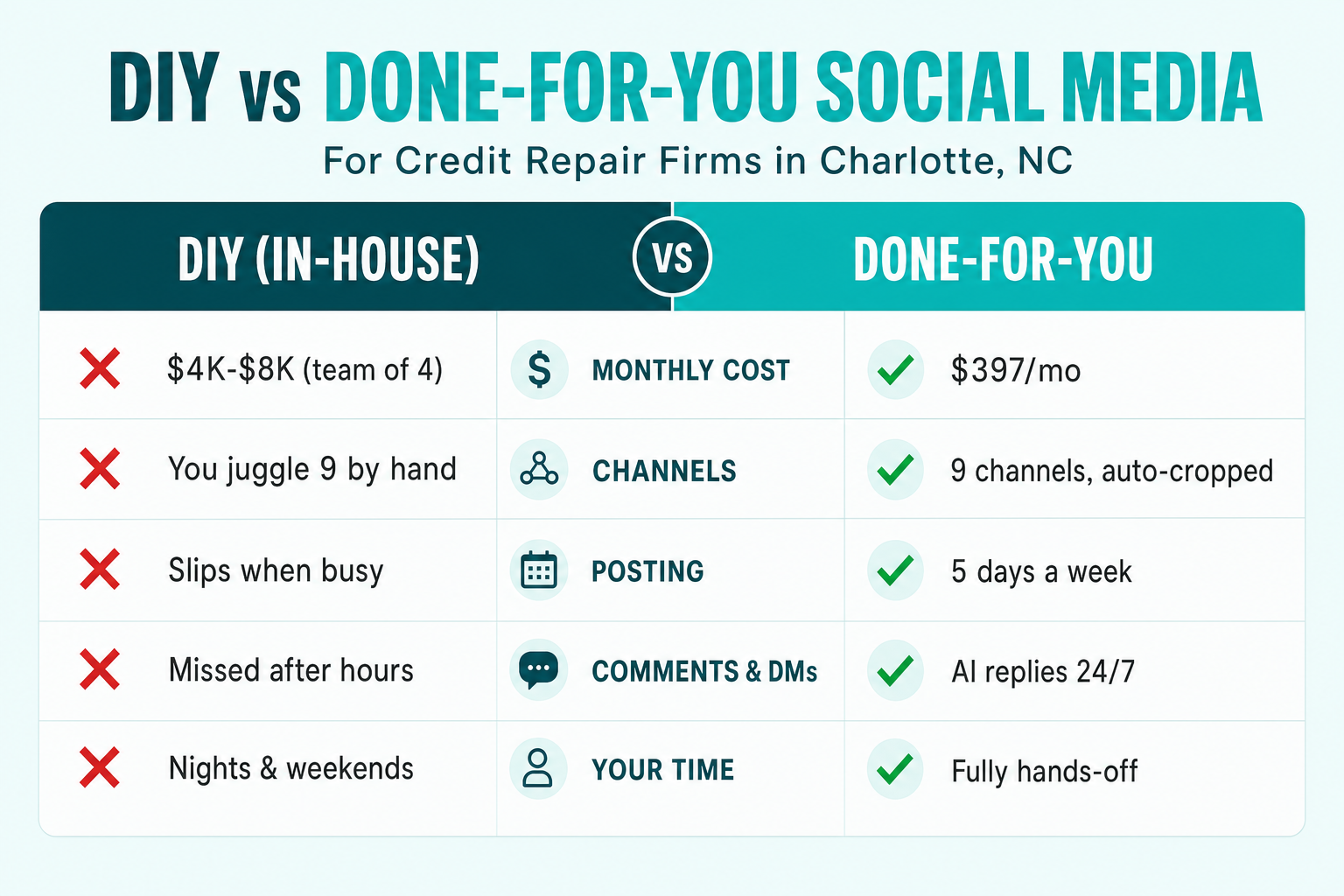
- Side-by-side: DIY vs done-for-you for a Charlotte firm
- What done-for-you actually includes
- When DIY still makes sense
- Frequently asked questions
- About the author
- Sources
DIY vs done-for-you: what each actually means
Before comparing cost, define the two options honestly, because “DIY” hides a lot of labor.
DIY (in-house) social media means your firm owns the whole production line: coming up with topics, writing captions, designing carousels, shooting and editing Reels, cropping every asset to nine different platform sizes, scheduling posts, and — the part everyone forgets — replying to every comment and DM before the prospect moves on. In a Charlotte firm, that job lands on the owner, a stretched-thin VA, or a patchwork of freelancers.
Done-for-you social media means a service runs that production line for you. You keep the brand, the strategy, and full control of compliance; they produce the content, publish it across your channels on a set cadence, and handle first-response on comments and DMs. You approve the voice once and stay focused on rounds and results.
The difference isn’t quality of intent — plenty of owners want to post consistently. The difference is whether a repeatable system exists when the week gets busy. That’s the lens for the rest of this comparison.
The real cost of DIY social media
The sticker price of DIY is “$0 — I’ll just do it myself.” The actual price is a team, because doing all nine channels well is genuinely four jobs: someone to plan and manage, someone to design, someone to edit video, and someone to reply to the community. Here’s what those roles cost as average US salaries.
Hire all four full-time and you’re past $270,000 a year before payroll taxes and benefits. Almost no Charlotte credit-repair firm does that — instead they hire pieces of it: a freelance editor here, a designer on Fiverr there, a part-time social manager. A blended freelance team typically lands around $4,000–$8,000 a month, and it still leaves the owner coordinating four people and filling every gap.
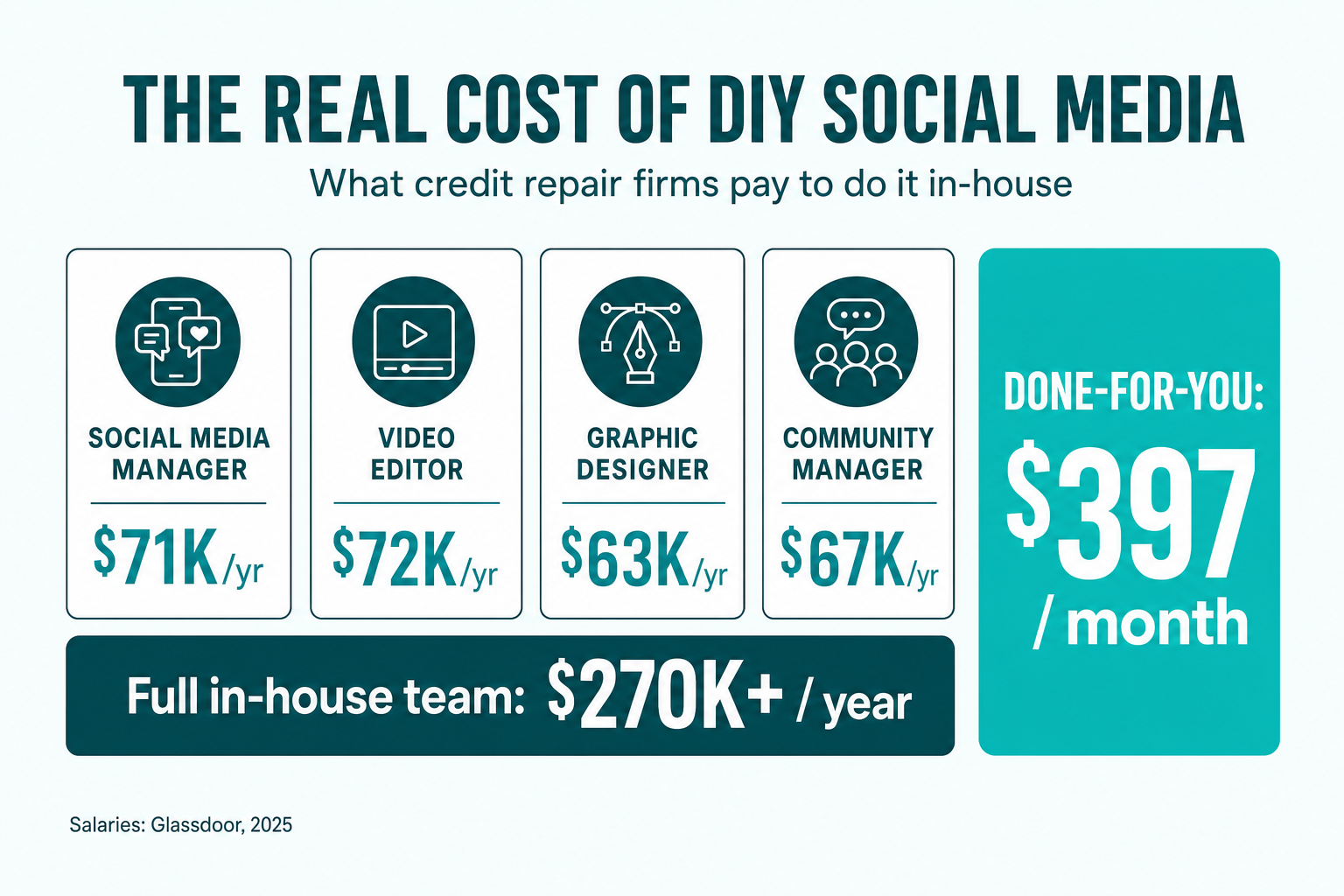
Put the two numbers next to each other and the gap is stark. Even the cheapest honest version of DIY — a lean freelance blend — is roughly ten to twenty times the cost of a done-for-you service, and you’re still the one holding it together.
The hidden cost DIY never shows: your time and consistency
Salaries are the visible cost. The one that quietly kills DIY is consistency, and it never appears on an invoice.
Social platforms reward firms that show up on a steady cadence and quietly bury the ones that post in bursts. But bursts are exactly what DIY produces: you batch a week of content when things are calm, then a heavy round of disputes hits, three clients need callbacks, and posting goes dark for two weeks. The algorithm notices before your audience does. When you come back, your reach has reset and you’re rebuilding momentum you already paid for.
There’s a second silent leak: the comment you never answered. A prospect in Charlotte watches your Reel about disputing a collection at 9:40 p.m., comments “how much?”, and waits. If your reply lands two days later, they’ve already messaged three other firms and booked with whoever answered first. DIY social almost always means comments and DMs get handled “when I get to it” — which is the exact window a lead goes cold. (We break down closing that gap in our Instagram and Facebook DM automation playbook.)
The firms that win on social aren’t the ones with the best single post. They’re the ones that never went quiet. Consistency is a system problem, not a motivation problem — and systems are exactly what a busy owner can’t spare attention for.
This is why “effort” is the wrong frame. A motivated owner can out-effort a done-for-you service for exactly one good month. What they can’t do is out-system it for twelve.
Why social media matters for credit repair specifically
Every business benefits from social media. Credit repair depends on it more than most, for three structural reasons.
1. You can’t run Google Ads. Google’s financial-products policy prohibits credit-repair advertising outright (Google Ads policy). Meta places credit repair under restricted financial categories as well. That removes the fastest paid shortcut most local businesses use, and pushes the weight of demand generation onto the channels you own: organic search and organic social. Going dark on social isn’t a missed nicety — it’s abandoning one of your only two front doors. (Its partner channel is covered in our credit repair SEO guide.)
2. Your buyer is emotional, skeptical, and researching you first. Someone who just got denied on a mortgage or an auto loan is anxious and wary — the niche is shadowed by scammy operators. Before they book, they look you up, and increasingly that means your social profiles, not just your website. A firm posting steady, educational, plainly-compliant content reads as real and safe. A ghost-town profile with three posts from last year reads as risky.
3. Video is where the reach is — and it’s the hardest thing to DIY. Short-form video (Reels, TikTok, YouTube Shorts) earns disproportionate reach, and marketers know it: a record 93% report good ROI from video (Wyzowl, 2025). But video is also the single most time-consuming asset to produce — scripting, filming, editing, captioning. It’s the first thing a solo owner drops and the first thing a done-for-you service is built to ship. We cover the channel-level tactics in our guides to Instagram, TikTok, and YouTube marketing for credit repair.
Side-by-side: DIY vs done-for-you for a Charlotte firm
Here’s the honest scorecard for a typical owner-operated credit-repair firm.
| Factor | DIY (in-house) | Done-for-you |
|---|---|---|
| Real monthly cost | $4,000–$8,000 (freelance team) or $270K+/yr (full-time) | From $397/mo |
| Channels covered | However many you can keep up with | 9: FB, IG, Google Business Profile, LinkedIn, TikTok, YouTube, Pinterest, Threads, Bluesky |
| Posting cadence | Slips when you’re busy | 5 days a week, every week |
| Video/Reels | Rarely — no time to shoot and edit | Produced weekly |
| Comments & DMs | Answered “when I get to it” | AI agents reply 24/7, book to your calendar |
| Compliance control | Full — but all on you | Full — you approve the voice; drafts stay in CROA guardrails |
| Setup time | Weeks of hiring and coordinating | Live after one onboarding call |
| What it costs you | Your nights, weekends, and focus | One approval, then hands-off |
Neither column promises a result — no service can, and any that does isn’t being honest. What the right column buys is presence and responsiveness at a price a firm can actually sustain, so the strategy and client relationships stay yours.
What done-for-you actually includes
“Done-for-you” is vague until you see the deliverables. For a credit-repair firm, our social media package is built around the exact production line DIY struggles with:
- Content, weekly: 1 text post, 1 image, 2 carousels, and 1 reel every week — score-jump education, myth-busting, and before/after process stories, written in a compliant voice.
- Published 5 days a week across 9 channels — Facebook, Instagram, Google Business Profile, LinkedIn, TikTok, YouTube, Pinterest, Threads, and Bluesky — each cropped and captioned per platform, automatically.
- 3 AI agents that reply to comments, DMs, and website chat in seconds, qualify the lead, and drop a booking link — so the “how much?” comment becomes a consult instead of a lost prospect.
- A monthly report from every channel, so you always see what the investment is doing.
- White-label and cancel with 15 days’ notice — from $397/mo for one brand, or $997/mo for up to four (multiple locations or reselling to your own GHL sub-accounts).
That’s the four in-house roles — manager, designer, editor, community — plus the automation layer, folded into one flat fee that’s less than a single week of one of those salaries.
When DIY still makes sense
Done-for-you isn’t automatically right for everyone. DIY is the better call when:
- You genuinely enjoy it and have the hours. If you’re a natural on camera, batch content easily, and post consistently without it stealing from client work, keep going — authentic owner-led content is powerful.
- You already employ a capable in-house team. If a social manager and editor are already on payroll for other reasons, the marginal cost of using them is low.
- You’re pre-revenue and time-rich, cash-poor. Very early on, your own sweat is the cheapest input you have. Do it yourself until the disputes-and-billing side of the business needs all your attention — then revisit.
For most owner-operated Charlotte firms past the startup phase, though, the constraint isn’t willingness — it’s hours. The moment social media is competing with billable dispute work for your evenings, done-for-you stops being an expense and starts being the thing that keeps a channel you can’t afford to lose alive. If your bottleneck is broader than content — you need someone running the whole GHL back office — a dedicated GHL VA may be the better fit, and the two pair well.
Frequently asked questions
Is done-for-you social media really cheaper than doing it myself?
It's cheaper than doing it well. If you value your time at $0 and post inconsistently, DIY looks free. But matching what a done-for-you service ships — daily posts across 9 channels, weekly video, and 24/7 comment and DM replies — takes roughly four roles (manager, designer, editor, community) costing about $270K/year full-time, or $4,000–$8,000/month as freelancers. Our service starts at $397/month.
Will outsourcing my social media get me in trouble with CROA?
Not if it's done right. You remain the credit repair organization responsible for compliance, and you approve the brand voice up front. A credit-repair-specific service drafts content that describes process and effort — never promised deletions or score increases — and you keep final say on everything published. The risk is higher with a generic agency that doesn't know CROA than with a niche done-for-you service that does.
How is this different from just using a scheduling tool?
A scheduling tool (Buffer, Hootsuite, or GoHighLevel's own planner) publishes content you still have to create. Done-for-you means the content itself — captions, graphics, carousels, and Reels — is produced for you, then published. The tool solves distribution; the service solves production, which is the part that actually eats an owner's time.
Which channels should a Charlotte credit repair firm prioritize?
Start where your buyers already research you: Instagram and Facebook for local reach and reviews, Google Business Profile for 'credit repair near me,' and TikTok or YouTube Shorts for short-form video, which earns the most reach. A done-for-you service covers all 9 at once, but if you're DIY, pick two or three and be relentlessly consistent rather than spreading thin. See our Instagram and TikTok playbooks.
How fast will I see results from social media?
Organic growth compounds — expect meaningful traffic and inbound in roughly 3–5 months as algorithms start surfacing your content to new audiences. Because a done-for-you service posts 5 days a week across 9 channels, a single reel can break out much sooner. Anyone promising overnight results — or a guaranteed lead count — isn't being honest.
Can I do a hybrid — post some content myself and outsource the rest?
Yes, and many firms do. Owner-led face-to-camera videos plus a done-for-you engine for the volume (carousels, graphics, cross-posting, and comment/DM response) is a strong mix. You bring the authenticity; the service brings the consistency and the nine-channel reach.
About the author
Marcus Pennington is a retention and recurring-revenue consultant who advises credit-repair business owners and the GoHighLevel agencies that serve them. A former SaaS churn analyst, he focuses on the unglamorous economics of growth — what actually costs money, what protects monthly recurring revenue, and where owners quietly overspend. He is allergic to hype and partial to a clean cost comparison.
Editorial personas are original and fictional, created for editorial attribution and subject-matter framing. They are not real staff and do not provide legal or financial advice.
Related posts
- How Houston Credit-Repair Firms Turn Comments Into Booked Consults: A DM Automation Playbook
- Instagram Marketing for Credit Repair
- TikTok Marketing for Credit Repair
- Credit Repair SEO: The Organic Growth Playbook
- 2026 Credit Repair Industry Statistics
Sources
- Wyzowl — State of Video Marketing (2025): wyzowl.com/video-marketing-statistics
- Glassdoor — Social Media Manager salary (2025): glassdoor.com
- Glassdoor — Video Editor salary (2025): glassdoor.com
- Glassdoor — Graphic Designer salary (2025): glassdoor.com
- Glassdoor — Community Manager salary (2025): glassdoor.com
- Google Ads — Financial products and services policy (credit repair prohibited): support.google.com/adspolicy
- BrightLocal — Local Consumer Review Survey (2025): brightlocal.com