

A New York City prospect who just got denied on an apartment application in 2026 doesn’t always open Google and scroll blue links anymore. A growing share of them type “who can help me fix my credit in NYC” into ChatGPT, ask Perplexity, or read the AI Overview that Google now stacks above the search results — and they act on the handful of firms the AI names back. If your firm isn’t one of those names, you never enter the conversation. Answer Engine Optimization (AEO) and Generative Engine Optimization (GEO) are how you become the firm the AI cites.
This is a practical, CROA-safe playbook for getting a New York City credit-repair business surfaced and quoted by AI search — the concrete steps, in order, with the data behind why each one matters. We sell the operating system, never the outcome: nothing here promises a score change, a deletion, or a ranking, and neither should your marketing.
Table of contents
- Why AI search now decides who NYC prospects call
- What AEO and GEO actually mean
- The 7-step playbook to get cited by AI search
- How to tell whether AI engines are citing you
- The compliance line you cannot cross
- Frequently asked questions
- About the author
- Related reading
- Sources
Why AI search now decides who NYC prospects call
Answer first: AI search matters for a New York City credit-repair firm because a large and growing share of your prospects now get their shortlist of firms from an AI, not from a page of ten blue links — and the AI only names sources it can read, trust, and quote. If your site isn’t structured for that, you’re invisible in the exact moment a prospect decides who to call.
Three shifts make this urgent for this niche specifically.
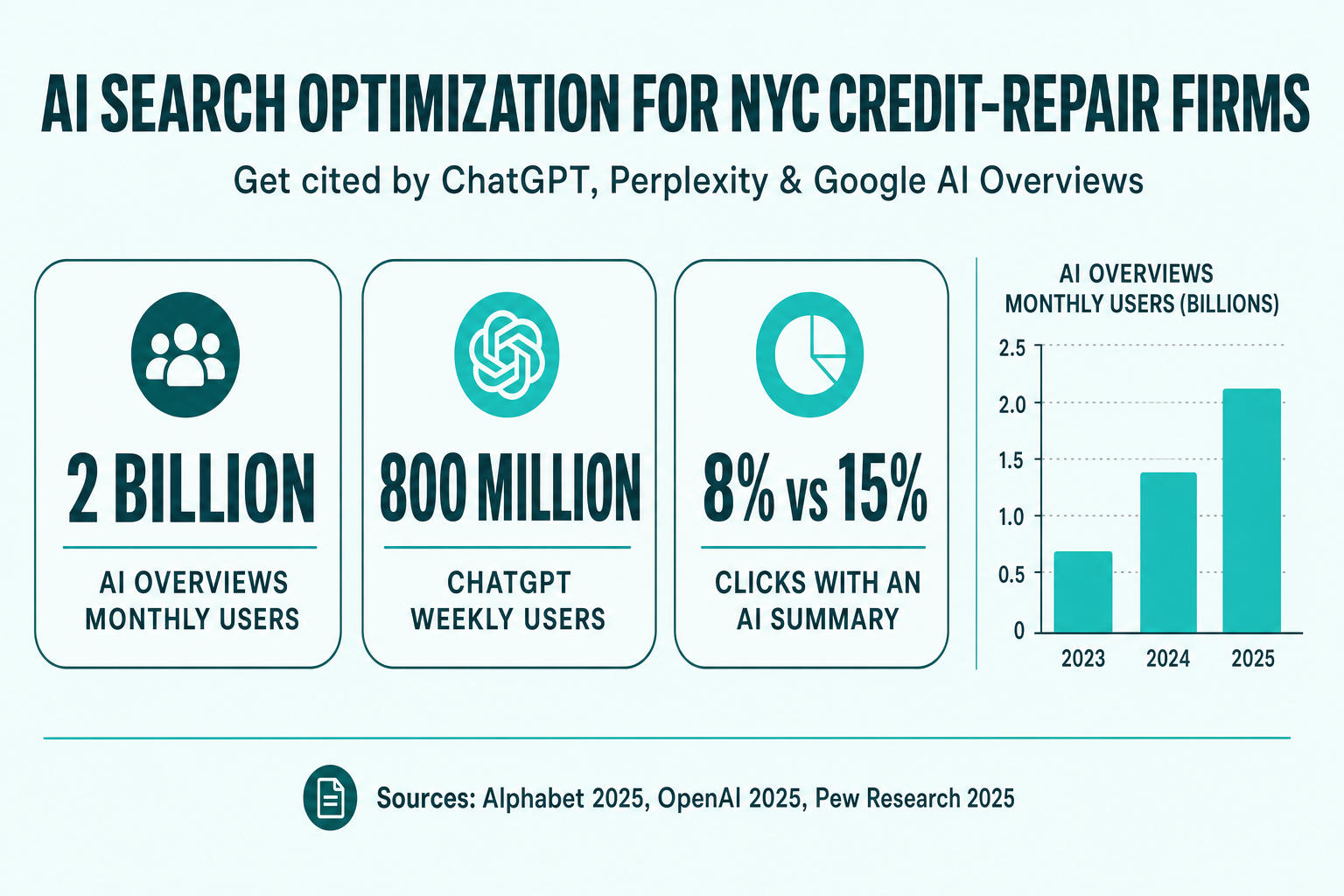
First, the audience has genuinely moved. The scale is no longer speculative.
Second, the click is disappearing. Even when your firm ranks, an AI summary sitting above the results absorbs the attention. Pew Research tracked real browsing and found that when an AI summary appeared, users clicked any traditional search result on just 8% of those searches — versus 15% when no summary appeared — and only 1% clicked a source link inside the summary itself (Pew Research Center, 2025).
Third, you can’t buy your way back in. Google’s advertising policy bans credit-repair ads from serving at all, so you can’t offset lost organic and AI visibility with paid traffic. Every prospect arrives through organic search, the map pack, referrals, social — or, increasingly, an AI answer. Losing that channel is pure waste. (For the search-side of this, see our credit repair SEO playbook and the Astro vs GoHighLevel page-speed comparison.)
And the demand is real. In 2024 the CFPB logged more than 2.8 million consumer complaints, and about 85% were about credit or consumer reporting (CFPB, 2024). Roughly 30% of U.S. consumers carry a subprime score below 670 (Experian, 2025), and the FTC’s landmark study found 1 in 5 consumers had an error on at least one credit report (FTC, 2013). Across the five boroughs, people are actively asking for help — the only question is whether the AI they ask can find and cite you. For the full market picture, see our 2026 credit repair industry statistics.
What AEO and GEO actually mean
Answer first: AEO (Answer Engine Optimization) is structuring your content so answer engines — Google’s AI Overviews, Bing Copilot, voice assistants — can extract a direct, correct answer and attribute it to you. GEO (Generative Engine Optimization) is the broader practice of making generative tools like ChatGPT and Perplexity choose your firm when they compose an answer. They overlap heavily, and for a local service business the goal is the same: be the clearly-structured, trustworthy, machine-readable source the AI reaches for.
The mechanics differ from classic SEO in three ways:
- Traditional SEO optimizes to rank a page so a human clicks it.
- AEO/GEO optimizes to be extracted and cited inside an answer the human may never click past.
That changes what you build. Ranking rewards keywords and links; being cited rewards clarity, structure, direct answers, and trust signals a language model can parse. The good news for credit-repair firms: AI answers appear most on exactly the informational, question-shaped searches your prospects run. BrightEdge found AI Overview coverage is dramatically higher for informational intent than transactional — over 80% for some informational categories versus under 20% for commercial ones (BrightEdge, 2025). “How do I fix my credit after an eviction?” is an informational query. That’s your home field.
The 7-step playbook to get cited by AI search
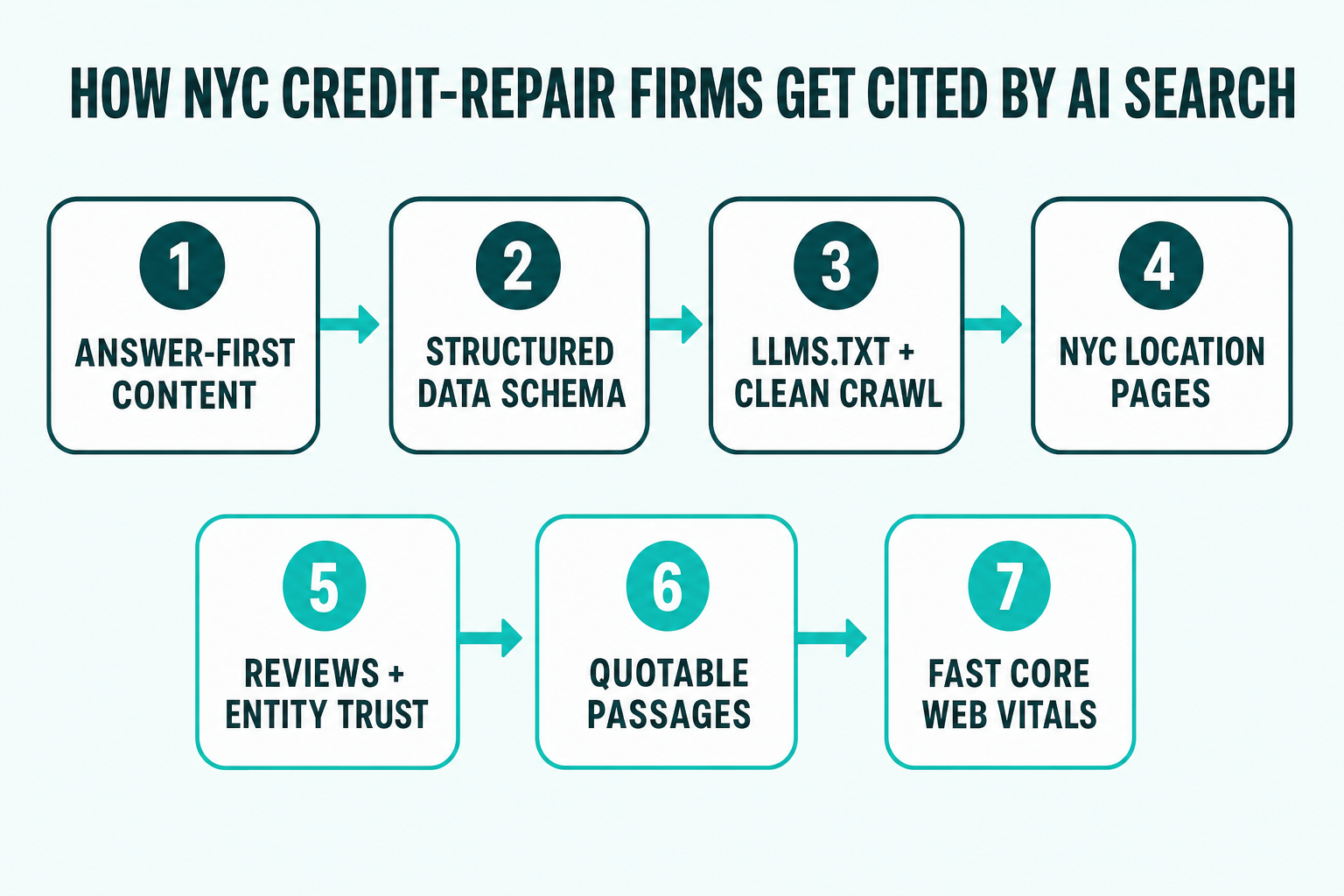
Here’s the build, in order. Each step compounds on the last — do them in sequence and you turn a generic marketing site into a source AI engines trust enough to name.
Step 1 — Answer the real question, first, in plain words
Open every important page and blog post with a direct, self-contained answer to the question a prospect actually typed, in two or three sentences, before any preamble. AI engines lift the passage that most cleanly answers the query. A page that buries the answer under a founder story gets skipped; a page that leads with “Yes — under the Fair Credit Reporting Act you can dispute inaccurate items on your New York credit report yourself, and a credit-repair firm can manage that process for you. Here’s how it works…” gets quoted.
Write to the questions, not just the keywords: “How much does credit repair cost in NYC?”, “Is credit repair legal in New York?”, “How long does it take?” Each deserves its own answer-first section with a question-shaped H2 or H3.
Step 2 — Add the structured data AI engines read
Schema.org markup (JSON-LD) is how you hand a machine unambiguous facts: your business name, that you’re a LocalBusiness/ProfessionalService, the Service types you offer, your areaServed (New York City and the boroughs), your hours, and your FAQPage answers. Structured data doesn’t guarantee a citation, but it removes the ambiguity that makes an AI skip you — and emerging analysis of AI citations finds pages carrying rich, attribute-complete schema are referenced more often than bare pages (SSRN working paper, 2025). Every FAQ block on this site, for instance, emits valid FAQPage JSON-LD automatically. Don’t hand-roll it inconsistently; make it a build-time default across the whole site.
Step 3 — Ship a clean llms.txt and a crawlable site
AI crawlers need to reach and parse your content. Three files do the heavy lifting: a correct sitemap.xml, a robots.txt that welcomes the crawlers you want, and an llms.txt — an emerging standard file that gives language models a clean, plain-text map of your most important pages. Pair that with server-rendered HTML (not content that only appears after heavy JavaScript executes), because anything an AI crawler can’t render, it can’t quote.
Step 4 — Build real New York City location pages
Generative answers to “credit repair near me in the Bronx” or “Brooklyn credit repair help” reward genuine local relevance. That means individually written pages for the boroughs and neighborhoods you serve — Manhattan, Brooklyn, Queens, the Bronx, Staten Island — each with locally specific content, areaServed schema, and a real answer to a local question, not one templated page with the city name swapped in. This is also the single highest-leverage move for the local map pack, so it pays off in classic and AI search at once.
Step 5 — Earn the entity trust AI models weight heavily
Language models lean on consensus: they cite sources that other trustworthy places corroborate. Practically, that means consistent NAP (name, address, phone) across your Google Business Profile and directories, a steady flow of genuine reviews, and mentions on pages the models already trust. Reviews do double duty here — they’re both a human trust signal and a corroboration signal for AI. Our five-star review pipeline for credit-repair firms and the Phoenix review-automation playbook show how to build that flow compliantly.
Step 6 — Write self-contained, quotable passages
An AI engine quotes a passage, not a whole page. Structure content so each section stands on its own: a clear heading, one idea, a complete answer that makes sense lifted out of context, and a cited number where a claim needs proof. Short paragraphs, definition sentences (“Credit repair is…”), and tidy lists are easier to extract than long, winding prose. Every stat you cite with a real source also makes the passage more citable, because the model can verify it.
Step 7 — Make it fast enough to be crawled and read
Speed is an AEO factor, not just a UX one: slow, heavy pages get crawled less thoroughly and abandoned by humans before they convert. A static-first build with green Core Web Vitals loads instantly for the prospect and renders cleanly for the crawler. This is where platform choice bites — page-builder sites ship heavy JavaScript by default, while a static-first Astro build ships almost none. We cover the full speed argument in the Astro vs GoHighLevel comparison; the short version is that a fast, server-rendered site is table stakes for both Google and the AI engines.
The firms winning AI visibility in New York aren’t gaming anything. They just built a site a machine can read without guessing — clear answers, clean schema, real location pages, and reviews that back them up. AEO is mostly just doing the fundamentals in a structured, honest way.
Here’s how the two disciplines line up, so you can see where your current site is likely leaking:
| Factor | Classic SEO goal | AEO / GEO goal |
|---|---|---|
| Primary objective | Rank the page so a human clicks | Be extracted and cited inside the answer |
| Content shape | Keyword-targeted, long-form | Answer-first, self-contained passages |
| Structured data | Helpful for rich results | Near-essential — how the model reads you |
| Local signals | Map pack + location pages | areaServed schema + genuine borough relevance |
| Machine access | Indexable HTML | Crawlable HTML + llms.txt, low JS |
| Trust signal | Backlinks | Reviews, NAP consistency, corroborated mentions |
| Speed | Ranking factor | Crawl + render + conversion factor |
The point isn’t to abandon SEO — it’s that AEO/GEO is mostly the same fundamentals, done cleanly enough that a language model can parse and trust them. A site built right for one is built right for both.
How to tell whether AI engines are citing you
You can’t improve what you don’t watch. A lightweight, repeatable check:
- Ask the engines directly. Every couple of weeks, prompt ChatGPT, Perplexity, and Google’s AI Mode with the questions your prospects ask — “best credit repair company in Brooklyn,” “how to fix credit after collections in NYC” — and note whether you’re named, what the AI says about you, and who it cites instead. Perplexity is especially useful because it lists its sources.
- Watch AI-referral traffic. In analytics, segment referrals from
chatgpt.com,perplexity.ai, and similar. It’s small today for most firms, but the trend line tells you whether your GEO work is landing. - Track your source pages. If the AI cites a competitor’s “cost of credit repair” page, that’s your cue to publish a clearer, better-sourced answer to the same question.
- Re-check after every change. Answer engines refresh on their own schedule; give a change a few weeks before judging it.
Treat it like any other operations metric: check on a cadence, fix the biggest gap, repeat. If you’d rather the whole capture-and-follow-up layer run itself, the Snapshot automation system and AI chatbot turn an AI-driven visit into a booked, tracked consultation — while client progress updates keep enrolled clients informed after they sign. Pair a fast, AI-readable site with the Credit Repair Snapshot and the leads it captures flow straight into your onboarding, dispute-round, and billing workflows.
The compliance line you cannot cross
AEO makes you more visible; it never changes what you’re allowed to say. The same CROA guardrails apply to every AI-optimized answer, FAQ, and location page:
- Describe process and effort, never promised outcomes. “We manage the dispute process under the FCRA” is fine; “we’ll delete your collections” is not — in a blue link or an AI answer.
- Never let structured data imply a guaranteed result. Your
Serviceschema describes what you do, not what score a client will reach. - Keep the disclosures intact. Written contracts, the Consumer Credit File Rights disclosure, the three-day cancellation right, and the ban on charging before services are performed all still govern your firm.
- You remain the credit-repair organization. No tool, and no AI, changes that responsibility.
Structuring content this way isn’t only compliant — it’s more citable, because answer engines favor precise, verifiable, non-hyperbolic statements. Honest, specific, well-sourced writing is exactly what a language model is most comfortable quoting. Compliance and AEO pull in the same direction.
Frequently asked questions
What is AEO/GEO and how is it different from SEO for a credit-repair firm?
SEO optimizes a page to rank so a human clicks it. AEO (Answer Engine Optimization) and GEO (Generative Engine Optimization) optimize your content so AI answer engines — Google AI Overviews, ChatGPT, Perplexity — extract a direct answer and cite your firm inside the response, which the user may never click past. For credit repair the tactics overlap heavily: answer-first content, clean schema, an llms.txt, real location pages, genuine reviews, and a fast, crawlable site. The difference is the goal: being ranked versus being quoted.
How do I get my NYC credit-repair business mentioned by ChatGPT or Perplexity?
Give the engines something clear to read and a reason to trust it. Publish answer-first pages that directly answer the questions prospects ask, add LocalBusiness/Service/FAQ schema, ship a correct sitemap, robots.txt and llms.txt, build genuine New York City and borough location pages, keep your name/address/phone consistent everywhere, and gather real reviews. Then test by asking the engines your prospects' questions and see who they name. There's no paid shortcut and no guarantee of placement — it's earned through structure and trust.
Is it worth optimizing for AI search if most traffic still comes from Google?
Yes, because the two overlap and the shift is fast. Google's own AI Overviews reached 2 billion monthly users in 2025, and Pew found users click a traditional result on only 8% of searches that show an AI summary versus 15% without one. Most AEO fundamentals — schema, fast pages, clear answers, location pages — also strengthen classic Google rankings, so the work is not either/or. You're future-proofing while improving today's search performance.
Does schema markup guarantee an AI will cite my firm?
No. Schema removes ambiguity and makes your facts machine-readable, which helps, and analysis suggests pages with rich structured data are cited more often — but no markup guarantees a citation. AI engines weigh many signals, including how well your content answers the question, how trustworthy your site appears, and whether other sources corroborate you. Schema is necessary groundwork, not a magic switch.
Can AEO content promise faster credit results to win the AI citation?
No — and it would backfire. CROA prohibits promising specific outcomes, so your content must describe process and effort, never a guaranteed deletion or score increase, whether a human or an AI is reading it. It also happens that answer engines favor precise, verifiable, non-hyperbolic statements, so compliant writing is more citable, not less. You remain the credit-repair organization responsible for full CROA compliance.
How long until AI search optimization shows results?
Plan on months, not days. Answer engines re-crawl and refresh their models on their own schedules, and trust signals like reviews and consistent citations build over time. Ship the structural fundamentals — schema, llms.txt, location pages, fast pages, answer-first content — then re-check whether the engines name you every few weeks. Anyone promising instant AI citations for a credit-repair site isn't being straight with you.
About the author
Simone Braxton is a GHL Automation Strategist focused on credit-repair operations. She spent eight years running back-office operations for credit-repair firms before moving full-time into GoHighLevel implementation, and she writes about the systems — from compliant automation to the search-and-AI front end — that decide whether a firm scales or stalls. Simone is a fictional editorial persona used for authorship attribution; her articles are operational guidance, not legal or financial advice.
Related reading
- Credit Repair SEO: The 2026 Local + Organic Search Playbook
- Astro vs GoHighLevel Websites for Credit Repair: Page Speed Compared
- How Phoenix Credit Repair Firms Get More Google Reviews on Autopilot
- The Five-Star Review Pipeline for Credit-Repair Firms
- Credit Repair Industry Statistics 2026: Market Size, Demand & Benchmarks
Sources
- TechCrunch — Google AI Overviews have 2B monthly users (Alphabet Q2 2025) — AI Overviews reached 2 billion monthly users.
- TechCrunch — Sam Altman says ChatGPT has hit 800M weekly active users (Oct 2025) — ChatGPT weekly active users.
- Gartner — Search engine volume will drop 25% by 2026 (Feb 2024) — projected shift to AI assistants (forecast).
- Pew Research Center — Google users are less likely to click on links when an AI summary appears (2025) — 8% click with a summary vs 15% without; 1% click a link inside the summary.
- BrightEdge — Google AI Overview rollout reveals clear intent hierarchy (2025) — AI Overview coverage far higher for informational than transactional queries.
- SSRN — Structured data and AI citation (working paper, 2025) — pages with rich schema cited more often by AI engines (preprint).
- CFPB — 2024 Consumer Response Annual Report — 2.8M+ complaints; ~85% about credit/consumer reporting.
- Experian — Average U.S. credit score / subprime share (2025) — roughly 30% of consumers score below 670.
- FTC — Study of Credit Report Accuracy (2013) — 1 in 5 consumers had a credit report error.
Credit Repair Snapshot for GHL is a GoHighLevel automation product. We are not a credit repair organization, law firm, or credit bureau, and we do not dispute items, repair credit, or provide credit, legal, or financial advice. You remain responsible for CROA and TCPA compliance. Results vary; we make no promise that any item will be removed or that any score will improve.